

That is the part most B2B SaaS marketing strategies published before 2026 miss entirely. They still assume the buyer lands on your site, reads your content, fills a form, and enters your funnel. Buyers now assemble a shortlist somewhere you cannot see, then contact two or three vendors who already made the cut. This guide covers what changed, what still works, and how to tell the difference.
B2B SaaS marketing strategies target buying committees of roughly 11 people across an 11-month cycle, not individual users. In 2026 the shortlist often forms inside an AI chatbot before any vendor contact. Winning means being cited in third-party sources, publishing comparison and proof content, and measuring pipeline rather than traffic.
Table of Contents
What Makes B2B SaaS Marketing Different
B2B SaaS marketing sells a subscription to a group, not a product to a person. A typical purchase involves around 11 stakeholders and runs about 11.3 months from first research to signature (6sense Buyer Experience Report, 2024). Most of that time happens without you. Buyers spend roughly 17% of their total buying time meeting suppliers, and that slice is split across every vendor they consider (Gartner B2B Buying Survey, 2024).
Two numbers should reset how you think about your funnel. First, 81% of buyers already have a preferred vendor by the time they make first contact, and 85% have their requirements set before they speak to anyone (6sense, 2024). Second, 75% say they would prefer to buy with no sales rep involved at all (Gartner, 2024).
Read those together and the job changes. You are not persuading someone during a sales conversation. You are trying to be the preferred vendor before the conversation starts, using material that travels through Slack threads and forwarded emails while you are not in the room.
The Buying Committee, Role by Role
Each person on the committee is asking a different question, and generic content answers none of them well. Map your material to the roles instead of to funnel stages.
| Role | What they actually ask | Content that answers it |
|---|---|---|
| End user | Will this make my day easier or harder? | Product tours, workflow walkthroughs, free trial |
| Department head | Does this fix the problem I reported upward? | Case studies with named outcomes, before and after metrics |
| IT or security | What breaks, and what data leaves? | Security overview, SOC 2 status, integration docs |
| Finance | What is the total cost and when does it pay back? | Transparent pricing, ROI model, contract terms |
| Executive sponsor | Is this a defensible decision? | Analyst mentions, peer references, category explainers |

Gartner also found 77% of buyers describe their most recent purchase as very complex or difficult, with the top complaint being the effort of reconciling information from many sources (Gartner B2B Buying Survey, 2024). Content that reduces that reconciliation work outperforms content that adds to it.
Start With ICP and Positioning, Not Channels
Pick your ideal customer profile and your positioning before you pick a channel. An ICP names the industry, company size, tech stack, and trigger event that makes a company ready to buy. Positioning names the category you compete in and the one thing you do better. Without both, every channel underperforms and you cannot tell which one is at fault.
The trigger event is the part most teams skip. A company does not buy a compliance tool because it exists. It buys after a failed audit, a new enterprise client demanding evidence, or a funding round that brings reporting obligations. Marketing to the trigger produces far better conversion than marketing to the persona alone.
How to Write a Value Proposition Buyers Repeat
Your value proposition has to survive being repeated by someone who does not work for you. The end user will explain your product to their boss in one sentence, and that sentence is what actually gets evaluated.
Test it this way. Write your positioning in one line, then ask three customers to explain what you do without looking at it. If they use your words, the positioning is doing its job. If they use different words, theirs are usually better than yours. This is the same lesson we saw building micro-SaaS products that generate steady revenue: a narrow, repeatable promise beats a broad, forgettable one.
AI Chatbots Now Build Your Shortlist
This is the biggest change to B2B SaaS marketing since content marketing itself, and most published strategies have not caught up. Around 94% of B2B buyers used a generative AI tool during their purchase process (6sense Buyer Experience Report, 2025), and 51% of software buyers now start research in an AI chatbot more often than in Google (G2 Answer Economy report, April 2026).
The influence is not passive. In that same G2 study of 1,076 buyers, 69% said they chose a different vendor than they originally planned after chatbot guidance, and one in three bought from a vendor they had never heard of before the AI surfaced it. G2 also found AI chatbots are now the top influence on software shortlists at 54%, ahead of review sites at 43% and vendor websites at 36%.
So the shortlist forms in a place you cannot instrument. Your analytics will show flat or falling organic traffic while your win rate on the deals you do see stays fine. That pattern is not a content problem. It is a visibility problem happening one layer earlier.
How to Get Cited by AI Assistants
Language models cite what they can extract and verify. Four things move the needle, and none of them are new tactics dressed in new words.
- Answer the question in the first 40 to 60 words of every section. Extractable claims get quoted. Long windups get skipped.
- Publish original data. A survey of your own users, benchmark data from your product, or a documented test gives models something they cannot get from a competitor’s page.
- Earn third-party mentions. Bain research found the large majority of citations for unbranded B2B questions come from third-party sources rather than vendor sites. Review platforms, industry publications, podcasts, and comparison articles matter more than another page on your blog.
- Add structured data. Mark up your product pages with Schema.org SoftwareApplication and your FAQ sections properly, so machines can parse what a human would read visually.

Google’s own guidance on creating helpful, reliable, people-first content has not changed direction here. Demonstrated first-hand experience and original analysis are still the qualifying signals. AI systems reward the same things, just faster and with less patience for filler.
Getting Your Schema Right Without a Developer
Structured data is the one item on that list a marketer can ship alone, and it is the one most teams keep postponing. You do not need engineering time to write JSON-LD. You need the right schema type, valid syntax, and the discipline to keep it matching what is actually on the page.
Start with the types that describe your business rather than your blog. Organization markup tells machines who you are, who publishes your content, and where your official profiles live. Product markup handles your paid tiers. Article markup handles everything in your resource library. If writing that by hand feels like a job for someone else, our free schema markup generator produces valid Organization, Product, Article, and Website blocks you can paste straight into the page head, then check against Google’s Rich Results Test before you ship.
One warning worth repeating. Schema that contradicts the visible page is worse than no schema at all. If your markup claims a price the page does not show, or an author the byline does not name, you have handed a verification system a reason to distrust everything else you publish.
Content Marketing That Serves the Buying Committee
Effective B2B SaaS content answers a specific question for a specific role at a specific moment. Category explainers serve the executive sponsor early. Comparison pages serve the department head mid-evaluation. Integration and security documentation serves IT. Publishing volume without that map produces traffic that never becomes pipeline.
Three content types carry disproportionate weight in software evaluations, and most teams underinvest in all three.
- Comparison pages, including against yourself. “Us vs them” pages written honestly, admitting where the competitor is stronger, get cited by AI assistants and trusted by buyers. Pages that claim you win every row get discounted by both.
- Pricing transparency. Buyers building requirements without a number will either guess high and disqualify you, or guess low and feel misled later. A public price, even a range with clear variables, removes a real blocker.
- Proof with numbers in it. “Increased efficiency” is worth nothing. “Cut invoice approval from six days to eleven hours across 40 users” is a sentence someone repeats in a meeting.
Vertical focus beats horizontal breadth here too. A single deeply researched piece for one industry outperforms five generic ones, which is exactly the pattern behind our work on healthcare marketing strategies. Buyers in regulated industries discount anything that reads as if it were written for everyone.
SEO and Paid: Where Each One Earns Its Budget
Organic search earns compounding visibility for problem-aware and solution-aware queries. Paid search buys immediate presence on high-intent commercial terms and lets you test messaging in days rather than quarters. In 2026 the split has shifted, because zero-click behavior and AI answers have thinned the middle of the organic funnel while high-intent terms hold their value.
| Organic search | Paid search and social | |
|---|---|---|
| Best for | Category education, comparisons, long-tail problem queries | Competitor terms, category terms, retargeting evaluators |
| Time to signal | 3 to 9 months | Days |
| What it costs | Content production and links | Cost per click, rising with competition |
| Main 2026 risk | AI answers absorb informational clicks | Bid inflation on category keywords |
| Best use together | Rank for the comparison, then retarget everyone who reads it | Test which message converts, then build content around the winner |
Retargeting matters more than it used to. If most of the evaluation happens off your site, the visitor who read one comparison page and left is not a failed conversion, they are a committee member doing homework. Getting the economics of that right is most of the job, and it is where a specialist can pay for itself. Our breakdown of how a SaaS PPC agency drives qualified leads covers the account structure side in detail.
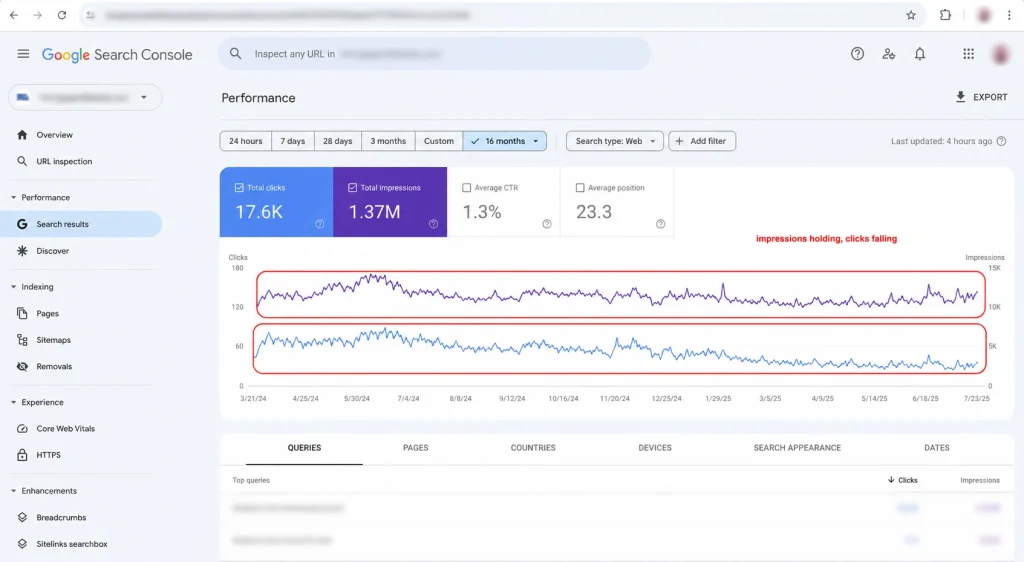
What to Do When Organic Clicks Fall
Do not panic-publish. Falling clicks with steady pipeline means your content is being read inside AI answers rather than on your site, and the fix is citation visibility, not volume. Falling clicks with falling pipeline means a genuine ranking or intent problem.
Separate the two before you act. Check whether your branded search volume is holding, whether demo requests mention sources you never tracked, and whether new customers say they “found you through ChatGPT” during onboarding calls. Those signals arrive before your analytics show anything.
Email and Lifecycle Marketing for Long Sales Cycles
Email is where an 11-month cycle gets managed. Its job in B2B SaaS is not to close, it is to stay useful and present while a committee works through an internal process you cannot see. Behavior-triggered sequences beat time-based drips, because a buyer who visits your pricing page twice in a week is in a different state from one who downloaded a guide in March.
Build the triggers around evidence of evaluation, not around your calendar. Repeat pricing page visits, a security documentation download, a second person from the same domain signing up, or a trial account inviting teammates all signal an active committee. Each deserves a different message.
List quality decides whether any of this works. Bounces and spam traps damage sender reputation, and a damaged domain reputation quietly suppresses everything else you send. Run new lists through our free bulk email verifier before the first send, and read our guide to verifying emails and maintaining a clean list if deliverability has already slipped.
Where Your CRM Fits
Lifecycle marketing falls apart when the CRM does not reflect reality. If three people from the same account are tracked as three unrelated leads, your scoring is measuring individuals in a group decision, which produces nonsense. Account-level tracking is the minimum requirement before any lead scoring model is worth building.
Pick the platform that matches your motion rather than the one with the best feature list, and if you are still choosing, our eight-platform CRM breakdown compares the realistic options by business size.
LinkedIn, Communities, and Partner Marketing
LinkedIn remains the highest-yield social channel for B2B SaaS because it is the only one where job title targeting is reliable. What has changed is the format. Posts from named people outperform posts from company pages by a wide margin, so the account that builds authority is usually a founder or a practitioner, not the brand.
Communities do something advertising cannot. When a buyer asks a Slack group or a subreddit which tool to use, the recommendation carries weight no ad buys. You cannot manufacture that, but you can earn it by having employees answer questions publicly without pitching, over months.
Partner marketing is the underused third leg. Integration partners, agencies serving your ICP, and complementary vendors all have the trust you are trying to build. Co-hosted webinars, joint research, and marketplace listings put your name in front of a warm audience. For SaaS selling into commerce operations, that often means appearing alongside implementation specialists such as B2B wholesale solution providers, where the buyer is already mid-project and actively assembling a stack.
The B2B SaaS Marketing Metrics That Matter
Track pipeline economics, not traffic. Four numbers tell you whether your B2B SaaS marketing strategies are working: customer acquisition cost payback period, net revenue retention, the ratio of lifetime value to acquisition cost, and pipeline velocity. Sessions and impressions describe activity. These describe whether the business compounds.
| Metric | What it answers | How to read it |
|---|---|---|
| CAC payback period | How many months of gross margin to recover acquisition cost | Shorter payback means you can reinvest faster. Rising payback is the earliest warning of channel saturation |
| Net revenue retention | Does existing revenue grow without new logos | Above 100% means expansion outpaces churn. This is the metric investors check first |
| LTV to CAC ratio | Is each customer worth what you paid for them | A ratio under 1 means you are buying revenue at a loss. Very high ratios often mean underspending |
| Pipeline velocity | How fast qualified pipeline becomes revenue | Improves through better fit, not more leads. Watch it when you change targeting |
Attribution deserves honesty. With most research happening off-site and inside AI tools, last-touch attribution will credit your branded search and demo form for work done by a podcast mention six weeks earlier. Self-reported attribution on the demo form, one open question asking how the buyer heard of you, usually beats your analytics for accuracy.
Frequently Asked Questions
What is B2B SaaS marketing?
B2B SaaS marketing is the practice of promoting subscription software to other businesses. It differs from consumer marketing in three ways: the buyer is a committee rather than a person, the cycle runs months rather than minutes, and revenue depends on retention as much as acquisition. Marketing therefore continues after the sale, through onboarding, adoption, and expansion.
How long is the average B2B SaaS sales cycle?
Around 11.3 months on average, according to the 6sense Buyer Experience Report published in 2024. Smaller self-serve products close far faster, sometimes within days, while enterprise deals with security review and procurement can exceed a year. The useful takeaway is not the average itself, it is that most of that time passes without any vendor contact at all.
How much should a B2B SaaS company spend on marketing?
Early-stage companies chasing growth typically spend a much larger share of revenue than mature ones, and the right number depends on your CAC payback period rather than on a benchmark. If payback is short and holding steady as you spend more, you are underspending. If payback stretches as spend increases, you have found the ceiling of your current channels.
Does SEO still work for B2B SaaS in 2026?
Yes, but the definition changed. Ranking is no longer the whole goal, since being cited inside an AI answer now shapes shortlists before a click happens. Content built for extraction, with clear answers, original data, and third-party corroboration, performs in both places. Thin content written to fill a keyword calendar performs in neither.
How do I market a SaaS product with no customers yet?
Borrow trust you have not built yet. Publish original research or a documented test, since data gets cited even without brand recognition. Get design partners in exchange for detailed case studies. Answer questions publicly in the communities where your ICP already gathers. Founder-led content works at this stage precisely because there is no brand to hide behind.
What is product-led growth and does it fit every SaaS?
Product-led growth means the product itself drives acquisition, through free trials, freemium tiers, or viral sharing. It fits products a single user can adopt and see value from quickly, without configuration or approval. It fits badly where implementation is long, security review is mandatory, or value only appears once a whole team is onboarded. Many companies run it alongside sales rather than instead of it.
How many decision-makers are in a B2B SaaS purchase?
Roughly 11 on average, based on the 6sense 2024 research, with Gartner putting the range for complex purchases at six to ten. Enterprise deals go higher. The practical consequence is that your champion presents your product internally without you present, so the material you give them has to work when nobody is there to explain it.
Should we publish pricing on our website?
In most cases yes. Buyers build requirements before contacting you, and a missing price either gets guessed wrong or gets you removed from consideration. Hiding pricing makes sense only when cost genuinely varies by an order of magnitude between customers, and even then a starting figure with named variables beats “contact sales” alone.
How do we measure AI search visibility?
Start manually. Ask the main assistants the questions your buyers ask, in your category, and record which vendors get named. Repeat monthly and track movement. Add self-reported attribution to your demo form. Dedicated tracking tools exist, but the manual version costs an hour a month and gives you the answer that matters: are you in the answer or not.
Conclusion
The founder who lost that deal did three things afterward. He published a comparison page that admitted where two competitors were stronger. He ran a survey of 200 users in his category and released the data. He asked every new customer, on the onboarding call, where they first heard the name. Within two quarters, a quarter of new deals were reporting an AI assistant as first contact.
None of that is exotic. It is the same discipline B2B SaaS marketing strategies have always needed, aimed at where the evaluation now happens. Know the committee, publish proof they can forward, earn mentions on sources you do not own, and measure pipeline instead of sessions. The hard question is the one worth sitting with: if a buyer asked an AI assistant to name the best tools in your category today, would your name come back?