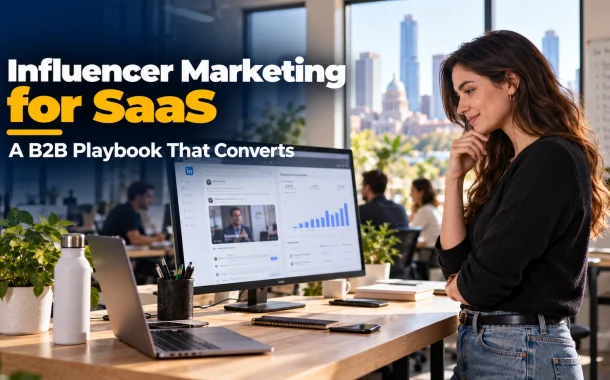
Influencer marketing for SaaS works when the creator’s audience is your buyer, not when the audience is big. For Hannah’s next campaign we picked three HR practitioners on LinkedIn with fewer than 30,000 followers each. Their walkthrough posts booked more demos in a month than the YouTube video did in a quarter.
Quick answer: Influencer marketing for SaaS means paying trusted creators in your buyer’s niche to show how your software solves a real problem. For B2B, practitioners on LinkedIn, YouTube reviewers and newsletter writers convert best. Give each creator a tracked landing page and an offer, then measure trials, demos and pipeline.
Table of Contents
What Is Influencer Marketing for SaaS?
Influencer marketing for SaaS is a partnership where a creator your buyers already trust shows your software in action to their audience. Unlike consumer influencer campaigns, the goal is not a quick purchase. It is a trial, a demo or a shortlist spot, because SaaS buyers compare tools, involve colleagues and commit to monthly or annual contracts.
That changes almost every choice you make. The creator, the format, the offer and the way you measure success all look different from a consumer brand’s campaign.
| Factor | Consumer influencer marketing | Influencer marketing for SaaS |
|---|---|---|
| Who the creator is | Lifestyle, beauty, fitness, travel personalities | Practitioners, analysts, reviewers, educators |
| What the audience wants | Inspiration and entertainment | A solution to a work problem |
| Best formats | Short videos, photos, unboxing | Walkthroughs, comparisons, case studies, webinars |
| Conversion goal | A purchase today | A trial, demo or shortlist spot |
| Sales cycle | Minutes to days | Weeks to months |
| How you measure | Sales and promo codes | Trials, demos, pipeline and customer acquisition cost |
You can find influencers easily for consumer campaigns because reach and lifestyle appeal do most of the work. SaaS is harder. Expertise, credibility and a believable demo matter far more than follower count.
Why Influencer Marketing for SaaS B2B Works
B2B buyers do much of their research before they ever talk to sales, and they trust people more than brand messaging. LinkedIn reports that 56% of B2B buyers depend on creator input in the last stage of the buying process. In the same report, 82% of B2B marketers say creators increase credibility with decision-makers.
Those numbers come from LinkedIn’s June 2026 announcement of Creator Marketplace, a tool inside Campaign Manager that helps brands find vetted creators by topic and expertise. LinkedIn also says 70% of marketers believe buyers rely more on peer voices and experts than on brand-produced content.
Three things make creators especially useful for software:
- Complex products need a guide. A ten-minute walkthrough from someone who uses the tool daily answers questions a landing page cannot.
- Content keeps working. A YouTube tutorial or comparison video can bring in trials for a year or more after it goes live.
- Trust moves the shortlist. When a known practitioner says “this is what I use,” buyers skip a round of research.
Leads from creators also tend to arrive warmer than cold ad clicks, because the creator has already explained the use case. That makes the rest of your funnel matter more. Influencer-generated leads still need fast follow-up and a clean handoff to sales to turn into revenue.
Which Influencers Fit a SaaS Brand?
The right SaaS influencer is someone your buyer already learns from. For B2B software, that usually means practitioners and experts, not celebrities. Match the creator to your buyer’s job title first, then check engagement and content quality. A creator with 15,000 followers who are all your buyers beats one with 500,000 who are not.
| Creator type | Where they publish | Best for | Watch out for |
|---|---|---|---|
| Practitioner creators | LinkedIn, newsletters | B2B tools sold to a specific role (HR, finance, RevOps, security) | Small reach, so pair several creators |
| Software reviewers | YouTube | Comparisons, “best X tools” and alternative searches | Audiences that are hobbyists, not buyers |
| Newsletter writers | Substack, beehiiv, email | Niche B2B audiences with high trust | Harder to measure without tracked links |
| Podcast hosts | Podcasts, YouTube | Founders and executives with long commutes | Slow, indirect attribution |
| Community leaders | Slack groups, Discord, forums | Developer tools and technical products | Communities that ban promotion |
| Customers and employees | Credible case studies and Thought Leader Ads | Needs internal approval and support |
Micro-creators, often defined as 10,000 to 50,000 followers, are usually the best starting point for niche SaaS. They tend to have closer relationships with their audience, they charge less, and they are more open to long-term partnerships. Larger creators work better for broad tools with a free plan, where top-of-funnel volume matters.
Influencer Marketing for SaaS: A 7-Step Playbook
A SaaS influencer campaign that converts follows a simple order: set one goal, define the buyer, find creators that buyer follows, brief them on a real use case, send traffic to a tracked page with an offer, amplify what works, and measure pipeline. This is the process we use with SaaS clients.
- Pick one goal. Trials, demos or webinar sign-ups. One goal per campaign keeps the brief and the measurement clean.
- Write down the buyer. Job title, company size, the problem they search for, and the tools they use now.
- Find creators that buyer follows. Search by topic, then check who comments on their posts. If the commenters have your buyer’s job title, you have a match.
- Brief a use case, not a script. Give the creator a login, a real problem to solve on camera, and your two or three key points. Let them use their own words. Audiences can tell when a creator reads a brand script.
- Build a page for each creator. Use the creator’s name and photo, a headline that continues their post, one offer and one call to action. Our UI/UX design team builds these pages so each creator’s traffic lands on a page that matches what they said.
- Amplify the winners. On LinkedIn, Thought Leader Ads let you put ad budget behind a creator’s post once they approve it. Boost the posts that already perform organically.
- Measure pipeline, not views. Track trials, demos, opportunities and closed revenue per creator, then renew the partnerships that pay back.
Plan for three to six months per creator. One sponsored post rarely moves a B2B buyer. A series that shows the product solving different problems, plus a live session, builds the familiarity that gets a tool onto a shortlist.
Content Formats That Convert SaaS Leads
Educational content converts best in SaaS because buyers want to see the product solve their problem. Walkthroughs and comparison videos drive the most trials. Short clips build awareness but rarely convert on their own. Match each format to a funnel stage and give it one clear call to action.
| Format | Funnel stage | Best call to action |
|---|---|---|
| Product walkthrough or tutorial | Consideration | Start a free trial |
| Comparison or “alternative to X” video | Decision | Book a demo or start a trial |
| Creator case study with real results | Decision | Book a demo |
| Co-hosted webinar or live session | Consideration | Register, then demo follow-up |
| LinkedIn carousel or text post with a framework | Awareness to consideration | Download a template |
| Short video highlighting one feature | Awareness | Visit the creator’s landing page |
| Newsletter feature | Consideration | Claim an extended trial |
Short videos still have a place. They work as hooks that send viewers to the longer walkthrough. Our guide to vertical video covers how to shoot and edit them for LinkedIn, YouTube Shorts and Reels.
Reuse every piece. A good creator walkthrough can become a paid ad, a testimonial on your pricing page, a clip in onboarding emails and a slide in sales decks. Agree on these reuse rights in the contract, with a time limit, before the creator publishes.
How to Pay SaaS Influencers
SaaS brands pay creators in three main ways: a flat fee per piece of content, an affiliate commission on paying customers, or a hybrid of both. Flat fees suit awareness and new creators. Affiliate deals suit creators who already use your tool. Hybrids work best for long-term B2B partnerships.
| Model | How it works | Best for | Risk |
|---|---|---|---|
| Flat fee | Fixed payment per post, video or webinar | First campaigns and awareness | You pay whether it converts or not |
| Affiliate commission | A share of revenue from customers the creator refers, often recurring | Creators who already use your product | Top creators may decline pure commission |
| Hybrid | A lower flat fee plus a commission | Long-term partnerships | Needs clean tracking to pay fairly |
| Product access | Free plan upgrades or credits | Micro-creators and communities | Rarely enough on its own for B2B creators |
Recurring commissions suit SaaS well, because the creator earns for as long as the customer stays subscribed. That gives them a reason to keep mentioning your tool. Rates vary widely by niche and audience, so ask each creator for their media kit and compare cost per demo or trial, not cost per post.
Best Influencer Marketing Software for SaaS
The best influencer marketing software for SaaS depends on where your buyers spend time. For LinkedIn-heavy B2B campaigns, LinkedIn’s own Creator Marketplace and Favikon cover LinkedIn creators. For YouTube, Instagram and TikTok discovery, Heepsy and Modash are strong options. Prices below come from each vendor’s own pricing page.
| Tool | Platforms covered | Best for | Price (vendor page, October 2026) |
|---|---|---|---|
| LinkedIn Creator Marketplace | Finding vetted B2B creators and running Thought Leader Ads | Inside Campaign Manager, you pay for ads | |
| Favikon | 9 channels including LinkedIn and Substack | B2B creator discovery with authority scores | Core $199/month, Pro $299/month, lower on annual billing |
| Heepsy | Instagram, TikTok, YouTube, LinkedIn | Affordable discovery with a free plan | Free plan, Starter from $69/month billed annually |
| Modash | Instagram, YouTube, TikTok | Larger creator searches and affiliate tracking | Essentials $199/month, Performance $499/month |
Start small. A free or entry plan is enough to build a list of 20 to 30 creators for one campaign. Move to a bigger plan only when you run several campaigns at once. Favikon lists its prices on its LinkedIn tools page, and Modash on its pricing page.
You will also need a way to track results: UTM links in Google Analytics, a CRM field for lead source, and an affiliate tool if you pay commission. Our list of content marketing tools for SaaS blogs covers analytics and SEO tools that work alongside creator campaigns.
Disclosure Rules for SaaS Influencer Campaigns
In the US, the Federal Trade Commission requires creators to disclose any material connection with a brand, such as payment, free products or an affiliate commission. The disclosure must be clear and easy to notice. The FTC says a platform’s built-in disclosure tool is not always enough on its own.
The FTC sets this out in its Disclosures 101 guidance for social media influencers. Brands share responsibility, so build disclosure into every brief and contract.
Platforms add their own tools:
- YouTube. Creators turn on the paid promotion setting in YouTube Studio, which adds a disclosure label at the start of the video. See YouTube’s help page on paid product placements.
- LinkedIn. Thought Leader Ads show as sponsored content, and the creator must approve the post before you can promote it.
- Everywhere else. Ask creators to say the relationship in the post or video itself, in plain words, near the start.
The UK and EU have similar rules for creators and brands. If you run campaigns in several countries, follow the strictest rule across all of them.
How to Measure Influencer Marketing for SaaS
Measure influencer marketing for SaaS by pipeline and customer acquisition cost per creator, not by views or likes. Track each creator with a unique UTM link, a dedicated landing page and a lead source field in your CRM. Add a “How did you hear about us?” question at sign-up to catch the buyers who come back later.
| Metric | What it tells you | Where to track it |
|---|---|---|
| Landing page visits | Whether the creator’s audience clicks | Google Analytics with UTM links |
| Trials or demos booked | Whether the audience matches your buyer | Product analytics and CRM |
| Trial-to-paid rate | Whether the creator sends real buyers | Billing system and CRM |
| Pipeline created | The sales value the creator influenced | CRM opportunities by lead source |
| Customer acquisition cost per creator | Whether the partnership pays back | Creator fee divided by new customers |
Here is the simple maths. If a creator costs $3,000 for a three-post series and brings 6 paying customers, your acquisition cost is $500 per customer. If your average customer pays $100 a month and stays two years, each is worth about $2,400, so the series pays back several times over.
Expect a lag. B2B buyers often see a creator’s post, research for weeks and then book a demo directly. Self-reported attribution at sign-up catches many of these. Our guide to choosing a CRM for startups covers lead source tracking in more detail.
Does Gen Z Like Influencer Marketing?
Yes, more than older groups. Morning Consult’s late-2024 surveys found that 56% of Gen Z and millennial social media users trust influencers when deciding what to buy, against 41% of all social media users. Of the 1,002 Gen Z respondents, 832 said they follow influencers. Trust in influencers overall fell five points from 2023 to 2024.
The figures come from Morning Consult’s influencer marketing guide. For SaaS, this matters more each year. The oldest Gen Z workers are now in their late 20s, and many SaaS tools sell to them directly through free plans. Product-led tools for designers, developers, students and creators should test YouTube and TikTok creators alongside LinkedIn.
Common Mistakes in SaaS Influencer Campaigns
Most SaaS influencer campaigns fail for the same few reasons: the audience does not match the buyer, the creator gets a script instead of a use case, traffic lands on the generic homepage, or the brand measures views instead of pipeline. Each one is easy to fix before launch.
- Buying reach instead of fit. Hannah’s 400,000-subscriber video is the classic case.
- One post and done. B2B buyers need several touches. Plan a series.
- No product access. A creator who has not used the tool for a week cannot demo it convincingly.
- Generic landing pages. Sending creator traffic to the homepage wastes the trust the creator built.
- No reuse rights. Agree in advance how long you can use the content in ads and on your site.
- Ignoring disclosure. A missing disclosure can hurt both the creator and your brand.
Influencer marketing works best as one part of a wider plan. Our guide to SaaS marketing strategies for B2B brands shows how creators fit alongside SEO, paid search, email and product-led growth.
FAQ
These are the questions SaaS founders and marketers ask us most about creator campaigns.
How do you do marketing for SaaS?
Start with a clear buyer and one core problem your product solves. Then combine search content, paid search, email nurturing, a free trial or demo, and trusted voices such as creators and customers. Measure each channel by trials, demos and revenue, and put more budget behind what pays back.
Does influencer marketing work for B2B SaaS?
Yes, when you pick practitioners your buyers already follow. LinkedIn reports that 56% of B2B buyers depend on creator input in the final buying stage. Small, expert creators on LinkedIn, YouTube and newsletters usually outperform large general audiences for B2B tools.
What is the best influencer marketing platform for SaaS?
For LinkedIn-focused B2B campaigns, start with LinkedIn Creator Marketplace or Favikon. For YouTube, Instagram and TikTok creators, Heepsy offers a free plan and paid plans from $69 a month billed annually, while Modash starts at $199 a month.
How do I find influencers for my SaaS product?
Search your topic on LinkedIn and YouTube, look at who your customers follow, and ask your best customers which newsletters and podcasts they read. Influencer software speeds this up with filters for topic, audience location and engagement. Always check that the commenters match your buyer.
Are micro-influencers better for SaaS?
Often, yes. Creators with 10,000 to 50,000 followers usually have tighter, more specific audiences, lower fees and more willingness to work long term. For niche B2B tools, several micro-creators tend to beat one large creator.
How much does influencer marketing for SaaS cost?
There is no standard rate. Fees depend on the creator’s niche, audience size and format, and B2B creators with senior audiences charge more per follower. Compare creators by expected cost per trial or demo, and consider affiliate or hybrid deals to tie cost to results.
What are 5 niches commonly used by influencers?
The most common influencer niches are fashion and beauty, fitness and health, food, travel, and gaming or technology. For SaaS, the more useful niches are professional ones: marketing, sales, HR, finance, software development, design and productivity.
Does Gen Z like influencer marketing?
Yes. Morning Consult found that 56% of Gen Z and millennial social media users trust influencers when deciding what to buy, against 41% of all social media users. That trust makes creators useful for SaaS tools that sell to younger teams.
Do SaaS influencers need to disclose sponsorships?
Yes. In the US, the FTC requires creators to disclose payment, free products or commissions clearly. YouTube has a paid promotion setting, and LinkedIn Thought Leader Ads show as sponsored. Build disclosure into every creator brief and contract.
How long does a SaaS influencer campaign take to show results?
Expect trials within days of a post, but demos and paid customers can take weeks or months, depending on your sales cycle. Plan partnerships for three to six months and judge them on pipeline and acquisition cost over that period.
Conclusion
Back to Hannah. Her first campaign had reach and no buyers. Her second had three HR practitioners, a tracked page for each, and a real hiring problem solved on camera. That campaign filled her demo calendar for a month and became her best-performing ad when she boosted it.
Influencer marketing for SaaS rewards fit over fame. Pick creators your buyers already learn from, give them product access and a real use case, send their audience to a page made for them, and judge every partnership by pipeline and acquisition cost.
Who does your best customer follow on LinkedIn right now?