


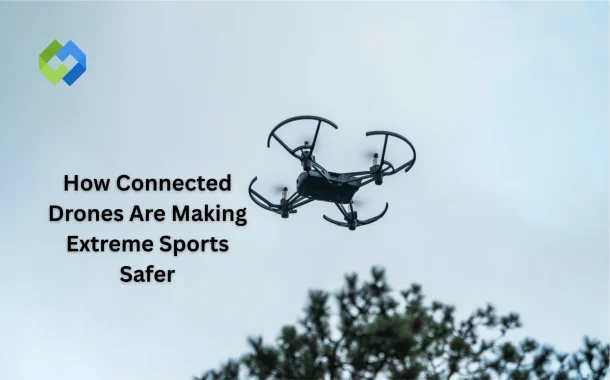
Today, innovators are looking beyond simple aerial photography, seeking a specialized drone software development company to build intelligent aerial systems that do more than just record—they protect. These advanced drones are evolving from passive observers into active guardians, utilizing the Internet of Things (IoT) and Artificial Intelligence (AI) to monitor threats and save lives in real-time.
Table of Contents
Table of Contents
The Evolution: From Filming to Function
For the past decade, drones in extreme sports were primarily synonymous with content creation. They were the “flying tripods” that captured breathtaking 4K footage of snowboarders descending pristine peaks or mountain bikers navigating treacherous ridges. While this revolutionized sports media, the utility of the hardware was limited to visualization. The pilot was usually a human operator standing nearby, focused entirely on framing the shot, not on the safety of the athlete.
However, the paradigm is shifting. The “connected drone” is the result of combining advanced sensors with software for autonomous flight. These gadgets now carry different payloads of logic and communication in addition to cameras. They are digitally linked to the athlete through wearables or smart devices and are made to function with a high degree of autonomy. This change transforms the drone into a proactive safety partner that can search the surroundings for dangers that an athlete might overlook in an emergency.
Real-Time Threat Detection in the Elements
The ability of connected drones to see the invisible is their main contribution to safety. These airborne systems can evaluate complicated settings in milliseconds by utilizing Computer Vision and Edge AI, which process data locally on the drone instead of transferring it to the cloud.
Think about the alpine sports context. Avalanches are a persistent, unseen danger in mountaineering and backcountry skiing. In front of a skier, a linked drone with LiDAR and thermal imaging capabilities can scan the snowpack. High-risk areas can be identified by the onboard software’s analysis of the snow density and slope stability. The drone can instantly notify the skier’s smartwatch or heads-up display if it detects a possible fracture line, allowing them to alter their course before a catastrophe happens.
Heatstroke and dehydration are also silent killers in desert marathons and trail running. An athlete’s body temperature can be tracked from above by drones fitted with thermal cameras. The drone can anticipate physical collapse before it occurs by comparing this heat data with the athlete’s pace and gait analysis (using gait recognition algorithms), warning the athlete or the support team to halt and hydrate.
The IoT Ecosystem: How Connectivity Saves Lives
The phrase “connected drone” suggests that the unmanned aerial vehicle (UAV) is a component of a wider ecosystem. IoT is crucial in this situation. The drone serves as a flying gateway in an extreme sports situation.
Cellular connectivity is frequently nonexistent in remote locations, such as deep gorges or open oceans. By acting as a signal repeater while hovering at a greater altitude, a linked drone can establish a local mesh network. It can connect an injured climber’s SOS beacon to a remote base station or rescue satellite.
Additionally, wearable technologies and drones work together to provide a “digital lifeline.” Consider a lone kayaker on a distant river. Their wearable heart rate monitor may send a distress signal straight to the hovering drone if it notices an abrupt spike followed by no movement, which could indicate a capsize or damage. When the drone detects an abnormality, it can immediately descend to assess the situation, record the GPS coordinates, and, if programmed, fly to the closest point of connectivity to transmit a distress call to emergency services. Human latency, which frequently plays a crucial role in survival, is eliminated by this automated series of events.
Search and Rescue (SAR) Applications
When prevention fails, rapid response is the only remaining option. In traditional Search and Rescue (SAR) operations, locating a lost or injured individual is the most time-consuming phase. Helicopters are expensive and weather-dependent, while ground teams are slow.
Connected drones are revolutionizing SAR operations in extreme environments. Swarms of autonomous drones can be deployed to scan vast areas of forest or ocean. Unlike a human pilot who might suffer from eye fatigue, an AI-powered drone never blinks. It scans thousands of images per minute, looking for specific color contrasts (like a bright jacket against snow) or thermal signatures.
Once a victim is located, the drone transforms from a scout into a first responder. Heavy-lift drones can drop emergency kits containing defibrillators, thermal blankets, or radios directly to the athlete’s location hours before a ground team can reach them. This capability is not science fiction; it is a software engineering challenge that is currently being solved by developers integrating precise payload release mechanisms with autonomous navigation systems.
The Technological Backbone
Building these systems requires a complex fusion of hardware and software. It is not enough to simply slap a sensor on a commercial drone. The software architecture must be robust enough to handle data processing in real-time without latency.
Developers focus heavily on “sensor fusion”—combining data from optical cameras, thermal sensors, gyroscopes, and GPS to create a coherent understanding of the world. Additionally, energy management algorithms are crucial. In extreme cold or high winds, battery life depletes rapidly. Intelligent software monitors the drone’s health and calculates the “point of no return,” ensuring the device always has enough power to return to a safe landing zone or a portable docking station.
Cybersecurity is another critical layer. As these drones communicate with wearables and transfer location data, ensuring the link is secure from hacking or interference is paramount. This requires encrypted communication protocols custom-built for low-bandwidth environments.
The Future: A Personal Aerial Guardian
In the future, the idea of a “follow-me” drone will become a “protect-me” drone. We are headed toward a time when every fan of extreme sports may have a personal aerial protector. These small, foldable drones will take off from a backpack, track the athlete on their own, and continuously look for threats in their surroundings.
A climber will be alerted to an impending storm front that is concealed behind a mountain range by using predictive analytics to forecast weather changes. They will listen for ice breaking or rockfalls using acoustic sensors. The technology is quickly becoming smaller, making it available to weekend warriors and enthusiasts in addition to professional Red Bull athletes.
Conclusion
Risk-taking is being redefined at the nexus of extreme sports and IoT technologies. Athletes will always be motivated by the human spirit to reach greater heights and waves, but technology makes it more likely that they will come home to share their story. The ability of intelligent software is demonstrated by the transition from passive recording to active protection. These systems will become standard equipment, just like a harness or helmet, as they are improved.
Real-world applications of this technology are already emerging, proving that the concept is viable and necessary. For example, Indeema recently engineered a solution specifically tackling the dangers of open water environments. You can explore their detailed case on drones to see how real-time aerial threat detection and instant alerts are being used to revolutionize surfer safety and bring peace of mind to the ocean.