

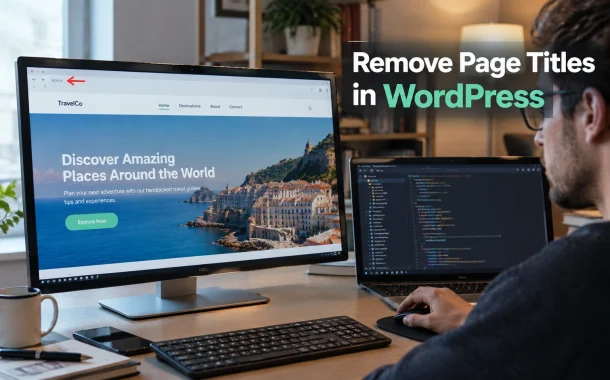
Where that switch lives depends entirely on whether your site runs a block theme or a classic one, and most guides skip that question and send everyone straight to CSS. This covers all six methods, how to tell which applies to you in ten seconds, and the accessibility detail that almost every tutorial on this topic gets wrong.
To remove a page title in WordPress, check whether your theme is a block theme or a classic theme. Block themes: open Appearance then Editor, edit the Pages template, and delete the Title block. Classic themes: use your theme’s title toggle, a plugin such as Title Remover, or CSS targeting
.entry-title.
Table of Contents
First, Check Which Theme You Have
Open your dashboard and look under Appearance in the left sidebar. If you see Editor, you have a block theme. If you see Customize instead, you have a classic theme. That one check decides every instruction that follows, and it takes less time than reading this paragraph.
Block themes arrived with full site editing and are now the default. Twenty Twenty-Four and Twenty Twenty-Five are block themes. Astra, GeneratePress, Neve, Divi, and most page-builder themes are classic themes, though several now ship block versions too.
| What you see under Appearance | Theme type | Best method |
|---|---|---|
| Editor | Block theme | Delete the Title block from the template |
| Customize | Classic theme | Theme setting, plugin, or CSS |
| Both | Classic theme with block support | Use Customize |
If you are unsure, the Editor option is the reliable signal. Classic themes do not have it.
Remove Page Titles in a Block Theme
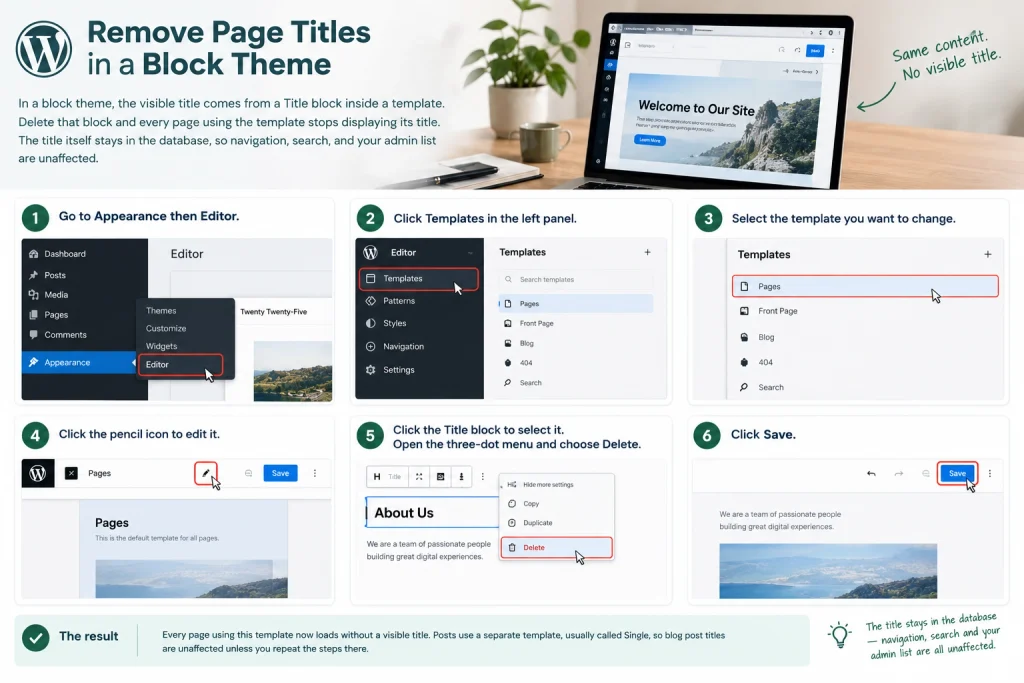
In a block theme, the visible title comes from a Title block inside a template. Delete that block and every page using the template stops displaying its title. The title itself stays in the database, so navigation, search, and your admin list are unaffected.
Remove the Title From All Pages
- Go to Appearance then Editor.
- Click Templates in the left panel.
- Select the template you want to change. For standard pages this is usually Pages.
- Click the pencil icon to edit it.
- Click the Title block to select it.
- Open the three-dot menu in the block toolbar and choose Delete.
- Click Save.
Every page using that template now loads without a visible title. Posts use a separate template, usually called Single, so blog post titles are unaffected unless you repeat the steps there.
Remove the Title From One Page Only
Templates apply in groups, so hiding one page’s title means giving that page its own template.
- In Appearance then Editor, open Templates.
- Find the Pages template and choose Duplicate from its three-dot menu.
- Name the copy something clear, such as “Page, no title”.
- Delete the Title block from the copy and save.
- Open the page you want to change, and in the page settings sidebar under Template, select your new template.
This is more work than a plugin checkbox, but nothing extra loads on the front end. Our guide to WordPress post templates covers how templates map to content types if this part is unfamiliar.
Remove Page Titles in a Classic Theme
Classic themes have no Site Editor, so the switch lives in one of three places: a theme setting, a page builder, or CSS.
Check Your Theme’s Own Setting First
Several popular themes include a per-page title toggle, and it is always the cleanest option because the theme stops outputting the element instead of hiding it afterwards.
Astra, Neve, and GeneratePress all offer this. In GeneratePress, the disable title option sits in the page editor sidebar, just below the content container option. In Astra and Neve, look for a page-level settings panel with a title visibility control.
Premium and multipurpose themes usually have something similar somewhere in their per-page options. Our overview of the Bridge WordPress theme is one example of how much these theme-level settings vary between products.
Using Elementor
If you build pages with Elementor, open the page in Elementor, click the settings gear at the bottom left, and turn off Hide Title. This works when Elementor knows which CSS selector holds your theme’s title, which it detects automatically for most themes.
If the title stubbornly remains, your theme uses a selector Elementor cannot find. Set it manually under Elementor, then Settings, then Advanced, in the CSS Print Method area, or fall back to the CSS method below.
The CSS Method, and When Not to Use It
CSS hides the title visually while leaving the HTML in place. It works on any theme and takes two minutes. It is also the method with the accessibility problem described later, so read that section before you use it site-wide.
Add CSS under Appearance then Customize then Additional CSS, or through a code snippets plugin.
Hide titles on every page:
css
.entry-title {
  display: none;
}
Hide the title on one page only, using the page ID that WordPress adds to the body class:
css
.page-id-42 .entry-title {
  display: none;
}
Find your page ID by opening the page in the editor and reading the post= number in the browser address bar.
If .entry-title Does Nothing
.entry-title is the most common class, not a standard. Your theme may use something else. To find the right one, right-click the title on your live page, choose Inspect, and look at the highlighted element in the panel that opens. Copy the class name from there and use it in place of .entry-title.
If the title sits inside a wrapper with padding, hiding the heading can leave an empty gap. Inspect the parent element and hide that instead, or set its padding to zero.
Plugins That Add a Hide Title Checkbox
If you want a checkbox in the page editor and nothing else, a small plugin does the job. Title Remover and Hide Page and Post Title both add a per-page toggle, and both are free.
The trade-off is honest rather than dramatic. You are adding a plugin to solve a layout problem, and every plugin is one more thing to keep updated. For a site with two landing pages, a theme setting or six lines of CSS is usually better. For a site where a non-technical client needs the control, the checkbox is worth it.
Before installing anything, check your theme’s page settings again. A surprising number of people install a plugin to replicate a toggle their theme already had.
The Custom Code Method
For precise control in a child theme, this snippet hides the title on named pages only and loads nothing anywhere else:
php
// In your child theme's functions.php
// Hides the page title on specific page IDs only.
add_action( 'wp_head', function () {
    if ( is_page( array( 12, 34 ) ) ) {
        echo '<style>.entry-title{display:none}</style>';
    }
} );
Replace 12 and 34 with your own page IDs.
One thing to avoid. Plenty of tutorials suggest filtering the_title to return an empty string. That filter runs everywhere the title is used, including navigation menus, breadcrumbs, search results, and your admin post list. People apply it, then spend an afternoon wondering why their menu went blank. If you must use it, restrict it tightly with in_the_loop() and is_main_query() checks.
Always test code changes somewhere other than a live site. Our guide to WordPress local development covers setting that up, and if filters and actions are new to you, our explainer on WordPress hooks is the place to start.
The Part Most Guides Get Wrong: Your H1
Here is what almost no tutorial on this topic mentions. Your page title is usually the page’s <h1>, and display: none removes it from the accessibility tree entirely. Screen reader users lose the heading that tells them what the page is, and the page is left with no H1 at all.
That matters for two reasons. Screen reader users move through a page by jumping between headings, so a page with no H1 gives them no starting point. And an H1 is a strong signal to search engines and AI systems about what a page covers. Removing it without replacing it throws that away for no benefit.
There are three fixes, in order of preference.
Give the page a real H1 in its content. If your hero section has a big headline, set that block’s heading level to H1 and delete the template’s Title block. The page keeps exactly one H1, it says something useful, and it looks the way you wanted.
Change the Title block’s level instead of deleting it. In a block theme you can set the Title block to H2 and promote a content heading to H1. Useful on a homepage, where the site title in the header often serves as the H1 already, as the University of Wisconsin’s theme documentation explains for its own sites.
Hide it visually but keep it for screen readers. If you cannot give the page another H1, this CSS removes the title from view while leaving it available to assistive technology:
css
.entry-title {
  position: absolute;
  width: 1px;
  height: 1px;
  padding: 0;
  margin: -1px;
  overflow: hidden;
  clip: rect(0 0 0 0);
  white-space: nowrap;
  border: 0;
}
This is the standard screen-reader-only pattern. It is strictly better than display: none when the title is your only H1.
The homepage deserves a special note, because it is where duplicate H1s most often appear. If your site title in the header is already an H1 and your static front page prints a Title block as well, you have two. Remove or demote one. Our guide to changing the front page in WordPress covers how that page is assigned.
Does Removing the Page Title Hurt SEO?
Not on its own, as long as you understand that three different things share the word “title” and only one of them is what you are hiding.
| What it is | Where it appears | Affected by hiding the page title? |
|---|---|---|
| SEO title tag | Browser tab and Google results | No. Set separately in your SEO plugin |
| H1 heading | Visibly on the page | Yes. This is what you are removing |
| Page slug | The URL | No |
Your search result listing comes from the title tag, not the visible heading, so hiding the heading changes nothing about how your page appears in Google. The browser tab is unaffected for the same reason.
The real risk is leaving the page with no H1. Fix that with one of the three approaches above and the SEO question mostly disappears. What you should not do is hide the title with display: none across an entire site and forget about it, because every page then loses its top-level heading at once.
Troubleshooting
| Problem | Cause | Fix |
|---|---|---|
| CSS does nothing | Your theme uses a different class | Inspect the title and copy its real class |
| Title gone but a gap remains | The wrapper still has padding | Hide the parent element or zero its padding |
| Title disappeared from menus too | A the_title filter is applied globally | Remove it and use CSS or the template method |
| Title still shows on one page | That page uses a different template | Check the page’s Template setting |
| Change vanished after a theme update | CSS was added to the parent theme | Move it to Additional CSS or a child theme |
| Blog posts still show titles | Posts use the Single template | Repeat the steps on that template |
Frequently Asked Questions
How do I remove the page title in WordPress?
Check whether Appearance shows Editor or Customize. With Editor, go to Appearance, Editor, Templates, open the Pages template, select the Title block, and delete it. With Customize, use your theme’s title toggle if it has one, install a plugin such as Title Remover, or add .entry-title { display: none; } under Additional CSS.
How do I hide a page title without a plugin?
Use your theme’s own setting if it has one, delete the Title block from the template in a block theme, or add CSS under Appearance, Customize, Additional CSS. All three avoid installing anything, and the template method is the cleanest because it removes the element rather than hiding it.
Does hiding the page title affect SEO?
Not directly. Your search listing comes from the SEO title tag, which is set separately in your SEO plugin and is unaffected. The genuine risk is leaving the page without an H1 heading. Promote another heading on the page to H1, or use screen-reader-only CSS instead of display: none.
Will removing the page title change the browser tab?
No. The browser tab comes from the HTML title tag in the page’s head, not from the visible heading. Hiding the visible title leaves the tab and your Google listing exactly as they were.
How do I hide the title on just one page?
In a block theme, duplicate the Pages template, delete the Title block from the copy, and assign that template to the page. In a classic theme, use page-specific CSS with the page ID, such as .page-id-42 .entry-title { display: none; }, or use a plugin that adds a per-page checkbox.
What is the CSS class for a WordPress page title?
Most themes use .entry-title, but it is a convention rather than a rule. To find yours, right-click the title on the live page, choose Inspect, and read the class on the highlighted element. Use that class in your CSS.
Which plugin removes page titles in WordPress?
Title Remover and Hide Page and Post Title are the two commonly used free options, and both add a checkbox to the page editor. Check your theme’s settings first, since many themes already include this toggle and the plugin would be redundant.
How do I remove the page title in Elementor?
Open the page in Elementor, click the settings gear at the bottom left, and enable Hide Title. If the title still shows, Elementor has not detected your theme’s title selector, so set it manually in Elementor’s advanced settings or use CSS instead.
Can I remove the title from blog posts as well?
Yes, using the same approach on a different template. In a block theme, edit the Single template instead of Pages and delete its Title block. In a classic theme, target the post title’s class in CSS, or use a plugin that covers both posts and pages.
Why is my page title still showing after I hid it?
Usually the page uses a different template than the one you edited, your CSS targets a class the theme does not use, or a caching plugin is serving an old copy. Check the template assigned to the page, inspect the title to confirm its class, then clear your cache.
Should I delete the title or leave it blank?
Leave it filled in and hide it. The title is used in navigation, search results, the admin list, and your sitemap. A blank title makes the page hard to find in your own dashboard. Every method here hides the title visually while keeping it in the database.
Does hiding the page title affect accessibility?
It can, and this is the detail most guides miss. Hiding an H1 with display: none removes it from the accessibility tree, so screen reader users lose the heading that identifies the page. Either give the page another H1 or use screen-reader-only CSS that keeps the heading available while hiding it visually.
Pick the Method That Fits Your Setup
That stray “Contact” above your hero section is a template decision, not a mistake, and which lever removes it depends on one thing: what Appearance shows in your sidebar.
So check that first. Editor means block theme and the fix is deleting a Title block. Customize means classic theme, and your theme’s own setting beats CSS, which beats a plugin. Then, whichever route you take, look at the page and ask whether anything on it is still an H1. If nothing is, promote your main headline before you move on.
Which page were you trying to clean up, and does it already have a headline that could carry the H1 instead?