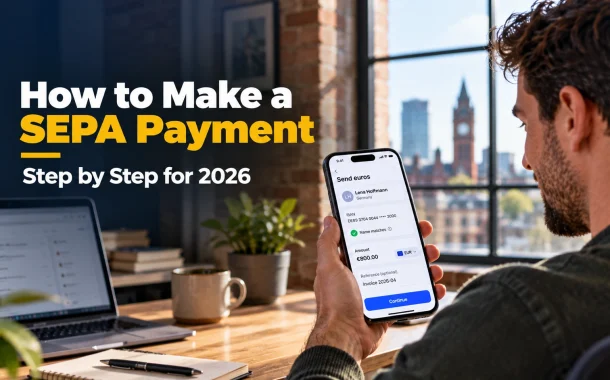
Same two people, same amount, same IBAN. The only difference was how Danny set the payment up. Knowing how to make a SEPA payment properly decides whether your money arrives in full within a day. Get it wrong and it arrives short after a slow trip through SWIFT. The steps differ a little depending on whether you pay from the euro area, the UK, the US, Australia, or Pakistan.
To make a SEPA payment, open your banking app, choose a euro transfer, and enter the recipient’s name and IBAN, the amount in euros, and a reference. Check the name-match result, pick instant or standard, and confirm. Instant payments arrive within seconds. Standard ones arrive by the next business day. You must pay in euros, and usually no BIC is needed.
Table of Contents
What You Need Before You Make a SEPA Payment
To make a SEPA payment you need four things: the recipient’s full name, their IBAN, the amount in euros, and a payment reference. You also need an account that can send euro transfers through SEPA. Most banks in the 41 SEPA countries can, and so can fintech accounts such as Wise and Revolut.
The SEPA Payment Details Checklist
| Detail | Required? | Where to find it | Common mistake |
|---|---|---|---|
| Recipient’s full name | Yes | The invoice or the recipient’s account details | Using a shop or brand name when the account is in a person’s name |
| Recipient’s IBAN | Yes | The invoice, or ask the recipient | A missing or swapped digit. IBANs carry check digits, so most typos get rejected |
| Amount in euros | Yes | The invoice | Paying in pounds or dollars, which can push the payment onto SWIFT |
| Payment reference | Strongly advised | The invoice number or what the recipient asks for | Leaving it blank, so the recipient can’t match your payment |
| BIC or SWIFT code | Usually not | The recipient’s bank details | Typing a BIC that doesn’t match the IBAN’s bank |
| Your own address | Only for some routes | Your bank fills it in | Missing for payments involving the UK or Switzerland, see below |
Do You Need a BIC for a SEPA Payment?
Usually not. Since February 2016, euro payments between EU countries need only the IBAN, and the UK’s Financial Conduct Authority says the same for SEPA payments. Some banking apps still show a BIC field. If yours insists, use the BIC from the recipient’s bank details. Our guide to what a SWIFT code is explains how to read one.
Check That the IBAN Is in a SEPA Country
The first two letters of an IBAN show the country, such as DE for Germany or FR for France. A SEPA payment only works when both accounts are in SEPA countries. The Single Euro Payments Area guide lists all 41. If you’re unsure what each part of the number means, see what an IBAN is.
How to Make a SEPA Payment in Your Banking App
In most banking apps, a SEPA payment is just a euro transfer to an IBAN. You don’t pick “SEPA” by name. You enter a European IBAN and a euro amount, and the bank routes it through SEPA. The steps below work for euro-area banks and for UK, Wise, and Revolut accounts holding euros.
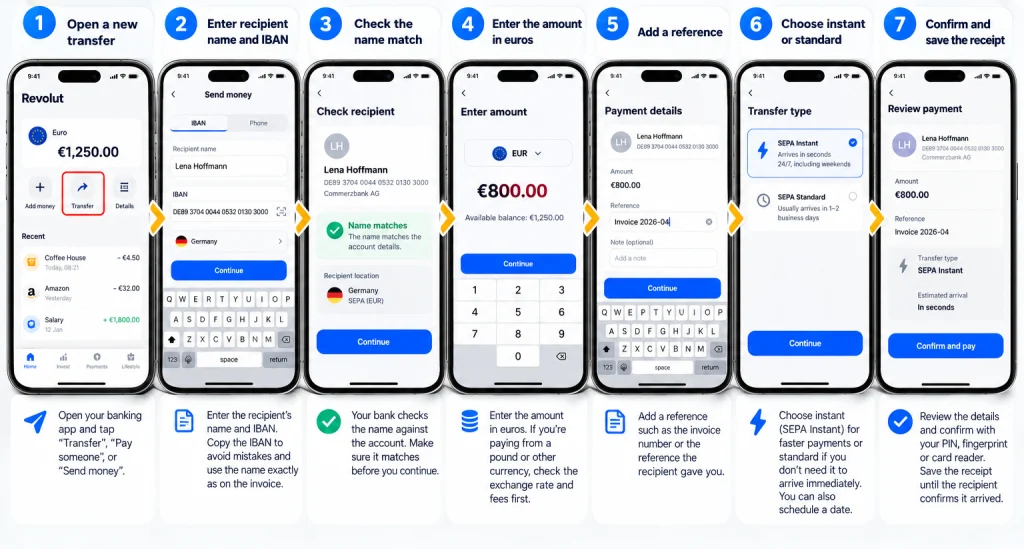
- Open a new transfer. Look for “Transfer”, “Pay someone”, or “Send money”. In UK apps, choose a euro or international payment.
- Enter the recipient’s name and IBAN. Copy the IBAN rather than typing it, and use the name exactly as it appears on the invoice.
- Read the name-match result. Euro-area banks now check the name against the account before you pay. More on this below.
- Enter the amount in euros. If you pay from a pound, dollar, or other account, check the exchange rate and fee before you go on.
- Add a reference. Use the invoice number or the reference the recipient gave you.
- Choose instant or standard. Pick a date if you want to schedule it.
- Confirm and save the receipt. Approve with your PIN, fingerprint, or card reader, then keep the confirmation until the recipient says it arrived.
Verification of Payee: Match, Close Match and No Match
Since 9 October 2025, banks in the euro area must check the payee’s name against the IBAN before every SEPA transfer, standard or instant. Banks in EU countries outside the euro area follow by 9 July 2027, according to the European Central Bank. The UK runs its own check, Confirmation of Payee, for pound payments.
| Result | What it means | What to do |
|---|---|---|
| Match | The name and IBAN belong together | Go ahead |
| Close match | A small difference, often a typo. The app usually shows the account’s real name | Fix the name if the suggested one is clearly right, then continue |
| No match | The name doesn’t fit the account | Stop. Contact the recipient on a number you already have before you pay |
| Check not possible | The other bank couldn’t answer | Pay only if you trust the details from a known source |
A “no match” warning is often innocent, such as a freelancer trading under a studio name. It’s also the main defence against invoice fraud, where a scammer sends you a “new” IBAN. If you ignore the warning and pay, your bank is less likely to cover the loss.
Instant or Standard: Which Should You Choose?
Choose instant when the money must land now, such as a deposit, a late invoice, or a weekend purchase. Choose standard for a first payment to someone new, because instant payments can’t be stopped once sent. Inside the euro area, an instant payment can’t cost more than a standard one. Our guide to SEPA Instant Payments covers limits and failed instant transfers.
How to Make a SEPA Payment From the UK, US, Australia or Pakistan
You can make a SEPA payment directly only from an account in a SEPA country. That includes the UK and Switzerland, but not the US, Australia, or Pakistan. From those three, use a provider that pays out euros inside Europe, such as Wise, or your bank sends a slower SWIFT wire.
| Where you pay from | Can you send SEPA directly? | Best route | Watch out for |
|---|---|---|---|
| Euro area (Germany, France, Ireland and others) | Yes | Your bank app, standard or instant | Name-match warnings |
| EU outside the euro area (Sweden, Poland and others) | Yes, from a euro account or with conversion | Bank app or a fintech euro account | Your bank’s exchange rate if you pay from local currency |
| United Kingdom | Yes, if your bank offers euro SEPA payments | Euro payment in your bank app, or Wise or Revolut | Paying in pounds by “international payment” can send it by SWIFT |
| United States | No | Wise or another provider that pays out in euros locally | A bank wire in euros goes by SWIFT, with wire and correspondent fees |
| Australia | No | Wise or another provider that pays out in euros locally | Same SWIFT costs as the US if you use your bank |
| Pakistan | No | A euro outward remittance through your bank, by SWIFT | Pakistani residents can’t open Wise accounts. Outward payments need a permitted purpose and documents |
Making a SEPA Payment From the UK
The UK left the EU but stayed in SEPA. Most high-street banks let you send euros to a European IBAN, though the menu may say “international” or “euro payment”. Choose euros as the currency. Because the UK is outside the EEA, your bank must include your full address with the payment, so keep it up to date.
Many UK freelancers keep a euro balance with Wise or Revolut for this. Paying from euros you already hold avoids converting twice, which is exactly what cost Danny €29 the first time.
Making a SEPA Payment From the US or Australia
American and Australian banks can’t send SEPA payments. A euro wire from Chase or Commonwealth Bank goes by SWIFT, often with a sending fee and possible correspondent fees. A provider like Wise takes your dollars, converts them, and pays the euros out from its own European accounts. Wise says euro payouts are usually instant, otherwise one to two working days.
Making a SEPA Payment From Pakistan
There’s no SEPA route from a Pakistani account. Wise’s own Pakistan guide says residents of Pakistan can’t sign up for Wise accounts. Pakistani banks send euros abroad as a SWIFT outward remittance, usually for permitted purposes such as university fees or medical bills, with supporting documents. Ask the recipient for their IBAN and their bank’s SWIFT code.
How Long Does a SEPA Payment Take to Arrive?
A SEPA Instant payment arrives within about ten seconds, any time of day, every day of the year. A standard SEPA transfer must reach the recipient’s bank by the end of the next business day. If you send a standard payment after your bank’s cut-off time or at the weekend, the clock starts on the next business day.
| Payment type | Arrives | Weekends and holidays |
|---|---|---|
| SEPA Instant Credit Transfer | Within about 10 seconds | Runs 24/7, 365 days a year |
| Standard SEPA transfer (online) | By the end of the next business day, often same day | Waits for the next business day |
| Standard SEPA transfer (paper form in a branch) | Up to two business days | Waits for the next business day |
| Euro wire by SWIFT (from outside SEPA) | Usually one to five business days | Waits, and may cross several countries’ holidays |
How Long Does It Take to Receive a SEPA Payment?
Once the money reaches your bank, it must be in your account straight away. So when you receive a SEPA payment, expect instant ones within seconds and standard ones by the next business day after the sender paid. If a standard payment is late, ask the sender for the date they sent it and their confirmation.
Cut-Off Times and Same-Day SEPA Payments
Each bank sets its own cut-off time for standard SEPA transfers, often in the afternoon. Pay before it and the money often arrives the same day. Pay after it and the payment is treated as sent the next business day. If you need it there today, pick instant instead, which ignores cut-off times.
How Much Does a SEPA Payment Cost?
Inside the EU, a euro SEPA payment must cost the same as a domestic euro payment at the same bank, which is often nothing. In the euro area, instant payments can’t cost more than standard ones. The real costs usually come from currency conversion, when you pay from pounds, dollars, or another currency.
Where SEPA Payment Fees Come From
- Transfer fee. Usually free inside the EU. UK banks set their own euro payment fees, so check your price list.
- Exchange rate margin. If your account isn’t in euros, the bank converts the money, often at a rate worse than the mid-market rate.
- SWIFT fees. If the payment leaves SEPA and goes by SWIFT, sending and correspondent fees can apply. See why SWIFT wires arrive short.
SEPA Payment vs SWIFT Wire
| SEPA payment | SWIFT wire in euros | |
|---|---|---|
| Who can send | Accounts in the 41 SEPA countries | Banks almost anywhere |
| Currency | Euros only | Any currency |
| Speed | Seconds, or by the next business day | Usually one to five business days |
| Cost inside the EU | Same as a domestic euro payment | Sending fee plus possible correspondent fees |
| Details needed | Name and IBAN | Name, IBAN or account number, SWIFT code, often an address |
| Name check | Yes, from euro-area banks | No |
What to Do If a SEPA Payment Goes Wrong
If you sent a SEPA payment to the wrong IBAN or for the wrong amount, contact your bank at once and ask for a recall. A standard payment can sometimes be stopped before it leaves. Once the money is credited, the recipient must agree to send it back. Instant payments can’t be cancelled, only recalled.
How a SEPA Recall Works
- Call your bank the same day. Duplicate, technical, and fraud recalls are meant to be raised within 10 banking days.
- Give the payment details. Date, amount, the IBAN you used, and your reference.
- Wait for the recipient’s bank. It has up to 15 banking days to reply, and it needs the recipient’s consent to return credited money.
- For other mistakes, ask for a payer’s recall request. A wrong amount or IBAN can be raised for up to 13 months, but the return is never guaranteed.
Rejected and Returned SEPA Payments
A payment can bounce if the IBAN is closed, the account can’t receive euros, or the details fail a check. A returned SEPA payment normally comes back in full, while a returned SWIFT wire often comes back minus fees. Ask the recipient to confirm their details, then send it again.
SEPA Payment Scams to Watch For
The most common trick is an email saying a supplier or landlord has “changed bank” and giving a new IBAN. Never act on a change of details by email alone. Call a number you already have, and treat a “no match” result on a familiar payee as a red flag.
Making SEPA Payments as a Business
Businesses make SEPA payments the same way, but often in bulk. Business banking apps let you upload a payment file in the ISO 20022 format, called pain.001, to pay many suppliers at once. Every line still needs a name, an IBAN, a euro amount, and a reference, and each is checked for a name match.
Getting Paid by SEPA Instead of Paying
If you invoice European clients, put your euro IBAN, the exact account name, and your invoice number as the reference on every invoice. For recurring billing, collect by direct debit instead, covered in our SEPA direct debit mandate guide and Stripe SEPA bank transfers.
Frequently Asked Questions
Short answers to the SEPA payment questions people ask most.
Are SEPA payments free?
Often, but not always. EU rules say a euro payment to another EU country must cost the same as a domestic euro payment at your bank. Many banks charge nothing for either. Banks can still charge if they charge for domestic transfers. Converting from pounds, dollars, or another currency adds an exchange rate cost, and UK banks set their own euro payment fees.
Are SEPA payments only in euro?
Yes. SEPA payments are always in euros, even when they start in a country that doesn’t use the euro, such as the UK, Sweden, or Poland. If your account holds another currency, your bank or provider converts the money into euros first. A payment in pounds, kronor, or dollars isn’t a SEPA payment and usually travels by SWIFT or a local system instead.
Do SEPA payments work on weekends?
SEPA Instant payments do. They run 24 hours a day, every day of the year, including weekends and bank holidays. Standard SEPA transfers don’t move on weekends. If you send one on Saturday, your bank treats it as sent on Monday, and it arrives by Tuesday at the latest. If timing matters over a weekend, choose instant when your bank and the recipient’s bank both offer it.
Are SEPA payments same day?
They can be. SEPA Instant payments arrive in seconds. A standard SEPA transfer sent online before your bank’s cut-off time often arrives the same day, and must arrive by the end of the next business day. After the cut-off, or on a weekend or holiday, it rolls to the next business day. Instant is the only way to be sure of same-day arrival.
Can I make a SEPA payment from a US bank account?
Not directly. The US isn’t in SEPA, so a euro payment from a US bank goes by SWIFT, often with a wire fee and possible correspondent fees. To pay as a SEPA transfer, use a provider that holds euros in Europe, such as Wise. You send it dollars from your US account, and it pays the recipient’s IBAN in euros through the local system.
Do I need the recipient’s address for a SEPA payment?
Usually not. Inside the EEA, the recipient’s name and IBAN are enough, and some banks advise against adding an address. Payments involving a SEPA country outside the EEA, such as the UK or Switzerland, must carry the payer’s full address. Your bank normally adds your address for you, so keep it current in your banking profile.
Can I cancel a SEPA payment?
Only before it leaves your bank. A scheduled or future-dated standard payment can usually be cancelled in your app up to the day before. Once a standard payment has gone, you can only ask your bank for a recall, and the recipient must agree to return the money. Instant payments can’t be cancelled at all, because they complete within seconds.
Is there a limit on how much I can send by SEPA?
The SEPA schemes have no fixed maximum for standard transfers or, since the Instant Payments Regulation, for instant ones. Your bank sets its own daily or per-payment limits, and euro-area banks must let you choose your own limit for instant payments. Large payments may also trigger extra security checks or a call from your bank before they’re released.
What reference should I use for a SEPA payment?
Use whatever the recipient asks for, usually an invoice number, booking code, or customer number. Keep it short and plain, since the reference field holds up to 140 characters and some banks cut it shorter. Without a clear reference, a business may not match your payment to your account, which can delay your order or trigger a late-payment reminder.
What happens if I send a SEPA payment to the wrong IBAN?
If the IBAN doesn’t exist, the payment is rejected and comes back to you, usually in full. If it belongs to someone else, the money goes to them. Contact your bank immediately and ask for a recall. The other person’s bank will ask them to return it. If they refuse, your bank must give you the information you need to pursue the money yourself.
Pay in Euros, Pay by SEPA
Danny’s €29 lesson came down to one setting. When he paid in pounds through “international payment”, his bank chose SWIFT, converted at its own rate, and let a bank in the middle take a cut. When he paid euros to the same IBAN, the money went by SEPA and arrived in full the next morning. Now he holds a small euro balance for European suppliers and checks the name-match result before every payment.
That’s how to make a SEPA payment that works first time. Have the name, IBAN, euro amount, and reference ready. Read the name check, then choose instant when timing matters and standard when you want a safety margin. From the US, Australia, or Pakistan, use a provider that pays out in euros locally, or accept SWIFT’s cost and delay. Your recipient gets the full amount, and you keep the fees. Which of your regular payments is still going by SWIFT when it could be SEPA?