


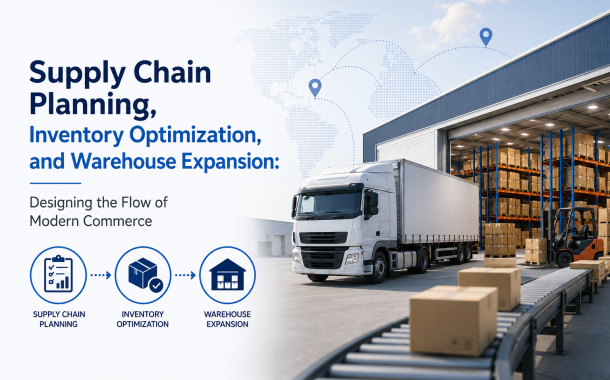
At the core of this challenge are three capabilities: Supply Chain Planning, Inventory Optimization, and Warehouse Expansion. They work together to create a seamless network that can either smooth out or bring strain to a business. Together, these form the resilience, efficiency and scalability of the whole value chain.
Table of Contents
Supply Chain Planning: Designing Decisions Before They Happen
Supply Chain Planning is a strategic process of synchronizing the supply and demand while coordinating procurement, production and distribution. It is analytical, it is pro-active and it takes uncertainty and transforms it into decisions on what to produce, where it will come from, and how to get it there.
Data integration is a key component of modern planning. Historical sales patterns no longer stand alone, they are part of a wider group of real-time signals like market trends, promotions, external disruption etc. This makes it a more adaptive forecasting system and one that reacts to abrupt changes.
A key part of this discipline is scenario modeling, where planners simulate different future conditions to test how the supply chain will behave. This is where decision-support tools become especially powerful. For example, influence diagrams in Analytica are often used to map relationships between demand drivers, supply constraints, and cost variables, allowing planners to visualize uncertainty and its downstream effects before making decisions.
Sales and Operations Planning (S&OP) plays a central role by aligning departments around a single operational plan. Without this alignment, sales teams may overestimate demand while operations underprepare supply, leading to inefficiencies on both ends.
Ultimately, effective supply chain planning is not about eliminating uncertainty but structuring it in a way that allows better, faster decisions.
Inventory Optimization: Finding the Right Balance Point
Inventory optimization ensures that the right amount of stock is available at the right place and time. It is a balancing act between cost efficiency and customer service. Too much inventory ties up working capital and increases storage costs, while too little risks stockouts and lost sales.
Traditional methods such as fixed reorder points or static safety stock levels are increasingly insufficient in complex global networks. Instead, companies now rely on dynamic optimization models that continuously adjust based on demand signals and supply variability.
One of the most effective approaches is multi-echelon optimization, which treats the supply chain as a connected system rather than isolated storage points. Instead of optimizing each warehouse independently, it evaluates inventory across suppliers, central warehouses, and local distribution centers simultaneously.
Demand segmentation also plays a critical role. Products are categorized based on demand patterns—stable, seasonal, or highly volatile—and each category is assigned a different inventory strategy. High-variability products may require higher buffer stock, while stable products can be managed with leaner inventory levels.
Advanced analytics and machine learning systems further enhance optimization by detecting hidden patterns in sales data and adjusting replenishment automatically. This leads to a more adaptive system that reacts in near real time to changing conditions.
Warehouse Expansion: Building Capacity for Speed and Scale
Warehouse expansion is no longer just about adding more storage space. It is about building smarter distribution networks that bring products closer to customers and reduce delivery time.
The rise of e-commerce has dramatically changed warehouse strategy. Instead of relying on a few large centralized facilities, companies increasingly adopt distributed fulfillment networks. These smaller, strategically placed warehouses reduce last-mile delivery costs and improve shipping speed.
Location strategy is critical. A poorly placed warehouse can increase transportation costs and reduce efficiency across the entire supply chain. As a result, warehouse expansion decisions are tightly linked to demand forecasting and supply chain planning models.
Automation is also reshaping warehouse design. Robotics, automated storage systems, and AI-driven picking technologies improve accuracy and speed while reducing reliance on manual labor. These systems allow warehouses to operate at higher throughput levels with fewer errors.
Flexibility has become another key requirement. Instead of fixed-capacity buildings, companies are exploring modular warehouse designs that can scale up or down depending on demand fluctuations, especially in seasonal industries.
This modular approach also extends to the internal setup of the facility. Managers need storage systems that they can move or reconfigure as inventory needs change. Heavy-duty shelving and durable lockers help keep the floor organized and safe. Sourcing these items from a specialized supplier like the Metal Cabinet Store allows businesses to find commercial-grade options that withstand daily wear. Having the right physical setup prevents clutter and keeps operations running on time.
Integration: Why These Systems Must Work Together
Supply chain planning, inventory optimization, and warehouse expansion are often treated as separate functions, but in reality they are deeply interconnected.
Planning determines demand forecasts, which influence inventory levels. Inventory levels then determine how much warehouse space is required. In turn, warehouse capacity constraints feed back into planning decisions, affecting production and sourcing strategies.
When these functions are disconnected, inefficiencies emerge quickly. A company may expand warehouse space without improving forecasting accuracy, leading to underutilized facilities. Or it may optimize inventory without considering storage limitations, resulting in operational bottlenecks.
Integrated digital supply chain platforms help solve this problem by providing end-to-end visibility. They allow decisions in one area to immediately reflect across the entire system, improving coordination and reducing delays.
Challenges: Complexity in a Volatile World
Despite technological progress, supply chain management remains highly complex. Data quality issues can distort forecasts and lead to poor decisions. Even small errors in demand prediction can cascade into significant operational inefficiencies.
External disruptions also continue to pose risks. Geopolitical instability, transportation delays, and sudden shifts in consumer behavior can all destabilize carefully planned systems.
Sustainability adds another layer of complexity. Companies are increasingly expected to reduce emissions and waste while maintaining efficiency, requiring new trade-offs in network design and transportation planning.
Conclusion: Building a Responsive Supply Network
Modern supply chains are no longer linear systems; they are dynamic networks that must constantly adapt to change. Supply chain planning provides direction, inventory optimization ensures balance, and warehouse expansion enables scale.
When these three capabilities are integrated effectively, they create a supply chain that is not only efficient but also resilient. In a world defined by uncertainty, that adaptability becomes a core competitive advantage—turning complexity from a challenge into a source of strength.