


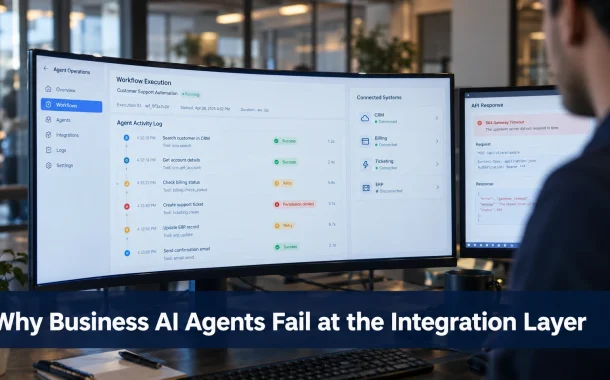
This explains why many agent projects perform well in a pilot and deteriorate after launch — a gap that shows up whenever you move from AI that answers to AI that takes action. Production introduces incomplete data, inconsistent processes, changing interfaces, and users with different access rights. The agent inherits all of that complexity. If the development team treats integration as a final implementation task, the project is already carrying more risk than the demo reveals.
Table of Contents
The System Boundary Determines Reliability
Business agents rarely work inside a single application. A service agent may need the CRM, ticketing platform, billing system, and policy library. An operations agent may combine an ERP, a supplier portal, email, and a reporting database. The reasoning layer can propose the next step, but each step depends on data contracts, authentication, latency, and the behavior of another system.
Those dependencies are often less stable than the agent design assumes. A CRM field may be optional even though the workflow requires it. Two systems may use different identifiers for the same account. These are ordinary data reliability and accuracy problems, but agents make them harder to see. An API may return a successful response before a change is fully processed. These are ordinary software problems, but agents make them harder to see because the interaction still appears conversational and coherent.
Tool Access Needs Narrow Operational Contracts
Giving an agent access to an API does not define how it should use that API. Every tool needs an operational contract that specifies allowed inputs, validation rules, user permissions, expected outputs, and failure behavior. The agent should see a small set of purpose-built actions rather than unrestricted access to a large internal service.
A refund tool, for example, can enforce a maximum amount, require an eligible transaction, and return a structured reason when the request cannot proceed. The model then decides whether the tool is relevant, while the software layer enforces policy. This division matters because business rules should remain deterministic even when the agent’s reasoning is probabilistic.
Permissions Must Follow the User
An agent should not become a privileged shortcut around existing access controls. If an employee cannot view a contract or change a payment status directly, the agent acting on that employee’s behalf should face the same restriction. Permission checks need to happen before information reaches the model and again before any action is executed.
This becomes more complicated when an agent works in the background. The team must decide whose authority applies, how long delegated access lasts, and which actions require fresh confirmation. Without those decisions, an apparently useful automation can create a security exception that the organization cannot explain during an audit or incident review.
Failure Handling Is Part of the User Experience
Most agent evaluations focus on successful tasks. Production reliability depends just as much on what happens when a task cannot be completed. The system needs defined responses for missing data, conflicting records, expired credentials, rate limits, unavailable services, and ambiguous requests.
Retries are appropriate for temporary network failures, but dangerous when an action may already have succeeded. A repeated payment request or duplicate customer update can create more damage than the original failure. Idempotency keys, transaction checks, and explicit status verification should therefore sit below the reasoning layer. When the system cannot establish a safe state, it should stop and provide a clear case for human review.
Good Agent Development Begins With Process Evidence
Teams often document the intended workflow and miss the one people actually use. Before designing the agent, developers should examine real cases, including incomplete requests, manual workarounds, reversals, and escalations. These examples show where judgment is required and where the surrounding systems fail to provide enough context.
The first release should support a narrow task with a clear owner. It can begin in shadow mode, producing recommendations without changing records. The team compares those recommendations with real decisions, measures errors by type, and identifies which failures come from reasoning, retrieval, integration, or policy. Action rights can expand only after the underlying failure patterns are understood.
Observability Must Reconstruct the Decision
A final answer is not enough for debugging or governance. The system should record which user initiated the task, which sources were retrieved, which tools were called, what each tool returned, and whether a person approved the result. Sensitive data still needs appropriate retention and masking, but the operational path must remain reconstructable.
This record allows the team to separate model errors from system errors. It also makes evaluation practical. A drop in task completion may come from a changed API, stale knowledge, a new permission rule, or a model update. Without action-level evidence, each incident becomes guesswork and every improvement risks introducing a different failure elsewhere.
The Right Measure Is Completed Work
Model accuracy is useful, but it does not establish the business case. The relevant measures are completed tasks, handling time, escalation rate, correction rate, and cost per successful outcome. A system that writes better summaries but creates more manual verification may have improved technically while making the workflow worse.
Reliable AI agents emerge from disciplined software development around a bounded operational problem. Teams need to understand the process, constrain the available actions, preserve identity and permissions, and test failure paths with the same care as successful ones. Once that foundation works, improved models can raise performance. Without it, a more capable model only reaches the same broken systems faster.