

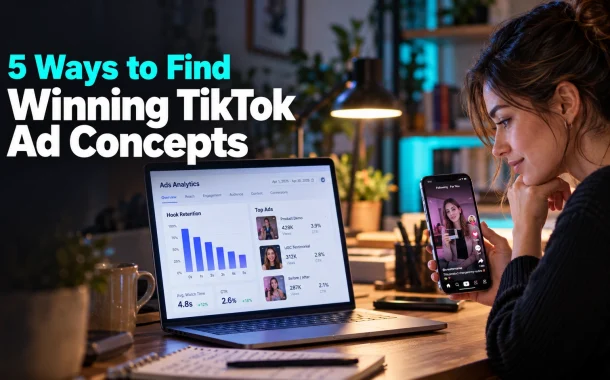
Finding winning TikTok ad concepts isn’t guesswork. Five clear methods consistently surface ideas worth running, and each one gets you closer to an ad that holds attention past those first two seconds.
Table of Contents
1. Study Your Competitors’ TikTok Ads
Your competitors are already running split tests on your behalf. Every ad they keep live past the first week cleared their internal performance bar, which makes it worth studying. This is where TikTok ad spying becomes one of the most direct ways to shortcut concept research; you can sort by how long an ad has been live, filter by niche or country, and see which hooks your market actually responds to instead of guessing.
Start with ads that have run 30 days or more in your category. Long run time is a strong proxy for performance. Write down the hook format, the product claim in the first five seconds, and whether the ad features a person, a voiceover, or text on screen. You aren’t copying anything; you’re building a map of what the market has already validated.
And don’t stop at the creatives. Look at the landing pages too. A sharp ad paired with a weak landing page still fails, but when both are polished, you’re seeing a concept that’s been taken all the way through to conversion. That’s what’s worth adapting.
2. Mine TikTok’s Creative Center for Trend Data
TikTok’s own Creative Center – free at ads.tiktok.com – is probably the most overlooked research tool for paid marketers. It surfaces trending sounds, hashtags, and top-performing ads sorted by region, objective, and industry. Most advertisers skip it because it feels like organic content research. But the Top Ads section runs on paid performance data, so what you’re seeing are concepts TikTok’s algorithm rewarded with reach.
Filter by your vertical and study what sits at the top. Look at structure: does the ad open with a problem statement, a product demo, or a bold claim? Count the seconds before the product shows up on screen. These patterns repeat because they work, and you want to understand them before building your own version.
Cross-reference what you find here against your competitor research. If a format shows up in both the Creative Center and a competitor’s long-running ad library, that’s a signal worth acting on; the algorithm favors it, and real advertisers have already proved it out.
3. Test UGC-Style Hooks Against Your Own Analytics
User-generated content hooks – someone talking straight to camera, speaking as a customer rather than a brand – tend to outperform polished brand spots on TikTok because the platform trains users to ignore anything that reads as a commercial. But not every UGC hook lands. The difference usually comes down to the first sentence.
Run three to five short concept tests with different hook angles: a personal problem statement, a surprising result, a before-and-after setup, a bold opinion, a direct question. Keep the rest of the ad identical where you can. Your analytics will tell you which hook gets people watching past the three-second mark, and that data beats any outside opinion every time.
The other metric worth sweating is thumb-stop rate. If your video gets impressions but bleeds viewers in the first second, the hook concept isn’t connecting, even when the product is right. TikTok’s ad manager surfaces this at the ad level, so you can see exactly where attention drops and adjust the concept accordingly.
4. Follow High-Performing Creators in Your Niche
Organic TikTok creators test concepts at a volume most paid teams can’t match. A creator with 200,000 followers might post three to five times a day, and their comment section tells you in real time which angles people actually care about. Comments like “Where can I get this?” or “I needed this video” are audience signals you can turn directly into ad concepts.
Save the posts that break that creator’s normal engagement pattern, the ones pulling five times the usual comments or shares. Those outliers usually sit on a concept that’s genuinely new to the audience; that novelty is exactly what you’re hunting. TikTok surfaces organic content differently from paid, but the human psychology behind what captures attention? Same across both.
So if a creator’s organic video about a product problem goes viral, consider building a paid concept around that same problem frame. You’re not copying the video, you’re treating an audience reaction as market research, which is exactly what it is.
5. Use Customer Language From Reviews and Comments
Here’s the thing: your best ad copy already exists. It’s sitting in your customers’ own words, product reviews, comment sections, DMs, support tickets. People describe their problems and their desired results in language that’s specific, emotional, and completely unfiltered by marketing instincts. That language converts better than anything invented from scratch because it sounds exactly like the person watching the ad.
Pull your last 50 reviews or comments and look for phrases that keep coming back. If three different customers independently write “I stopped buying the expensive version,” that phrase belongs in a hook. If people keep naming a specific before-state – “I was exhausted every afternoon” or “nothing fit right after I had my son” – those aren’t just testimonials; they’re concept seeds.
Apply the same approach to competitor reviews on marketplaces and in comment sections. You’re looking for pain points your product solves that your competitor isn’t addressing in their ads. That gap is where a concept wins.
Conclusion
Finding winning TikTok ad concepts comes down to working a system: study what competitors run long-term, use platform data to spot proven formats, test hook angles against real performance numbers, watch what organic creators prove out, and pull the exact language your customers already use. Each method gives you a different angle on the same underlying question, what does this audience actually respond to? Stack a few of these approaches together and you’ll spend far less time guessing, far more time scaling concepts that already have evidence behind them.