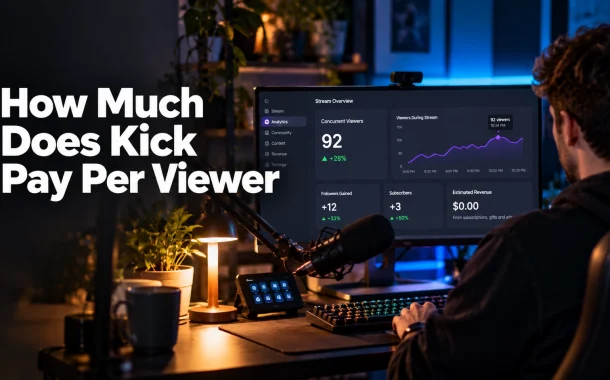
That answer disappoints people, so it gets softened into vague talk about “indirect” earnings. The useful version is specific. Kick has four real revenue streams, each with its own rate and its own eligibility bar, and viewers only matter because one of those bars is measured in average concurrent viewers. Hitting it unlocks subscriptions, tips and campaign work. Missing it means the viewer count is just a number on a screen. The figures below come from Kick’s own help documentation, including the revenue split, the Partner Program thresholds, what the platform says about ad payments, and how long the money takes to reach a bank account once it is earned.
Quick answer: Kick pays nothing per viewer. Earnings come from subscriptions and viewer tips, both split 95/5 in the streamer’s favour, plus Bounty campaigns and negotiated Partner Program compensation. Partner eligibility requires a 75 average concurrent viewer count over 30 days, 30 hours streamed, 250 followers and 25 active subscriptions. Ads pay no direct amount, and all payouts run through Stripe.
Table of Contents
How Much Does Kick Pay Per Viewer
Kick pays $0 per viewer. There is no per-view rate, no per-concurrent-viewer rate, and no hourly rate tied to audience size for ordinary creators. Viewers generate money only when they take an action that moves money: subscribing, sending a tip, or watching long enough to qualify a channel for the Partner Program.
Why no platform pays a flat per-viewer rate
A flat rate per viewer is trivially easy to fake. Any platform offering it would be paying for traffic rather than for content, and the cheapest way to earn would be to manufacture the traffic. Kick’s model instead pays on actions a bot cannot perform convincingly, which is why subscriptions and tips carry the revenue and raw view counts carry none.
What viewers are actually worth
Think of your concurrent viewer average as an eligibility metric rather than an income metric. It gates access to the programme that pays, and it influences how many of those viewers eventually subscribe. A channel averaging 75 viewers with 25 subscribers earns real money. A channel averaging 75 viewers with zero subscribers earns nothing, and the difference is conversion, not audience size.
The Four Ways Kick Actually Pays Streamers
Kick documents four distinct revenue streams, and only two of them carry a published rate. Subscriptions and viewer tips both run on a 95/5 split. Bounty campaign payments are set per campaign. Partner Program compensation is negotiated. None of the four pays on viewer count by itself.
| Revenue stream | What the streamer keeps | How the rate is set |
|---|---|---|
| Subscriptions | 95% | Fixed split, published |
| KICKs (viewer tips) | 95% | Fixed split, published |
| Bounties | Varies | Set in each Bounty post, per campaign |
| Partner Program | Varies | Negotiated with Kick |
Subscriptions
The steadiest of the four, because it recurs monthly without the viewer deciding again. Kick states a 95/5 split, and describes the 5% as a processing fee rather than a platform cut. On a $5 subscription the streamer receives $4.75 and the fee is $0.25.
KICKs
Kick’s tipping currency. Viewers buy KICKs and send them on a channel, and the streamer receives 95% of the value, matching the subscription split. This stream is missing from most discussions of Kick earnings despite carrying the same rate as subscriptions.
Bounties
Campaign work rather than audience monetisation. A brand or the platform posts a Bounty, the streamer completes it, and the reward is whatever that post specifies. Kick states that rewards vary by campaign, so there is no rate to quote.
Partner Program compensation
The tier people mean when they talk about being paid hourly. It is negotiated, not published, and it requires meeting the thresholds in the section below. Reports of hourly deals exist for high-profile creators, but Kick publishes no rate card, so any specific hourly figure circulating online is unverifiable.
What You Keep When a Viewer Subscribes on Kick
Kick takes 5% of subscription revenue and the streamer keeps 95%, which is the most generous published split among the major streaming platforms. The platform frames that 5% as a payment processing fee rather than a revenue share, per Kick’s revenue split documentation.
| Subscription price | Streamer keeps (95%) | Fee (5%) |
|---|---|---|
| $5 | $4.75 | $0.25 |
| $10 | $9.50 | $0.50 |
| $25 | $23.75 | $1.25 |
| 25 subs at $5 | $118.75 | $6.25 |
| 100 subs at $5 | $475.00 | $25.00 |
Figures calculated from the 95/5 split published in Kick’s help centre.
The arithmetic to be careful with
Five per cent of $10 is $0.50, so a $10 subscription returns $9.50. Watch for a quoted figure of $9.95 on a $10 subscription, which would be a 0.5% fee rather than 5%. Run the multiplication yourself on whatever price you set, because a tenfold error in the fee compounds across a subscriber base.
Why the split is not the whole picture
A 95% share of a small number is still a small number. Twenty-five subscriptions at $5 returns $118.75 a month before tax, which is the realistic starting point for a channel that has just qualified. The generous split matters at scale, and it is a reason to grow on Kick rather than a reason to expect early income.

Kick Partner Program Requirements
Kick’s published Partner Program thresholds are considerably higher than the figures that circulate in summaries of them. The requirement most often misquoted is the viewer one: Kick asks for a minimum average of 75 concurrent viewers over the past 30 days, not 75 followers. Followers are a separate and lower bar.
| Requirement | Threshold |
|---|---|
| Average concurrent viewers | 75 CCV over the past 30 days |
| Hours streamed | 30 hours in the past 30 days |
| Followers | At least 250 |
| Active subscriptions | 25 in the past 30 days |
| Unique chatters | 250 in the past 30 days |
| VODs | 3 in the past 30 days |
| Channel status | Verified before applying |
| Policy compliance | Terms of Service, Community Guidelines, DMCA Policy, KCIP terms |
Thresholds as published in Kick’s Partner Program documentation, which notes they are early-stage and subject to change.
75 concurrent viewers is not 75 followers
This is the single most consequential distinction on the page. Seventy-five followers is achievable in a week. Seventy-five people watching simultaneously, sustained as a 30-day average, is a substantially established channel. A creator working toward the first number while believing it unlocks monetisation will keep missing the bar without understanding why.
The 25-subscription requirement creates a sequencing problem
Partner status requires 25 active subscriptions, and subscriptions are themselves a monetisation feature. Read Kick’s documentation closely on this point before building a plan around it, because the order in which a channel gains subscription capability and Partner status determines what is achievable first.
Fast Track for creators established elsewhere
A creator with an existing audience on another platform can apply through Fast Track, which skips the standard streaming requirements. Kick states that the partnerships team reviews these applications within 24 hours. For anyone moving across from Twitch or YouTube with an audience already built, this is the relevant route rather than grinding the 30-day metrics from zero.
How to track progress
The Achievements section of the creator dashboard shows progress against the requirements, which beats estimating from analytics. Applications go by email to the partner team from the address linked to the Kick account.
Do Kick Ads Pay Per Viewer
No. Kick’s own creator advertising documentation states plainly that “ads themselves do not currently generate direct additional payment.” There is no CPM rate to earn against, no per-impression payment, and no per-ad payment for ordinary creators. Creators in the Partner Program are compensated through that programme instead.
This contradicts a widely repeated claim that Kick pays a few dollars per thousand ad impressions. That model describes YouTube, not Kick.
How ad breaks work if they do not pay directly
Ad breaks are scheduled rather than earned against. The dashboard shows a countdown, and a creator can defer a break or trigger it early. Deferring does not shift the next scheduled break, so delaying one does not buy a longer gap. Delivery also varies by viewer: not everyone sees an ad at the same moment, because it depends on location, category, channel and language, per Kick’s advertising documentation.
The category exclusion worth knowing
Monetisation is not available in the Slots and Casino category. A channel streaming that content cannot monetise it on Kick regardless of audience size, which is a hard eligibility wall rather than a performance issue.
When Kick Pays You and How the Money Arrives
Kick pays through Stripe, and that single fact determines most of what a streamer experiences after earning. Stripe identity verification is required, a bank account in a supported country has to be added, and payout currency has to be confirmed. Without those three steps, earnings accumulate but do not move.
| Situation | Timing |
|---|---|
| Non-verified streamer | Monthly payouts only |
| Verified streamer | Weekly or monthly, by choice |
| First payout | After Stripe verification and the end of the next monthly cycle, up to 30 days after month-end |
| US bank transfer (ACH) | 2 to 3 business days |
| US instant debit card payout | Within minutes, capped at $9,000 per payout |
| International streamer | Typically 3 to 7 business days |
Timings as published in Kick’s payout documentation.
The country problem nobody mentions
Stripe does not support payouts in every country. Where Stripe is unavailable, a Kick streamer cannot currently receive payouts at all. That is not a delay or a verification hurdle, it is a hard stop, and it should be checked before investing months in building a channel. Creators in that position usually end up routing income through an intermediary account instead, which is the situation our guide to moving money from Stripe to Payoneer was written for.
Currency conversion is covered
Earnings are tracked in US dollars and Stripe converts them to the bank’s currency. Stripe’s standard conversion fee is 1.50%, and Kick absorbs it rather than deducting it from the payout. That is a genuine saving on every international payout and it is easy to miss.
Why the first payout feels broken
International deposits all originate from Kick’s US-based Stripe account, which is why they take longer than domestic ones and why the timing varies by region. Combined with the up-to-30-days wait after month-end for a first payout, a new streamer can reasonably wait six weeks between earning and banking. The pattern matches Stripe’s behaviour generally, which our breakdown of Stripe payout schedules covers in more detail, along with why Stripe sometimes holds funds. Streamers in Pakistan specifically will find the regional timing in our Stripe Pakistan payout guide.
The verification step that stalls people
Stripe identity verification is a real KYC check, not a formality, and a mismatch between the name on the Kick account and the identity document stops the payout. The process is the same one Stripe runs across its products, described in our piece on Stripe identity verification. Finish it before the first month ends rather than after.
Why Inflating Your Viewer Count Gets You Suspended
Kick names botting as a suspendable behaviour violation: “using bots or scripts to artificially inflate Concurrent Viewers, followers, or chat activity.” Engagement manipulation through third-party tools is listed separately as a further violation. Consequences scale with severity and repetition, and reach up to a permanent ban.
The advice is self-defeating on its own terms
Partner eligibility is measured in average concurrent viewers. Botting concurrent viewers is the specific violation Kick names. So the metric a streamer would be tempted to inflate is the exact metric the platform watches, in the exact programme they are trying to enter. Passing the threshold with bot traffic puts the application in front of a team that can see the pattern.
There is no ad revenue to inflate anyway
The usual argument for buying views is that more impressions means more ad money. On Kick, ads do not generate direct additional payment, so there is no impression-based revenue to inflate. The supposed upside does not exist, and the documented downside is a channel ban.
What to do instead
Grow the metrics the programme actually measures. Thirty hours in 30 days is a schedule problem. Two hundred and fifty unique chatters is a chat-engagement problem. Twenty-five subscriptions is a conversion problem, and converting 3 of every 10 regular viewers beats tripling the raw count. Kick’s suspension documentation sets out what gets a channel suspended in full, and it is worth reading once before building any growth plan.
Frequently Asked Questions
How much does Kick pay per 1,000 viewers?
Nothing. Kick has no per-viewer or per-thousand-viewer rate. Revenue comes from subscriptions and viewer tips, both at a 95/5 split in the streamer’s favour, plus Bounty campaigns and negotiated Partner Program compensation. A channel with 1,000 concurrent viewers and no subscribers earns nothing from those viewers directly.
Does Kick pay more than Twitch?
On subscription split, yes. Kick publishes a 95/5 split, which is more generous than the standard arrangements elsewhere. Whether total earnings are higher depends on audience size and subscriber conversion rather than on the split alone, since 95% of a small subscriber base is still a small amount.
How many followers do you need to make money on Kick?
Kick’s published Partner Program requirements include at least 250 followers, alongside a 75 average concurrent viewer count over 30 days, 30 hours streamed, 25 active subscriptions, 250 unique chatters and 3 VODs. The often-quoted figure of 75 refers to average concurrent viewers, not followers.
Does Kick pay streamers hourly?
Not as a published rate. Hourly arrangements sit inside the Partner Program and are negotiated individually, so Kick publishes no rate card. Specific hourly figures circulating online cannot be verified against any Kick documentation. Treat them as reports about individual deals rather than as a rate anyone can expect.
How much does Kick take from subscriptions?
Five per cent, which Kick describes as a payment processing fee rather than a platform cut. The streamer keeps 95%. A $5 subscription returns $4.75, a $10 subscription returns $9.50, and 25 subscriptions at $5 return $118.75 before tax.
Do you get paid for ads on Kick?
Kick’s creator advertising documentation states that ads do not currently generate direct additional payment. Partner Program creators are compensated through that programme instead. There is no CPM rate for ordinary creators, so the claim that Kick pays a few dollars per thousand ad impressions does not match the platform’s own documentation.
When does Kick pay out?
Non-verified streamers receive monthly payouts only. Verified streamers can choose weekly or monthly. A first payout is processed after Stripe verification and the end of the next monthly cycle, which can be up to 30 days after month-end. US bank transfers then take 2 to 3 business days and international transfers typically 3 to 7.
Can you get paid on Kick from any country?
No. Payouts run through Stripe, and Stripe does not support payouts in every country. Where it is unavailable, a Kick streamer cannot currently receive payouts. Check whether Stripe supports payouts to your country before building a channel around Kick income, because no workaround exists inside the platform.
Will Kick ban you for viewbotting?
It can. Kick lists botting, defined as using bots or scripts to artificially inflate concurrent viewers, followers or chat activity, as a suspendable behaviour violation, with engagement manipulation listed separately. Consequences scale with severity and repetition and reach up to a permanent ban. Concurrent viewers is also the metric Partner eligibility is measured on.
Can you monetise a casino or slots stream on Kick?
No. Kick states that monetisation is not available in the Slots and Casino category. The restriction applies to the category rather than to the channel’s size, so audience numbers make no difference. Kick’s suspension rules also cover undisclosed gambling sponsorships and missing age labels on gambling streams.
Conclusion
How much does Kick pay per viewer comes down to one number, and that number is zero. The viewer count is an eligibility metric, not an income stream. What pays is a subscription at a 95/5 split, a tip at the same split, a Bounty completed for whatever that campaign offers, and Partner compensation negotiated privately once a channel clears thresholds measured in concurrent viewers, hours, chatters and existing subscribers.
The streamer checking a flat balance after a 90-viewer session is not being cheated. They are looking at the wrong metric. The ones worth watching are how many of those 90 return, how many talk in chat, and how many convert to a subscription, because all three feed the requirements that unlock the paying features. Two further things decide whether earned money arrives: Stripe identity verification, and whether Stripe pays out to your country at all.
Which of the Partner thresholds is furthest away on your channel right now, the concurrent viewers or the 25 subscriptions?