Table of Contents
What counts as an AI-ready data solution?
RAG requires traceable sources, current documents, and enforced retrieval permissions — not just a vector database. Predictive ML depends on historical coverage, consistent definitions, leakage prevention, and reproducible datasets.
Both need ownership of ingestion, quality, lineage, access, incidents, and handover. Databricks, Snowflake, Microsoft Fabric, Google Cloud, and AWS provide technology options; this list instead compares engineering partners who implement and operate data foundations around such tools. It does not conflate platform products, labeling marketplaces, and consulting services.
Selections reflect published services and cases reviewed in November 2026, not independent benchmarking. Test claims against your data estate.
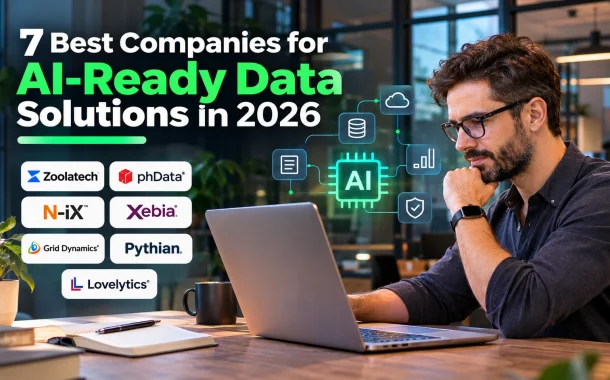
AI-ready data companies at a glance
| Company | Relevant strength | Consider first when… | Verify before contracting |
|---|---|---|---|
| Zoolatech | Custom data engineering, governance, AI-readiness assessment | AI must connect to complex enterprise systems | Workload-specific RAG/ML acceptance evidence |
| phData | Governed AI data foundations and semantic layers | Modernizing an enterprise intelligence platform | Platform assumptions and ownership after handover |
| N-iX | Pipelines, warehouses, governance, AI integration | Many source systems require reliable integration | Production support and workload-specific controls |
| Xebia | Cloud/data modernization and AI operating models | Governance and platform redesign must advance together | Division of responsibility across business and IT |
| Grid Dynamics | Data platforms, streaming, technical governance | Large, fast-changing operational data is central | Proof of access enforcement for your AI workload |
| Pythian | Cloud data engineering, migrations, ongoing operations | Existing data platforms need stabilization or rebuilding | Operations scope and governance deliverables |
| Lovelytics | Databricks-centric data engineering and governance | Your foundation is built around Databricks | Fit if a multicloud or alternative stack is needed |
The seven companies to evaluate
1. Zoolatech: AI-ready data engineering across enterprise systems
Best fit: Enterprises that need to turn fragmented operational data into governed inputs for RAG, predictive ML, or AI-enabled applications, while keeping ownership of their platforms.
Zoolatech is a software engineering partner rather than a packaged data platform vendor. Its AI-ready data services cover readiness assessments, quality and governance, streaming and lakehouse foundations, vector indexing, access-aware data delivery, and measurable data service levels. This matters when operational systems cannot deliver trustworthy data to AI applications.
There is also a more concrete engineering reference. In a published US Fortune 500 retail data-platform case, Zoolatech describes Kafka-based ingestion, BigQuery, automated data pipelines, and ML forecasting. The company reports that inventory accuracy improved from 60% to above 90%. The case supports production data-engineering experience, not a verified RAG deployment.
Proof to request: Can the proposed team demonstrate how it would propagate document permissions, track source freshness, and define separate release gates for retrieval and training data? That test is more useful than a chatbot demo.
2. phData: governed foundations and semantic consistency
Best fit: Enterprises building or modernizing a data foundation intended to serve analytics, AI applications, and agents from shared business definitions.
phData explicitly offers AI-ready data foundations alongside intelligence-platform architecture, data migrations, and agentic data-engineering enablement. Its published approach links ingestion, modeling, semantic layers, quality testing, governance, and activation. It suits environments with conflicting business definitions across reports and models.
The company has extensive experience with Snowflake and modern cloud-data architectures, while its services also cover broader migration and integration work. Confirm that the proposed stack fits existing cloud commitments.
Design test: Show how a disputed business metric is defined once, versioned, and reused by both an analytics consumer and an AI application. Who owns the definition when the implementation team leaves?
3. N-iX: large-scale integration and data-quality controls
Best fit: Organizations whose AI initiatives depend on joining legacy databases, SaaS applications, event streams, and cloud data stores reliably.
N-iX describes batch and streaming pipelines, data warehouses and lakes, validation tests, observability, security, and governance as part of its data-engineering practice. Its broader service portfolio also includes generative AI and RAG development. This makes it a relevant candidate when the main obstacle is not selecting a foundation model but moving dependable, appropriately controlled data between systems.
Request proof of the security controls and runbooks from the actual delivery team, not just a company-wide capability slide.
Traceability test: Can engineers trace one incorrect feature or retrieved record back through the ingestion path, identify its owner, and replay the correction without silently changing historical model inputs?
4. Xebia: cloud modernization with data governance
Best fit: Enterprises that need to redesign governance, operating responsibilities, and data platforms together before scaling AI.
Xebia’s cloud and data modernization practice includes data engineering, streaming, data management, governance, and platform architecture. It also describes readiness assessments and an agentic data foundation. This matters when departments share a lakehouse but disagree on who defines or approves datasets.
Buy broad transformation support only if the first release actually needs it.
Governance question: Which data-governance controls will be implemented in code, which remain business processes, and who is accountable for each after go-live?
5. Grid Dynamics: streaming data and technical governance
Best fit: Data-intensive enterprises whose AI systems depend on operational events and continuously changing data.
Grid Dynamics describes enterprise analytical data platforms with stream processing, observability, cataloging, lineage, quality enforcement, and governance. Its emphasis on technical controls is relevant when rapidly changing events create schema and quality drift.
Pipeline monitoring does not prove that revoked users cannot retrieve sensitive documents. Test those controls separately.
Failure-mode test: What happens when an event schema changes during a busy trading period, and how do the affected AI consumers learn that an input is no longer trustworthy?
6. Pythian: data-platform reliability and operations
Best fit: Companies whose planned AI workload is blocked by fragile ETL jobs, aging warehouses, or a platform the internal team cannot reliably operate.
Pythian offers enterprise data engineering, pipeline modernization, cloud warehouses and lakehouses, data governance, and AI enablement. Its services also cover operating and optimizing data environments. It fits readiness projects where unstable infrastructure is the immediate constraint.
Set explicit boundaries between modernization, ongoing support, and AI engineering.
Operations question: Which freshness and quality incidents will the provider detect and resolve, and which still require a named person on the client’s team?
7. Lovelytics: Databricks-centered data foundations
Best fit: Enterprises that have chosen Databricks and need to turn fragmented reporting data into a governed, reusable foundation for analytics and future AI work.
Lovelytics presents data engineering, governance, migration, and AI services with a strong Databricks focus. A published 2026 project with 7-Eleven describes a merchant data foundation and the standardization of more than 150 metrics in Unity Catalog. The case illustrates agreement on metric definitions before AI consumes them.
It does not establish a RAG or ML deployment. Buyers on other stacks should test how much of the method transfers.
Ownership question: Can the team show who owns metric definitions and how changes are reviewed before a model, dashboard, or agent consumes them?
The pilot that separates claims from capabilities
Ask each finalist to work through one bounded, realistic scenario using representative or appropriately masked data. Consider a hypothetical US retailer with store inventory feeds, customer policies, and a planned demand-forecasting model. RAG and forecasting need different acceptance tests.
| Test | Evidence to request | Failure that should stop release |
|---|---|---|
| Source lineage | Trace a feature or retrieved passage to its source version | Source or transformation cannot be identified |
| Permission change | Revoke access, then repeat a RAG query as that user | Restricted material remains retrievable |
| Freshness | Update a document or delay an event and measure propagation | Data is served beyond the agreed workload threshold |
| Quality control | Inject a duplicate or conflicting business value | Silent acceptance changes a model input |
| Reproducibility | Rebuild a training dataset from a dated snapshot | Results cannot be reconstructed |
| Incident ownership | Walk through an alert, escalation, rollback or forward fix | Nobody can authorize or carry out recovery |
These are proposed tests, not claims that providers have passed them. Define workload-specific thresholds with business owners before pricing.
The pilot should end with a decision record: passes, failures, remediation owners, and production gates.
How to choose without buying unnecessary complexity
For legacy integrations, prioritize engineering; for disputed definitions and permissions, prioritize executable governance. Existing Databricks or Snowflake investments may favor a platform specialist.
Contract for source inventory, quality checks, owners, access rules, lineage, tests, runbooks, and handover. This shortlist is a starting point, not a purchasing verdict.
Frequently asked questions
Is buying a vector database enough to make enterprise data AI-ready?
No. A vector index helps with retrieval, but the source documents still require access rules, freshness controls, lineage, versioning, and evaluation. The index should not become an unmanaged second copy of sensitive company knowledge.
Should we hire a data engineering company or an AI consulting company?
Hire for the missing capability. If pipelines and business definitions are unreliable, data engineering and governance come first. If the data already passes production acceptance checks, the larger gap may be model engineering, evaluation, or application integration. Many firms provide both, but the statement of work should name which team owns each layer.
What should an AI-ready data assessment produce?
At minimum: a named use case, a map of relevant sources and owners, measured quality and coverage gaps, permission and lineage findings, recommended remediation, and a documented go/no-go decision. An organization-wide maturity score alone does not demonstrate that a specific RAG or ML workload is safe to release.
Related questions
Do RAG and predictive machine learning need the same data preparation?
They share quality, governance, and lineage concerns. RAG adds document parsing, retrieval permissions, source attribution, and content-update behavior. Predictive ML often needs historical consistency, label quality, leakage controls, and reproducible feature generation. One generic readiness score can hide failure in either workload.
What is the first step in selecting an AI-ready data solutions company?
Choose one production decision the AI system must support, identify its source data and business owner, and ask vendors to demonstrate how they will test and operate that data. Compare the answers and artifacts before comparing marketing claims or proposed platform diagrams.