

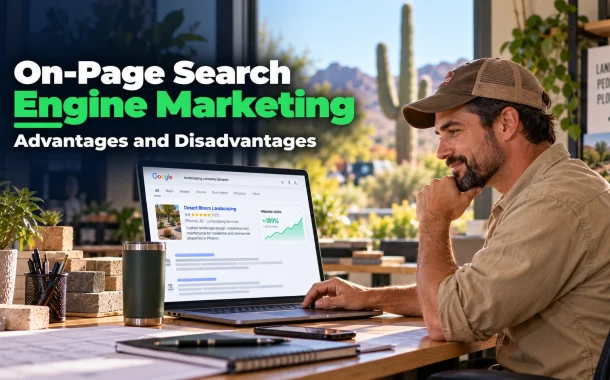
That work is on-page search engine marketing, and it paid off for Carlos. It also took months to show results and hours of his team’s time writing project descriptions. On-page search engine marketing activities are the changes you make on your own web pages to rank higher and earn more clicks, and most people call this on-page SEO. Each activity has clear advantages and real disadvantages, and knowing both helps you decide where to spend your time first.
Quick answer: The main advantages of on-page search engine marketing are lasting free traffic, full control over your pages, better user experience and higher click-through rates. The main disadvantages are slow results, ongoing time and skill, no guaranteed rankings and the risk of over-optimizing. It works best alongside technical SEO, links and, where needed, paid search.
Table of Contents
What Are On-Page Search Engine Marketing Activities?
On-page search engine marketing activities are the changes you control on each page: content, title tags, meta descriptions, headings, internal links, images, schema markup and page experience. They tell search engines what a page is about and help visitors decide to click and stay. Off-page work, like backlinks, happens on other sites.
The Seven Main Activities
- Content that answers the searcher’s question
- Title tags and meta descriptions that show in search results
- Headings that organize the page
- Internal links between related pages
- Images with descriptive file names and alt text
- Schema markup that labels page details for search engines
- Page experience, such as speed and mobile layout
The Four Main Types of SEO
On-page work is one of four main types of SEO. Google’s own SEO Starter Guide covers the basics of each.
| Type of SEO | What it covers | Who usually handles it |
|---|---|---|
| On-page SEO | Content, titles, headings, internal links, images | Writers, marketers, site owners |
| Off-page SEO | Backlinks, brand mentions, reviews, PR | Marketing and PR teams |
| Technical SEO | Crawling, indexing, site speed, sitemaps, redirects | Developers |
| Local SEO | Google Business Profile, local listings, location pages | Local business owners and marketers |
Advantages and Disadvantages of On-Page Search Engine Marketing at a Glance
The biggest advantages of on-page search engine marketing are lasting traffic and full control over your pages. The biggest disadvantages are the time it takes and the lack of guaranteed results. The table below sums up the main advantage and disadvantage of each activity, and it works as a quick reference or a slide.
Summary Table
| Activity | Main advantage | Main disadvantage |
|---|---|---|
| Content quality | Earns rankings, links and trust over time | Takes the most time and skill |
| Title tags and meta descriptions | Raises click-through rate from search | Google may rewrite them |
| Headings and structure | Helps readers and search engines scan the page | Easy to stuff with keywords |
| Internal links | Guides visitors and spreads ranking value | Too many links confuse readers |
| Images and media | Keeps visitors engaged and adds image search traffic | Large files slow the page |
| Schema markup | Can earn rich results like FAQs and reviews | No guarantee Google shows them |
| Page experience | Better speed lifts conversions | Fixes may need a developer |
1. Content Quality and Relevance
Content quality is the most important on-page activity because it decides whether a page deserves to rank at all. Google’s systems reward pages that answer what people search for, show real experience and are easy to read. The tradeoff is that good content takes the most time, research and expertise of any on-page task.
Advantages and Disadvantages of Content
Content is the base of all search engine marketing, paid or organic. Google’s guide to creating helpful, people-first content lays out what its systems look for.
Advantages
- Helpful pages keep ranking for months or years after you publish them.
- Good content earns backlinks without outreach.
- Clear answers near the top of a page can be quoted in featured snippets and AI-generated summaries.
- Content builds trust before a visitor ever contacts you.
Disadvantages
- Writing well takes time, research and real knowledge of your field.
- Content goes stale and needs regular updates.
- Thin or keyword-stuffed pages can drag down rankings across your whole site.
Getting Help With Content
Many businesses bring in help for this. A B2B SEO agency focuses on long sales cycles and decision-maker searches, while a SaaS SEO agency knows how software buyers search for features, comparisons and pricing. Either way, someone with real knowledge of your customers should review every page. Our guide on what to look for when investing in professional SEO services covers how to choose.
2. Title Tags and Meta Descriptions
Title tags and meta descriptions are what searchers see before they click, so they shape your click-through rate. A clear title also tells search engines what the page covers. The catch is that Google can rewrite both, and meta descriptions don’t directly affect rankings, so they help clicks more than positions.
Advantages and Disadvantages of Titles and Descriptions
Advantages
- A clear, specific title is one of the strongest on-page signals of what a page covers.
- A good description can raise clicks even when your ranking stays the same.
- Changes are quick and free to make.
Disadvantages
- Google says in its guide to title links that it may use headings or other page text instead of your title element.
- Meta descriptions don’t directly affect rankings.
- Long titles get cut off, and misleading ones raise bounce rates.
How to Write Them
Keep titles under about 60 characters, put the main topic first and write descriptions that promise exactly what the page delivers. Our free meta title and description tool previews how yours will look in search before you publish.
3. Headings and Page Structure
Headings break a page into sections that readers and search engines can scan. A clear H1, H2 and H3 structure helps people find their answer fast and helps search engines understand each section. Question-style headings can also match “People also ask” results, but stuffing headings with keywords backfires.
Advantages and Disadvantages of Headings
Advantages
- Readers scan headings to find their answer fast.
- Search engines use headings to understand each section.
- Question-style headings can match “People also ask” results.
Disadvantages
- Stuffing every heading with the same keyword reads badly and helps no one.
- Restructuring old pages takes time when you have hundreds of them.
Use one H1 per page, then nest H2s and H3s in order without skipping levels. Write each heading so it makes sense on its own.
4. Internal Linking Structure
Internal links connect pages on your own site, guiding visitors to related content and passing ranking value to your most important pages. They also help search engines find new pages. The risk is overdoing it, since too many links or vague anchors confuse readers and waste the value each link could carry.
Advantages and Disadvantages of Internal Links
Advantages
- They help visitors find related pages and stay longer.
- They pass ranking value to your most important pages.
- They help search engines find and understand new pages.
Disadvantages
- Too many links in one paragraph distract readers.
- Vague anchors like “click here” waste the link.
- Pages with no internal links pointing to them can sit unnoticed.
Planning Your Links
Our keyword gap analysis workflow shows how to find the pages worth linking together. For Carlos, linking each project gallery to the matching service page was one of the simplest changes we made.
5. Images and Media
Images, video and diagrams make a page easier to follow and keep visitors engaged. Descriptive file names and alt text also help accessibility and image search. The downside is cost and speed, since original visuals take time to create and large, uncompressed files slow the whole page.
Advantages and Disadvantages of Images
Advantages
- Visuals keep people on the page and explain steps faster than text.
- Descriptive alt text helps accessibility and image search.
- Original photos show real experience, which plain stock images can’t.
Disadvantages
- Large, uncompressed images slow pages down.
- Creating original visuals takes time or money.
Preparing Images
Free photo editing tools make it easy to crop, resize and label your own photos. Save them in a modern format like WebP or AVIF. Our WebP vs AVIF vs JPEG comparison covers which to pick.
6. Schema Markup
Schema markup is code that labels details like prices, ratings, events and FAQs so search engines understand them. It can earn rich results that stand out in search and help Google understand your business. But Google decides whether to show rich results, and wrong or misleading markup can lead to a manual action.
Advantages and Disadvantages of Schema
Advantages
- It can earn rich results that stand out in search.
- It helps search engines understand your business, products and authors.
Disadvantages
- Google decides whether to show rich results, and has cut back some types.
- Wrong or misleading markup can lead to a manual action.
Our step-by-step guide on how to add schema markup walks through the setup.
7. Page Experience and Speed
Page experience covers load speed, mobile layout and how stable a page feels while it loads. Faster, stable pages keep visitors from leaving and convert better, and good Core Web Vitals can help when other factors are close. Speed alone won’t rank a weak page, though, and many fixes need a developer.
Advantages and Disadvantages of Speed Work
Advantages
- Faster pages convert better and keep visitors from leaving.
- Good Core Web Vitals can help when other factors are close.
Disadvantages
- Speed alone won’t rank a weak page.
- Many fixes sit in hosting, themes or code, so you may need a developer.
Hosting plays a part here too. Our post on VPS hosting for SEO covers when a server upgrade helps.
Overall Advantages of On-Page Search Engine Marketing
The overall advantages of on-page search engine marketing are lasting traffic, full control, low cost and a better experience for visitors. Unlike paid ads, rankings you earn keep sending traffic after you stop spending, and the same fixes that help search engines also help the people reading your pages.
Five Advantages
- Lasting traffic. Unlike ads, rankings don’t stop the day you stop paying.
- Full control. You own your pages and can change them any time.
- Low cost. Most activities need time, not a media budget.
- Better user experience. The same changes that help rankings help visitors.
- Works in every market. On-page basics are the same for US, UK, Canadian, Australian and European audiences.
Local businesses gain the most. Our posts on why local SEO matters for lawn care and landscaping businesses and maximizing your online presence with local SEO show how on-page work combines with a Google Business Profile.
Overall Disadvantages of On-Page Search Engine Marketing
The overall disadvantages of on-page search engine marketing are slow results, no guaranteed rankings, ongoing work and the risk of over-optimizing. Most changes take weeks or months to show, competitors and algorithm updates can undo gains, and writing for search engines instead of people can hurt more than it helps.
Five Disadvantages
- Slow results. Most changes take weeks or months to show.
- No guarantees. Competitors, backlinks and algorithm updates all affect rankings.
- Ongoing work. Pages need updates as search habits and facts change.
- Skill needed. Good writing, research and basic HTML all help.
- Risk of over-optimizing. Writing for search engines instead of people can backfire.
The 3 C’s of SEO and Where On-Page Work Fits
The 3 C’s of SEO are content, code and credibility. On-page activities cover most of content and part of code, such as titles, headings and schema. Credibility comes mostly from off-page signals like backlinks and reviews. A site needs all three, but on-page work is the part you control fully.
Tools That Help
Tools make each C easier to track. Keyword research tools, Google Search Console and site audit crawlers all support solid SEO strategies, but they show you data, not decisions. Google’s Search Essentials list the basics every page should meet before you worry about tools. Carlos still had to decide which service pages mattered most to his business.
FAQs
These are the questions business owners ask us most about on-page SEO.
What are the advantages and disadvantages of SEO?
The advantages of SEO are lasting free traffic, higher trust and a strong return over time, since rankings keep working after the effort is done. The disadvantages are slow results, no guaranteed rankings, ongoing work and dependence on Google’s algorithm changes. Most businesses get the best results by pairing SEO with paid search while organic rankings grow, then shifting budget as free traffic builds.
What are the 3 C’s of SEO?
The 3 C’s of SEO are content, code and credibility. Content answers the searcher’s question clearly. Code makes the page easy to crawl and understand, through titles, headings, schema and speed. Credibility comes from backlinks, reviews and real expertise. On-page work covers content and much of code, while credibility mostly comes from off-page activity. Weakness in any one of the three holds back the other two.
What are the four main types of SEO?
The four main types are on-page SEO, off-page SEO, technical SEO and local SEO. On-page covers your content and page elements, off-page covers links and mentions, technical covers crawling and speed, and local covers maps and listings. Most sites need some of each, but on-page work is usually the fastest place to start, because you control every change and can make it today.
What are the advantages and disadvantages of marketing in general?
Marketing builds awareness, brings in customers and supports growth, and it helps you learn what buyers want. Its downsides are cost, time and results that are hard to predict or measure. On-page SEO is one of the lowest-cost marketing channels because it mostly needs time, but it’s also one of the slowest to show results. Paid channels work faster but stop when spending stops.
Is on-page SEO enough to rank?
Sometimes. For low-competition or local searches, strong on-page work alone can reach page one, especially with a well-kept Google Business Profile. For competitive searches you usually also need backlinks, technical fixes and a recognized brand. Start with on-page work, then measure where you land before spending on links or ads. Many small local businesses never need much more than this.
How long does on-page SEO take to work?
Small fixes like better titles can show changes within a few weeks, once Google recrawls the page. Content and structure changes usually take two to six months, depending on competition and how often Google crawls your site. Track results in Google Search Console and give each change time before judging it. Changing too many things at once makes it hard to tell what worked.
What is the difference between SEO and SEM?
SEO earns free rankings in search results. SEM often means paid search ads, though some people use it for both paid and organic search. On-page work supports both, since Google Ads quality scores also depend on landing page quality. A well-built page can lower ad costs and lift organic rankings at the same time, which makes on-page work a shared investment.
Do meta descriptions affect rankings?
Not directly. Google doesn’t use meta descriptions as a ranking factor, but they do affect whether people click your result. A clear description that matches the search can raise your click-through rate, which brings more visitors from the same ranking. Google may also rewrite descriptions it thinks don’t match a query, so write one that answers the main search plainly.
Is there an advantages and disadvantages of SEO PDF or PPT?
The summary table near the top of this page works as a ready-made slide. Copy it into PowerPoint or Google Slides, or print this page to PDF from your browser. Add the four types of SEO table if your audience needs the wider picture. Keep the source date on the slide, since search practices change often and an old deck can teach outdated tactics.
Can I do on-page SEO myself?
Yes. Most on-page tasks need a CMS login, a clear idea of what your customers search for and time. You can rewrite titles, improve content, add alt text and link pages without code. Bring in help for technical fixes, schema on large sites or when you need results faster than your team can deliver. Start with your best-selling or most-visited pages.
Conclusion
Carlos’s service pages now say exactly what he does and where, with clear titles, useful descriptions and links to the project photos that prove it. The calls from search started slowly, then kept coming after the ad budget stopped. His team still spends time each month adding new projects and updating pages, and that ongoing effort is part of the deal. He knows which pages bring calls now, so he knows where to spend the time.
That’s the honest picture of on-page search engine marketing. It gives you lasting traffic you control, at the cost of time, patience and steady effort. The advantages build on each other as more pages improve, while the disadvantages are mostly about speed and workload. Start with your five most important pages, fix their titles and content first, link them to each other and track the results in Search Console for a few months. Which page on your site deserves that attention first?