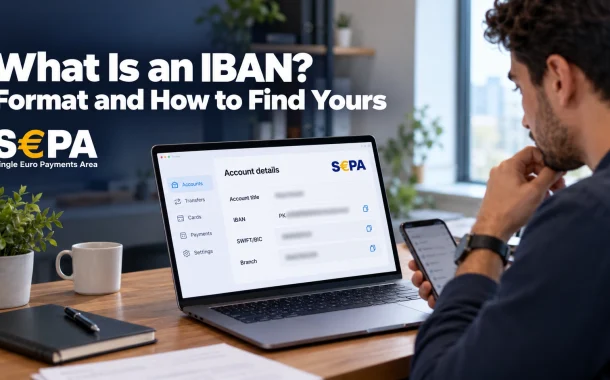
An IBAN is the international bank account number used across Europe, the Middle East, Pakistan, and about 89 countries in total. If you get paid from abroad, or pay someone overseas, it decides whether your money arrives the next day or bounces back two weeks later minus fees. So what is an IBAN, and what do you send when you don’t have one? The answer depends entirely on where your account is held.
An IBAN (International Bank Account Number) is a standard format for a bank account number, used in about 89 countries. It starts with a two-letter country code and two check digits, then the local bank and account number, up to 34 characters. Pakistan and the UK use IBANs. US accounts don’t, so Americans give a SWIFT code and account number.
Table of Contents
What Is an IBAN?
An IBAN is an International Bank Account Number: your normal account number, rewritten in one international format so any bank can read it. It became the ISO 13616 standard in 1997. Every IBAN starts with a country code and two check digits, followed by the bank and account details. It can be up to 34 letters and digits long.
Swift is the official registration authority for IBAN formats, and only a country’s central bank or national standards body can register one. That’s why every country’s IBAN looks a little different. A German IBAN has 22 characters, a French one 27, Norway’s is the shortest at 15, and Russia’s runs to 33.
How to Read an IBAN
| Part | German example | Pakistani example | What it means |
|---|---|---|---|
| Country code | DE | PK | The country where the account is held |
| Check digits | 89 | 00 (placeholder) | A math check that catches typos |
| Bank code | 37040044 | MUCB | Which bank holds the account |
| Account number | 0532013000 | 1234567890000001 | Your account, padded to a fixed length |
| Full IBAN | DE89 3704 0044 0532 0130 00 | PK00 MUCB 1234 5678 9000 0001 | 22 and 24 characters |
Paper Format vs Electronic Format
On invoices and statements, IBANs are printed in groups of four characters with spaces, like the examples above, so people can read them. When you type one into a banking app or payment form, leave the spaces out. Most forms strip them automatically, but some older ones reject an IBAN with spaces as “invalid”.
Which Countries Use IBANs?
About 89 countries use IBANs. That includes every EU and SEPA country, the UK, Switzerland, Türkiye, most of the Middle East, and Pakistan. A handful in Africa and Latin America, such as Egypt and Brazil, use them too. The US, Canada, Australia, New Zealand, India, and China don’t use IBANs for their accounts.
| Region | Uses IBAN | Doesn’t use IBAN |
|---|---|---|
| Europe | All EU and SEPA countries, the UK, Switzerland, Norway, Türkiye | None of note |
| Middle East | UAE, Saudi Arabia, Qatar, Kuwait, Bahrain, Oman, Jordan, Israel | None of note |
| South Asia | Pakistan | India, Bangladesh, Sri Lanka |
| Americas | Brazil, Costa Rica, Dominican Republic, Guatemala | United States, Canada, Mexico |
| Asia Pacific | Azerbaijan, Mongolia, Timor-Leste | China, Japan, Australia, New Zealand, Singapore |
| Africa | Egypt, Tunisia, Mauritius, Seychelles | Most others |
Why Europe Made IBANs Mandatory
Inside the Single Euro Payments Area, the IBAN is the only account detail you need for a euro transfer or direct debit. The European Commission’s SEPA rules made it mandatory so a payment from Germany to Spain works exactly like one inside Germany. Our guide to the Single Euro Payments Area covers how that system works across its 41 countries.
Does the US Have IBANs? What to Give Instead
No. US bank accounts don’t have IBANs, and no US bank can give you one. To receive an international wire into a US account, give the sender your bank’s SWIFT code and your account number. Add your full name and address, and your bank’s name and address. Domestic US payments use a nine-digit ABA routing number instead.
When a foreign form insists on an IBAN, there’s usually a second field labelled “account number” or “IBAN or account number”. Use that. If the form truly won’t accept anything else, ask the sender’s bank to process it as a SWIFT wire with your account number. That’s what my Lahore branch did in the end, once the officer found the right screen.
What a US Account Holder Gives a Foreign Sender
| Detail | Example format | Where to find it |
|---|---|---|
| SWIFT/BIC code | 8 or 11 characters, such as ABCDUS33 | Your bank’s international wire instructions page |
| Account number | Usually 8 to 17 digits | Your banking app or a check |
| Beneficiary name and address | Exactly as on your account | Your statement |
| Bank name and address | The branch or head office named in your bank’s wire instructions | Your bank’s website |
| Routing number | 9 digits | Some banks also ask for it, some don’t. Follow your bank’s instructions |
Can a US Business Get an IBAN?
Not from a US bank. But a US business can open a euro or pound account with a provider that issues IBANs, such as Wise, then share those details with European clients. That lets them pay by a cheap local SEPA transfer instead of an international wire. If you collect through Stripe, its bank transfer feature gives each customer a virtual IBAN. Our comparison of Stripe SEPA Direct Debit vs bank transfer walks through it.
Pakistan IBAN: Format and How to Find Yours
A Pakistani IBAN has 24 characters. It starts with PK, then two check digits, then the first four letters of your bank’s SWIFT code, then your account number padded to 16 digits. The State Bank of Pakistan required every bank to issue IBANs to customers by December 2012 and to use them for transfers from June 2013.
| Position | Characters | Example |
|---|---|---|
| Country code | 2 | PK |
| Check digits | 2 | Calculated by the bank using MOD 97-10 |
| Bank code | 4 | First four letters of the bank’s SWIFT code: HABB (HBL), MEZN (Meezan), UNIL (UBL), MUCB (MCB) |
| Account number | 16 | Your account number, with leading zeros added if it’s shorter |
Where to Find Your Pakistani IBAN
- Bank statement. SBP rules require banks to show the IBAN on account statements. It’s usually near the top, beside your account title.
- Mobile app or internet banking. Open your account details or account summary. Most apps show the IBAN with a copy button.
- Bank IBAN tools. Some banks offer an online IBAN generator or validator, such as Standard Chartered Pakistan’s bank code finder.
- Branch or helpline. Ask for an IBAN letter on bank letterhead. Some foreign clients and platforms ask for one as proof.
Using Your Pakistani IBAN to Get Paid From Abroad
Give a foreign client your PK IBAN, your bank’s full SWIFT code, your account title exactly as the bank holds it, and the branch address. The payment arrives as an international wire, not a SEPA transfer, because Pakistan isn’t in SEPA and PKR accounts can’t receive SEPA euros. If you’d rather withdraw platform earnings, see how a Stripe withdrawal to a Pakistani bank works, or whether you can transfer Stripe to Payoneer.
IBAN vs SWIFT Code vs Account Number vs Routing Number
An IBAN identifies one specific account. A SWIFT or BIC code identifies a bank, not an account. A routing number identifies a US bank for domestic payments. An account number identifies your account inside your own bank only. International transfers often need two of these together: an IBAN plus a SWIFT code, or an account number plus a SWIFT code.
| Code | Identifies | Length | Used for |
|---|---|---|---|
| IBAN | A specific account, in any IBAN country | Up to 34 characters (24 in Pakistan, 22 in the UK) | Transfers into IBAN countries, SEPA payments |
| SWIFT/BIC code | A bank or branch | 8 or 11 characters | International wires |
| ABA routing number | A US bank | 9 digits | US domestic transfers, ACH, direct deposit |
| Account number | An account inside one bank | Varies by bank | Domestic transfers, and wires to non-IBAN countries |
| UK sort code | A UK bank branch | 6 digits | UK domestic payments. Built into the UK IBAN |
Do You Need a SWIFT Code as Well as an IBAN?
It depends on the route. For a euro SEPA transfer between EEA accounts, the IBAN alone is enough. For an international wire, such as a payment from the US to Pakistan or from Dubai to the UK, the sender’s bank usually wants both. That means the IBAN and the receiving bank’s SWIFT code. When in doubt, give both. An extra correct detail never blocks a payment.
How to Check an IBAN Before You Pay
Every IBAN has two check digits that let a bank or validator spot a typo before the money moves. The check catches any single wrong character and almost every case of two swapped characters. It can’t tell you whether the account belongs to the person you mean to pay. For that, use the name check your bank offers.
- Copy the IBAN from the invoice or the recipient’s message instead of retyping it.
- Check the country code matches where the person banks. A UK supplier with a Lithuanian IBAN deserves a phone call.
- Check the length. PK should be 24 characters, GB 22, DE 22, FR 27.
- Let your banking app validate it. Most reject an IBAN with bad check digits on the spot.
- Read the name check result before you confirm.
Name Checks: Verification of Payee and Confirmation of Payee
Since October 2025, euro area banks must check the recipient’s name against the IBAN before any euro transfer, a service called Verification of Payee. UK banks run a similar check, Confirmation of Payee, for sterling payments inside the UK, though it doesn’t cover payments abroad. Treat a “no match” result as a stop sign. Banks warn that if you go ahead anyway, they may not be able to recover the money.
What Happens If You Use the Wrong IBAN?
An IBAN with a typo usually fails the check digits and gets rejected before the money leaves. An IBAN that’s valid but belongs to someone else is the real danger: the money usually lands in that account. Getting it back then depends on the other bank contacting the account holder and that person agreeing to return it.
| Mistake | What usually happens | What to do |
|---|---|---|
| Typo that breaks the check digits | Your bank rejects the IBAN before sending | Copy it again from the source |
| Valid IBAN, wrong name, payment by SWIFT | It may be returned, often minus fees, or credited anyway | Contact your bank the same day |
| Valid IBAN belonging to someone else | The money lands in that account | Ask your bank for a recall. The holder must agree to return it |
| Wrong SWIFT code but correct IBAN | Often delayed or returned | Ask your bank to amend or trace the payment |
Your Rights If You Send From the US
If you send an international transfer from the US as a consumer and you gave the wrong account number or IBAN, the CFPB’s remittance rule says your provider must promptly make reasonable efforts to recover the money. But if the provider warned you before payment that a wrong account number could cost you the transfer, you may lose it if recovery fails. Read that warning before you click through.
Is It Safe to Share Your IBAN?
Yes, mostly. Switzerland’s National Cyber Security Centre notes that an IBAN, even with a copy of your ID, isn’t enough to withdraw money from your account. The main risk is someone using it to set up a direct debit you didn’t approve. SEPA payers can claw those back for up to 13 months, so check your statements. See how to cancel a SEPA direct debit mandate if one appears.
Frequently Asked Questions
Quick answers to the IBAN questions that come up most often.
Is an IBAN the same as an account number?
Not quite. An IBAN contains your account number, plus a country code, two check digits, and a bank code, all in one international format. Your account number on its own only works inside your country or your bank. In Pakistan, for example, your 24-character IBAN wraps your normal account number, padded with zeros, after PK, the check digits, and four letters for your bank.
How do I find my IBAN number?
Look at your bank statement first. Banks in IBAN countries usually print it near the top. You’ll also find it under account details in your banking app or internet banking, often with a copy button. If you can’t see it, call your bank or visit a branch and ask for an IBAN letter. If your account is in the US, Canada, or Australia, you don’t have one.
Does Chase or Bank of America have an IBAN?
No. No US bank issues IBANs, including Chase, Bank of America, Wells Fargo, and Citi. To receive money from abroad, give the sender your bank’s SWIFT code, your account number, and your name and address exactly as on the account. Each bank publishes its own incoming international wire instructions, and some ask senders to include the routing number or an intermediary bank as well.
What is the IBAN format for Pakistan?
A Pakistani IBAN has 24 characters: PK, two check digits, four letters for the bank taken from its SWIFT code, then a 16-digit account number. HBL accounts carry HABB, Meezan accounts MEZN, UBL accounts UNIL, and MCB accounts MUCB. The State Bank of Pakistan set this format in 2012 and requires banks to show the IBAN on customer statements.
Do I need an IBAN to receive money from abroad?
Only if your account is in an IBAN country. If you bank in Pakistan, the UK, or Europe, the sender will need your IBAN and usually your bank’s SWIFT code. If you bank in the US, India, or Australia, you don’t have an IBAN, and you’ll give your account number and SWIFT code instead. Euro clients may prefer paying a euro IBAN from a provider like Wise.
Is an IBAN the same as a SWIFT code?
No. A SWIFT code, also called a BIC, identifies a bank, and it’s 8 or 11 characters long. An IBAN identifies one specific account at that bank, and it’s up to 34 characters. In Pakistan the two overlap slightly, because the IBAN includes the first four letters of the bank’s SWIFT code. International wires usually need both, so put both on every invoice you send abroad.
How many digits is an IBAN?
It depends on the country, up to a maximum of 34 characters. Pakistan and Saudi Arabia use 24, the UK and Germany 22, the UAE 23, France 27, and Norway only 15. IBANs mix letters and digits, so “characters” is more accurate than “digits”. If the one you’ve been given is the wrong length for its country code, check it with the sender.
Can someone steal money with my IBAN?
Not directly. An IBAN lets people pay you, not withdraw from your account. Switzerland’s National Cyber Security Centre says an IBAN and a copy of your ID aren’t enough to take money out. The realistic risk is a fraudulent direct debit, which you can dispute with your bank. Check your statements, and never share online banking passwords or one-time codes.
Can I use an IBAN to pay someone in the US?
No, because the US recipient doesn’t have one. Ask for their bank’s SWIFT code, their account number, their full name and address, and the bank’s address. If your bank’s form has a mandatory IBAN field, look for an “account number” option or ask the branch to process it as a SWIFT wire. Check whether their bank also wants the routing number included.
Does my IBAN change if I change branch?
Sometimes. Your IBAN is built from your account number, so if moving branches gives you a new account number, your IBAN changes too. If the bank keeps your account number, your IBAN stays the same. After any change, update the IBAN with clients, employers, and platforms that pay you. Keep the old account open until the first payment lands in the new one.
Know Which Number You Actually Have
The Texas payment went through two days later. The branch processed it as a SWIFT wire with the developer’s account number and his bank’s SWIFT code, and the IBAN box stayed empty. Since then, our onboarding form for overseas contractors asks one question first: which country is your account in? The answer tells us whether to ask for an IBAN at all.
The short answer to “what is an IBAN” is that it’s your account number in an international format. If your account is in Pakistan, the UK, or Europe, you have one, and it belongs on every invoice next to your SWIFT code. If it’s in the US, you don’t, and no form can make one exist. Give the SWIFT code and account number, or open a euro account if European clients want to pay locally. Either way, put the right details on the invoice before the client has to ask. Which of your clients is still struggling with a form that asks for a number you don’t have?