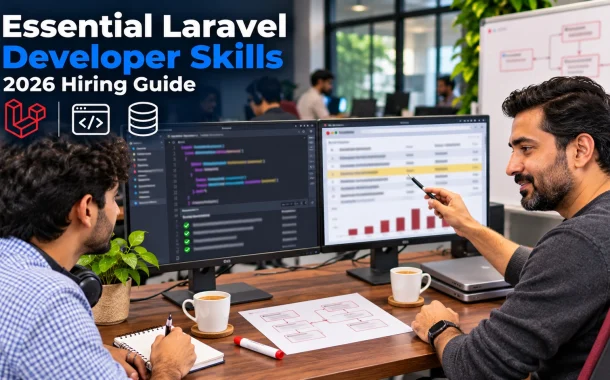
That gap is what Laravel developer skills really come down to. Knowing the framework’s syntax is the starting point, not the finish line. A strong developer understands PHP deeply, writes clean architecture, tests their code, builds secure APIs and can deploy and monitor an app in production. Below we cover the essential skills every dedicated Laravel developer should have, what separates junior, mid and senior developers, a practical Laravel developer roadmap for 2026 and how to assess skills when you’re hiring.
Quick answer: The essential Laravel developer skills are modern PHP, Laravel fundamentals like routing, Blade and Eloquent, database design and query optimization, testing with Pest or PHPUnit, secure API development with Sanctum, queues and caching, frontend integration with Livewire, Inertia or Vue, Git, deployment and security. Senior developers add architecture, performance tuning and team leadership.
Table of Contents
What Makes a Great Laravel Developer?
A great Laravel developer combines strong PHP knowledge with a deep understanding of how Laravel works under the hood. They follow the framework’s conventions, write code that’s easy to test and change and think about performance, security and deployment from the start. Business understanding and communication matter as much as technical skill.
Laravel Developer Skills Overview
| Skill area | Why it matters |
|---|---|
| Modern PHP | Laravel is built on it, and every feature depends on it |
| Laravel fundamentals | Routing, middleware, Blade, Eloquent and service container |
| Databases | Schema design, migrations, indexes and query optimization |
| Testing | Pest or PHPUnit tests prevent regressions |
| APIs | Clean, secure endpoints for apps and integrations |
| Performance | Queues, caching and fewer database queries |
| Deployment | Shipping safely with CI/CD and monitoring |
| Soft skills | Clear communication with clients and teams |
Why Skills Matter More in 2026
Laravel 13, released in March 2026, requires PHP 8.3 or newer. According to BuiltWith, Laravel powers hundreds of thousands of live websites, so employers expect developers who keep up with new versions instead of maintaining old habits.
Core Laravel Developer Skills: PHP and Fundamentals
Every Laravel developer skill builds on modern PHP and the framework’s core concepts. Developers should be comfortable with PHP 8.3 features, object-oriented programming and Composer, then understand routing, controllers, middleware, Blade, validation and the service container. Without these basics, advanced Laravel features become guesswork.
PHP Skills Every Laravel Developer Needs
| PHP skill | Where it shows up in Laravel |
|---|---|
| Classes, interfaces and traits | Models, services and contracts |
| Namespaces and Composer | Packages and autoloading |
| Typed properties and enums | Cleaner models and casts |
| Closures and collections | Query building and data handling |
| Readonly properties and match | Modern, safer business logic |
Laravel Fundamentals
Strong developers understand the request lifecycle, use Form Request classes for validation, rely on dependency injection through the service container and keep controllers thin. If you’re starting out, our guide on how to install the Laravel PHP framework covers setup.
Database and Eloquent Skills
Database skills separate average Laravel developers from strong ones. A skilled developer designs normalized schemas, writes reversible migrations, uses Eloquent relationships correctly and spots the N+1 query problem before users feel it. They also know when raw queries or database indexes are better than more Eloquent code.
Key Database Skills
| Skill | What good looks like |
|---|---|
| Migrations and seeders | Repeatable, version-controlled schema changes |
| Eloquent relationships | hasMany, belongsToMany and polymorphic relations used correctly |
| Eager loading | with() to avoid N+1 queries |
| Indexes | Indexes on columns used in filters and joins |
| Transactions | Multi-step writes that succeed or fail together |
| Other databases | MySQL, PostgreSQL and MongoDB when needed |
Finding Slow Queries
We use Laravel Debugbar and Telescope on every project to see query counts per page. Our Laravel Debugbar setup guide shows how, and our post on using MongoDB with Laravel covers non-relational data.
Testing, Debugging and Code Quality
Testing is one of the clearest signs of a dedicated Laravel developer. Laravel ships with Pest and PHPUnit support, and good developers write feature tests for important user flows, unit tests for business logic and tests for every bug they fix. Clean code standards keep the codebase easy for the whole team to change.
Testing and Quality Tools
| Tool | Use |
|---|---|
| Pest or PHPUnit | Feature and unit tests |
| Laravel Dusk | Browser testing |
| Laravel Pint | Automatic code style formatting |
| Larastan or PHPStan | Static analysis to catch bugs early |
| Telescope and Debugbar | Debugging requests, queries and jobs |
What We Look For
We ask candidates to write a feature test for a small endpoint. Strong developers test the happy path, validation errors and permissions without being asked.
API Development and Security Skills
Most Laravel projects today power mobile apps, single-page apps or third-party integrations, so API skills are essential. Developers should build RESTful endpoints with API resources, authenticate with Sanctum or Passport, add rate limiting and version their APIs. Security has to be built in from the first line of code.
API and Security Checklist
| Area | Skill |
|---|---|
| Authentication | Sanctum for SPAs and mobile, Passport for OAuth |
| Authorization | Policies and gates for every action |
| Validation | Form Requests on every input |
| Rate limiting | Throttle middleware on public endpoints |
| Output | API Resources for consistent responses |
| Common risks | SQL injection, XSS, CSRF and mass assignment |
Follow Security Standards
The OWASP Top 10 lists the most common web application risks. Laravel protects against many by default, but only when developers use its features correctly instead of working around them.
Performance, Queues and the Laravel Ecosystem
Performance skills keep Laravel apps fast as traffic grows. Dedicated developers move slow work like emails and reports into queues, cache expensive queries and use the official ecosystem tools instead of building everything from scratch. Knowing the right package saves weeks of development time.
Laravel Ecosystem Tools
| Tool | What it does |
|---|---|
| Horizon | Monitors Redis queues |
| Octane | Boosts performance with long-running servers |
| Scout | Full-text search |
| Cashier | Stripe and Paddle subscriptions |
| Reverb | Real-time WebSockets |
| Filament or Nova | Admin panels |
| Forge, Vapor and Laravel Cloud | Server management and hosting |
Frontend Integration
Laravel developers should also handle frontend integration with Livewire, Inertia with Vue or React and Vite for assets. The official starter kits in recent Laravel versions use these tools, so full-stack awareness is now expected.
DevOps, Git and Deployment Skills
A Laravel app isn’t finished until it runs reliably in production. Dedicated developers use Git branching and pull requests, automate tests with GitHub Actions or GitLab CI, deploy with zero downtime and monitor errors after release. These skills prevent late-night emergencies and make teams faster.
Deployment Skills
| Skill | Tools |
|---|---|
| Version control | Git, GitHub, GitLab and Bitbucket |
| CI/CD | GitHub Actions, GitLab CI |
| Hosting and deployment | Laravel Forge, Envoyer, Laravel Cloud, Docker |
| Environment management | .env files and secrets management |
| Monitoring | Sentry, Laravel Pulse and logs |
Learn the Full Workflow
Our guide on how to start a Laravel project walks through setup, and our post on remote development teams shows how we ship with distributed developers.
Laravel Developer Skills Roadmap: Junior to Senior
Laravel developer skills grow in clear stages. Juniors focus on PHP and framework basics, mid-level developers handle features end to end, and senior developers own architecture, performance and team decisions. Use this roadmap to plan learning or set expectations when hiring a dedicated Laravel developer.
Skills by Level
| Level | Typical skills |
|---|---|
| Junior | PHP basics, routing, Blade, Eloquent CRUD, Git basics |
| Mid-level | APIs, queues, testing, relationships, debugging, deployment |
| Senior | Architecture, performance tuning, security reviews, CI/CD, mentoring |
| Lead | Technical planning, code review standards, hiring and client communication |
Essential Skills Every Senior Laravel Developer Must Master
Senior developers design systems that stay maintainable for years, choose between service classes, actions and domain-driven design, profile performance under real traffic and review code for security. They also explain trade-offs clearly to clients and product managers.
How to Assess Laravel Developer Skills When Hiring
To assess Laravel developer skills, combine a short practical task with a code review conversation. CVs and certificates say little on their own. Ask candidates to explain past decisions, fix a real bug and write a small tested feature. This shows how they think, instead of just what they remember.
Our Hiring Process
- Review GitHub, past projects or code samples.
- Run a 60-minute paid task, such as building a small API endpoint with tests.
- Ask them to find an N+1 query in sample code.
- Discuss security, queues and deployment with real scenarios.
- Check communication with a short client-style explanation.
Hiring Options
If you’re hiring dedicated Laravel developers, compare in-house hiring, freelancers and dedicated teams on cost, availability and long-term support.
FAQs
Here are answers to common questions about Laravel developer skills.
What skills does a Laravel developer need?
A Laravel developer needs modern PHP, Laravel fundamentals like routing, middleware, Blade and Eloquent, database design, testing with Pest or PHPUnit, API development with Sanctum, queues and caching, Git and deployment skills. Frontend integration with Livewire, Inertia or Vue and a strong understanding of web security are also expected in 2026. Soft skills like communication matter as much as code, because strong developers explain trade-offs clearly.
What are the top Laravel skills employers look for?
Employers look for clean Eloquent usage, testing habits, secure API development, query optimization, queue handling and deployment experience. They also value Git workflow, clear communication and experience with ecosystem tools like Horizon, Filament and Laravel Cloud. Real projects and tested code samples count more than listing Laravel on a CV, and open source contributions help too.
What skills should a senior Laravel developer master?
A senior Laravel developer should master application architecture, performance profiling, caching and queue strategy, database optimization, security reviews, CI/CD pipelines and mentoring. They make decisions about patterns such as service classes or domain-driven design, review other developers’ code and explain technical trade-offs clearly to clients and managers. Good seniors also keep up with every major Laravel release and share what they learn.
Is Laravel still in demand in 2026?
Yes. Laravel remains one of the most popular PHP frameworks, powering hundreds of thousands of live websites and many SaaS products. Regular releases, an official hosting platform and a large ecosystem keep demand steady for developers who know modern Laravel, testing and deployment, beyond basic CRUD applications. Laravel 13 and Laravel Cloud show the framework keeps growing, and skilled developers remain in short supply.
How long does it take to learn Laravel?
With solid PHP skills, most developers can build basic Laravel apps within a few weeks and handle production features within several months. Getting comfortable with testing, queues, APIs, performance and deployment usually takes one to two years of real project work. Building and shipping a few complete projects speeds up learning the most. Laracasts and the official docs are good starting points.
What is a Laravel developer roadmap?
A Laravel developer roadmap is a learning path from PHP basics to advanced framework skills. It usually starts with PHP, Composer and Git, then routing, Blade and Eloquent, then APIs, testing and queues, and finally architecture, performance, security and DevOps. Following it step by step avoids gaps in key skills. Pick one area at a time, build something with it and revisit the roadmap as new versions add features.
Do Laravel developers need frontend skills?
Yes, at least basic frontend skills. Most Laravel projects use Blade with Livewire, or Inertia with Vue or React, and Vite to build assets. Developers don’t need to be designers, but they should handle forms, components and API data in the frontend. Full-stack Laravel developers are especially valuable for small teams. Basic CSS and JavaScript go a long way, and Livewire lets many developers stay mostly in PHP.
How do I test a Laravel developer’s skills?
Give a short paid task, such as building a tested API endpoint, then review the code together. Ask them to spot an N+1 query, explain how they would secure an endpoint and describe a deployment they managed. This shows real problem-solving, code quality and communication better than quiz questions or certificates. Keep the task close to your real project, and pay for it to respect their time.
Conclusion
Essential Laravel developer skills go well beyond knowing the framework’s syntax. Strong developers combine modern PHP, Laravel fundamentals, database and Eloquent expertise, testing, secure APIs, queues, caching, frontend integration and reliable deployment. Senior developers add architecture, performance tuning, security reviews and mentoring to that foundation.
The three developers we hired for that SaaS rebuild stood out because they tested their code, understood queries and thought about production from day one. Use the roadmap to plan your own learning or set hiring expectations, and assess candidates with real tasks instead of CV keywords. Keep learning with each new Laravel release, write tests for every important feature and review your code with teammates, because steady habits matter more than any single framework trick. If you are hiring, define the level you need before you start interviews. Which Laravel skill will you strengthen or test for first?