


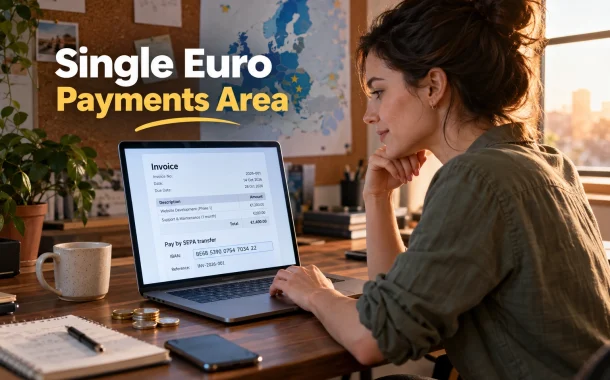
The Single Euro Payments Area, or SEPA, is the system behind that request. It lets anyone in 41 European countries send and collect euros the same way they pay at home. For a business in the US or Pakistan, it’s the difference between waiting a week on a wire and getting paid by tomorrow morning. And since 2025, the rules have changed again, with instant euro transfers now standard across the euro area.
SEPA, the Single Euro Payments Area, is a set of shared rules for euro payments. It lets people and businesses in 41 European countries send, receive, and collect euros as easily as at home. It covers credit transfers, instant transfers, and direct debits, using just an IBAN. Banks can’t charge more for a cross-border euro payment than a domestic one.
Table of Contents
What Is the Single Euro Payments Area (SEPA)?
The Single Euro Payments Area (SEPA) is a common set of standards for cashless euro payments across Europe. It makes a euro transfer from Germany to Spain work like a transfer inside Germany: same format, same speed rules, same fees. SEPA covers credit transfers, instant transfers, direct debits, and card payments in euro.
SEPA stands for Single Euro Payments Area. You’ll also see it written as “Single European Payments Area,” which is a common mix-up. The European Commission describes it as a framework that “harmonises the way cashless euro payments are made across Europe.” In plain terms, it removed the difference between a domestic and a cross-border euro payment.
Who Runs SEPA
Two groups share the job. EU lawmakers set the legal rules, mainly through the SEPA Regulation (EU) No 260/2012 and the 2024 Instant Payments Regulation. The European Payments Council (EPC), a banking industry body, writes the scheme rulebooks that banks sign up to. Your bank follows both.
A Short History of SEPA
- 2008: the SEPA Credit Transfer scheme launches.
- 2009: SEPA Direct Debit follows.
- August 2014: euro area countries must move all euro transfers and debits to SEPA formats.
- 2017: SEPA Instant Credit Transfer goes live.
- 2024: the Instant Payments Regulation makes instant transfers mandatory, with deadlines running to 2027.
What SEPA Means on a Bank Statement or Invoice
On a statement, “SEPA” tells you how the money moved. “SEPA CT” or “SEPA transfer” means someone sent you euros. “SEPA DD” means a business pulled euros from your account under a mandate. On an invoice, “pay by SEPA” means the sender wants your IBAN so they can push euros to you through their bank.
Which Countries Are in the SEPA Zone?
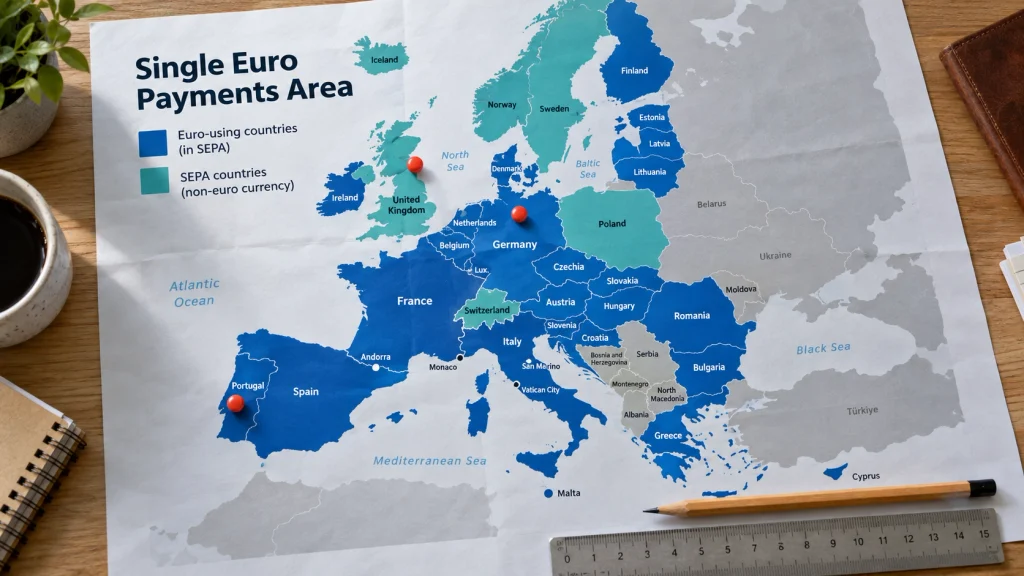
The SEPA zone covers 41 countries: the 27 EU member states, the three other EEA countries (Iceland, Liechtenstein, Norway), and 11 non-EEA countries including the United Kingdom and Switzerland. Several territories are included too, such as Jersey, Guernsey, and the Isle of Man. Being in SEPA doesn’t mean a country uses the euro.
The list below follows the European Payments Council’s official list of SEPA scheme countries, version 8.0 from December 2025. It’s the reference banks use.
| Group | Countries | Uses the euro? |
|---|---|---|
| EU, euro area (21) | Austria, Belgium, Bulgaria, Croatia, Cyprus, Estonia, Finland, France, Germany, Greece, Ireland, Italy, Latvia, Lithuania, Luxembourg, Malta, Netherlands, Portugal, Slovakia, Slovenia, Spain | Yes |
| EU, outside the euro area (6) | Czech Republic, Denmark, Hungary, Poland, Romania, Sweden | No (CZK, DKK, HUF, PLN, RON, SEK) |
| Other EEA (3) | Iceland, Liechtenstein, Norway | No |
| Non-EEA (11) | Albania, Andorra, Moldova, Monaco, Montenegro, North Macedonia, San Marino, Serbia, Switzerland, United Kingdom, Vatican City State | Mixed. Andorra, Monaco, Montenegro, San Marino and Vatican City use the euro. The rest don’t |
| Territories | Guernsey, Jersey, Isle of Man, Saint-Pierre-et-Miquelon, plus regions such as the Azores, Madeira, the Canary Islands, Gibraltar, Åland and the French overseas departments | Varies |
Is the UK Still in SEPA After Brexit?
Yes. The United Kingdom left the EU but stayed in the SEPA schemes as a non-EEA country. UK banks can still send and receive SEPA euro payments. The catch is that payments between the UK and EU now need a little more data, such as the payer’s address, because the UK sits outside the EU’s legal area.
Which Countries Joined SEPA Recently?
The Western Balkans and Moldova are the newest additions. Albania, Moldova, Montenegro, North Macedonia, and Serbia now appear on the EPC list, bringing the total to 41. Bulgaria also moved into the euro area column after adopting the euro in January 2026. Turkey, Ukraine, and the US are not SEPA countries.
The Four Types of SEPA Payments
SEPA has four main payment schemes. SEPA Credit Transfer (SCT) is a standard push payment that arrives by the next business day. SEPA Instant Credit Transfer (SCT Inst) arrives in seconds, around the clock. SEPA Direct Debit Core and SEPA Direct Debit B2B let a business pull euros from a customer’s account with permission.
| Scheme | Who starts it | Speed | Typical use |
|---|---|---|---|
| SEPA Credit Transfer (SCT) | The payer | By the end of the next business day | Invoices, salaries, rent |
| SEPA Instant Credit Transfer (SCT Inst) | The payer | About 10 seconds, 24/7, every day of the year | Urgent payments, person-to-person |
| SEPA Direct Debit Core (SDD Core) | The business, with a mandate | Set collection date | Subscriptions, utilities, gyms |
| SEPA Direct Debit B2B (SDD B2B) | The business, with a mandate | Set collection date | Business-to-business invoices |
SEPA Credit Transfer: the Standard SEPA Bank Transfer
This is what most people mean by a “SEPA transfer” or “SEPA bank transfer.” You enter the recipient’s name and IBAN, and the money lands by the end of the next business day under EU payment rules. It’s the workhorse of the system. The EPC says more than 29 billion SCT transactions run every year.
SEPA Instant Credit Transfer
SEPA Instant Payments move money in seconds, at any hour, including weekends and holidays. The EPC scheme now sets a maximum of nine seconds, inside the 10-second limit in EU law. There’s no longer a scheme-wide maximum amount, though your bank can set its own limit. If you want to read more, the EPC’s SCT Inst page has the full rules.
SEPA Direct Debit Core and B2B
Direct debits flip the direction. The customer signs a mandate once, and the business collects on schedule. Core works for consumers and businesses and gives payers an eight-week refund right. B2B is only for business payers and has no refund on authorized debits. For the full walkthrough, see how to set up and cancel a SEPA direct debit mandate.
How Does a SEPA Payment Work?
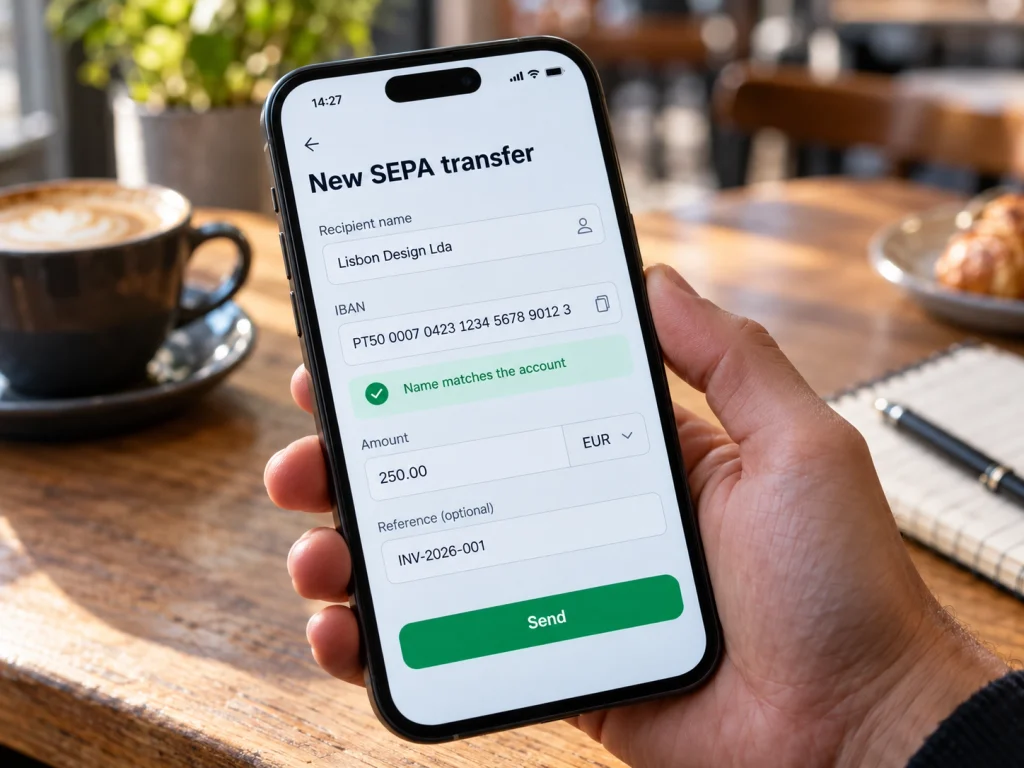
A SEPA payment needs only the recipient’s name and IBAN, plus an amount in euros. Your bank sends it through a clearing system to the recipient’s bank, which credits the account by the next business day, or within seconds for an instant transfer. You don’t need a BIC or SWIFT code for payments inside the EEA.
What Is an IBAN?
An IBAN, or International Bank Account Number, identifies one bank account anywhere in SEPA. It starts with a two-letter country code and two check digits, followed by the domestic account details. A German IBAN has 22 characters, and the longest IBANs reach 34. The check digits catch most typos before a payment leaves your bank.
| Part of the IBAN | Example | What it tells the bank |
|---|---|---|
| Country code | DE | The account is held in Germany |
| Check digits | 89 | A math check that catches typos |
| Bank code | 37040044 | Which bank holds the account |
| Account number | 0532013000 | The specific account |
Verification of Payee: the New Name Check
Since 9 October 2025, banks in the euro area must check the recipient’s name against the IBAN before you send. You’ll see a result like “match,” “close match,” or “no match.” This check is free by law and applies to standard and instant transfers. It’s there to stop misdirected payments and invoice fraud, so pay attention to a “no match” warning.
How Long Does a SEPA Transfer Take, and What Does It Cost?
A standard SEPA transfer arrives by the end of the next business day. A SEPA instant transfer arrives in about 10 seconds. On cost, EU law says a bank can’t charge more for a cross-border euro payment than for the same domestic one, and instant transfers can’t cost more than standard ones. Many charge nothing.
Here’s the catch. SEPA isn’t free by law. The rule is equal pricing, not zero pricing. If your bank charges €0.50 for a domestic transfer, it can charge €0.50 for a SEPA transfer to Italy. And the euro area rule doesn’t stop a bank in Poland or Sweden from charging for a euro payment from a local-currency account.
Why a SEPA Transfer Can Feel Slow
- You sent it after your bank’s daily cut-off time, so it counts from the next business day.
- A weekend or bank holiday sits in the middle. Standard SEPA doesn’t run on non-business days.
- The receiving bank holds the payment for a fraud or sanctions check.
- The money went to a non-euro account and needed a currency conversion first.
The Instant Payments Deadlines, 2025 to 2027
The Instant Payments Regulation rolls out in stages. Countries using the euro went first. Countries outside the euro area get until 2027.
| Requirement | Euro area banks | Non-euro area EU banks |
|---|---|---|
| Receive instant payments | 9 January 2025 | 9 January 2027 |
| Send instant payments | 9 October 2025 | 9 July 2027 |
| Verification of Payee | 9 October 2025 | 9 July 2027 |
| Instant costs no more than standard | 9 January 2025 | 9 January 2027 |
So if a Danish or Polish client says their bank “doesn’t do instant yet,” they may be right until mid-2027. Payment and e-money institutions, the licence many fintech apps hold, have until April 2027 to send instant euro payments in the euro area.
SEPA vs SWIFT vs ACH: What’s the Difference?
SEPA moves euros inside Europe, cheaply and by the next business day. SWIFT is a global messaging network that moves any currency between countries, often through intermediary banks that each take a fee. ACH is the US equivalent of SEPA for domestic dollar payments. A US dollar account can’t join SEPA directly.
| Feature | SEPA | SWIFT wire | US ACH |
|---|---|---|---|
| Currency | Euro only | Almost any | US dollar |
| Area | 41 European countries | Worldwide | United States |
| Account detail needed | IBAN | IBAN or account number plus BIC/SWIFT code | Routing number plus account number |
| Standard speed | Next business day, or seconds with SCT Inst | Often 1 to 5 business days | Same day to 2 business days |
| Fees | Same as domestic, often free | Sender, intermediary and receiver fees possible | Low or free |
| Instant option | SEPA Instant | No | FedNow and RTP |
When SWIFT Is Still the Right Choice
Use SWIFT when the money isn’t in euros, or when one side is outside the SEPA zone. A Pakistani rupee payment to Germany, or a dollar payment to France, can’t go through SEPA. You’ll pay more and wait longer, which is why so many freelancers and agencies open a euro account instead.
Can You Use SEPA From the US, Pakistan, or Outside Europe?
Not directly. SEPA only works between euro accounts held in SEPA countries. But a business in the US, Pakistan, or anywhere else can open a euro account with a SEPA IBAN through a provider such as Wise. It can also collect SEPA payments through Stripe. That lets European clients pay you as if you were local.
At Webzeto, we bill EU clients from Lahore, and the euro account changed our collections more than any invoice template did. Clients who sat on SWIFT invoices for weeks paid within days once we gave them an IBAN they recognized. The table below shows the main routes and what each one suits.
| Route | What you get | Best for | Watch out for |
|---|---|---|---|
| Wise EUR account details | A euro IBAN that receives local euro transfers with no receiving fee | Freelancers and agencies receiving invoice payments | SWIFT payments in EUR cost a flat €2.39 to receive. Some EU banks ask for a French or German IBAN, which Wise doesn’t issue |
| Stripe SEPA Direct Debit | Collect euros from customers’ accounts on a schedule | Subscriptions, SaaS, online courses | US price is 0.8% + 30¢, capped at $6.00, with funds settling in about 6 business days |
| Payoneer and similar | Multi-currency receiving, including EUR | Marketplace and platform payouts | Check the euro account fees and country availability for your location before you share details |
| A European business bank account | Full SEPA access, including direct debits | Companies with an EU entity | Usually needs an EU company and local paperwork |
Getting Paid in Euros as a Freelancer or Agency
For invoice payments, a euro IBAN is usually enough. Put it on the invoice with your legal name exactly as the provider shows it, because Verification of Payee will flag a mismatch. Then decide when to convert to dollars or rupees. If Payoneer is part of your setup, read whether you can transfer Stripe to Payoneer before you plan your withdrawals.
Collecting SEPA Payments as a US Business
For recurring billing, use SEPA Direct Debit through Stripe. US Stripe accounts can accept it, and Stripe generates the mandate for you. See how to turn on SEPA Direct Debit in Stripe, check Stripe payout times in the EU, and compare costs in how Stripe and PayPal fees compare. Remote workers juggling several currencies may also want our remote developer tax and banking checklist.
Is SEPA Safe? Fraud, Refunds, and Your Rights
SEPA is safe, but the two directions carry different risks. A SEPA direct debit gives the payer strong refund rights: eight weeks for any Core debit and 13 months if it was unauthorized. A SEPA credit transfer you send yourself is close to final. Getting it back depends on the recipient’s bank and, often, the recipient.
The Invoice Fraud Pattern to Watch For
The most common SEPA scam is an email that “updates” a supplier’s IBAN. The invoice looks right, the amount is right, and the money goes to a fraudster. Verification of Payee helps, because the new IBAN won’t match the supplier’s name. Even so, confirm any bank detail change by phone using a number you already have, never one from the email.
What to Do If You Sent a SEPA Transfer by Mistake
- Call your bank right away and ask for a recall of the payment.
- Give the date, amount, and the IBAN you sent it to.
- If it was fraud, report it to your bank and the police the same day.
- If you know the recipient, ask them to send it back directly. That’s often faster than a bank recall.
Frequently Asked Questions
Short answers to the SEPA questions that come up most often.
What does SEPA stand for?
SEPA stands for Single Euro Payments Area. It’s the set of rules and standards that lets people and businesses in 41 European countries make cashless euro payments under the same conditions as domestic ones. The term is sometimes written as “Single European Payments Area,” but the official name uses “Euro,” because the system only handles payments in euros.
How many countries are in SEPA?
There are 41 SEPA countries under the European Payments Council’s December 2025 list. That’s the 27 EU member states plus Iceland, Liechtenstein and Norway. Then come 11 non-EEA countries: Albania, Andorra, Moldova, Monaco, Montenegro, North Macedonia, San Marino, Serbia, Switzerland, the United Kingdom, and Vatican City. Several territories, such as Jersey and Guernsey, are also covered.
Is Switzerland in SEPA?
Yes. Switzerland is a SEPA country even though it isn’t in the EU and uses the Swiss franc. Swiss banks can send and receive SEPA euro payments from euro accounts. A payment from a Swiss franc account to an EU euro account involves a currency conversion first, so check your bank’s exchange rate and fee before you send.
Is a SEPA transfer free?
Often, but not always. EU law requires banks to charge the same for a cross-border euro payment as for the same domestic one, and instant transfers can’t cost more than standard ones. If your bank’s domestic transfers are free, your SEPA transfers are free too. If it charges for domestic transfers, it can charge the same amount for SEPA.
How long does a SEPA transfer take?
A standard SEPA Credit Transfer reaches the recipient’s bank by the end of the next business day. A SEPA Instant transfer arrives in about 10 seconds, at any time, every day of the year. Delays usually come from cut-off times, weekends, bank holidays, or a fraud check. Banks outside the euro area have until July 2027 to offer instant sending.
Do I need a BIC or SWIFT code for a SEPA payment?
No, not for payments within the EEA. The IBAN alone is enough, because it already identifies the country and the bank. Some banks still show a BIC field, and a few providers ask for it on payments to non-EEA SEPA countries such as Switzerland or the UK. If a form asks for it, the recipient’s bank can give it to you.
What is a SEPA account?
A SEPA account is any euro bank or payment account with an IBAN from a SEPA country. It can send and receive SEPA credit transfers and, if the provider supports it, direct debits. Non-Europeans can get one through providers such as Wise. Under the SEPA Regulation, a business in one EU country shouldn’t refuse a euro IBAN from another EU country.
Can I send a SEPA payment from a US bank account?
Not directly. A US dollar account sits outside SEPA, so your bank will send an international wire instead. To pay or get paid in euros the SEPA way, you need a euro account with a SEPA IBAN, such as one from Wise. Then you fund it in dollars, convert to euros, and send a normal SEPA transfer from that account.
What is the difference between SEPA and SEPA Instant?
Both are euro credit transfers using an IBAN. A standard SEPA transfer arrives by the next business day and only runs on business days. SEPA Instant arrives in about 10 seconds, 24 hours a day, including weekends. Since 2025, euro area banks must offer instant transfers and can’t charge more for them than for standard ones.
Is SEPA the same as the eurozone?
No. The eurozone is the 21 EU countries that use the euro as their currency. SEPA is wider, at 41 countries, and includes places like Sweden, Poland, the UK, and Switzerland that use their own currencies. In those countries, SEPA payments only work from euro accounts, which is why the payment must always be in euros.
Getting Paid the Local Way
Danny sorted out his Lisbon invoice in an afternoon. He opened a euro account, put the new IBAN on the invoice, and his client’s SEPA transfer landed the next morning, with no wire fees on either side. He’s since added two more European clients and hasn’t sent a SWIFT payment request since. That’s the real value of the Single Euro Payments Area for anyone outside Europe. You don’t have to join it. You just need an account that speaks its language.
For people inside Europe, SEPA keeps getting faster. Instant transfers are now standard in the euro area, name checks block misdirected payments, and the last non-euro countries catch up by 2027. Whether you send, receive, or collect by direct debit, the rules are the same in all 41 countries. Which of your European clients are still paying you the slow, expensive way?