


The reverse happens too. Developers push clients toward Stripe because it has cleaner docs and a better API, without ever checking whether PayPal’s buyer network would have meaningfully lifted conversion on that particular checkout page. Both choices cost money in different ways.
This guide draws on six years of hands-on work migrating e-commerce clients between payment processors, reviewing real merchant statements, and running fee analysis for businesses ranging from $3,000 to $400,000 in monthly volume. Every case study below is drawn from real merchant accounts, shared with client permission, with identifying details anonymized where requested.
Table of Contents
What Are the Base Transaction Fees for Stripe and PayPal in 2026?
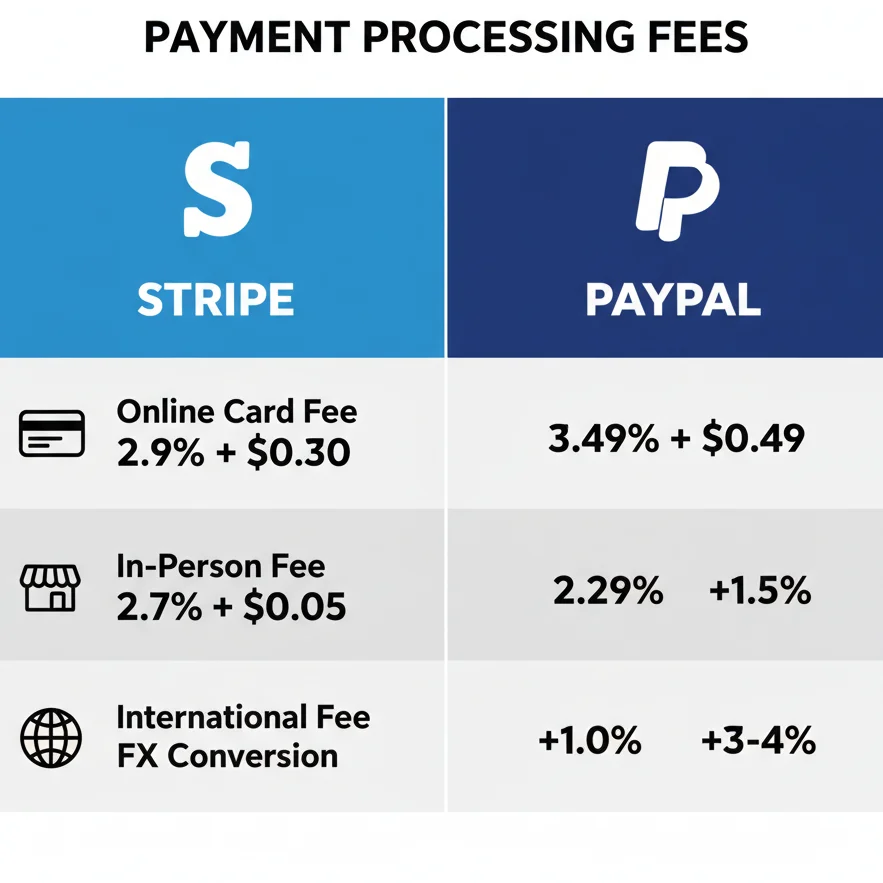
Quick Answer: Stripe charges 2.9% + $0.30 per successful card transaction online. PayPal charges 3.49% + $0.49 for standard card checkout, dropping to 2.99% + $0.49 when customers pay via PayPal Wallet. For in-person payments, Stripe charges 2.7% + $0.05 and PayPal charges 2.29% + $0.09.
Those headlines hide a lot. Here is the full fee picture side by side:
| Transaction Type | Stripe | PayPal |
|---|---|---|
| Standard card (online) | 2.9% + $0.30 | 3.49% + $0.49 |
| PayPal Wallet checkout | N/A | 2.99% + $0.49 |
| In-person (card present) | 2.7% + $0.05 | 2.29% + $0.09 |
| ACH bank transfer | 0.8% (max $5.00) | 0% (PayPal balance transfers) |
| Manual card entry (keyed) | 3.4% + $0.30 | 3.49% + $0.49 |
| Invoicing (paid by card) | 2.9% + $0.30 | 3.49% + $0.49 |
| International card (online) | +1.5% surcharge | +1.5% surcharge |
| Currency conversion | +1% fee (transparent) | +3–4% spread (hidden in rate) |
Fee data sourced directly from Stripe’s pricing page and PayPal’s merchant fees page as of April 2026.
The table already surfaces something important. If your customers mostly pay with credit cards online, Stripe is cheaper out of the gate. But the conversion rate argument for PayPal is real and worth quantifying: according to PayPal’s own merchant research (2024 Commerce Report), merchants offering PayPal Wallet as a checkout option see conversion rate improvements of 8% to 82% depending on their industry and customer demographic. A higher conversion rate with slightly higher fees can still net more revenue — the math depends entirely on your specific customer mix.
Stripe vs PayPal Fees for Small Transactions
That fixed fee component — $0.30 for Stripe, $0.49 for PayPal — punishes small transactions disproportionately. This is where businesses selling low-priced digital products, subscriptions under $10, or tips get hurt badly, and it is almost never discussed clearly in fee comparisons.
On a $3.00 transaction:
- Stripe takes $0.39 in fees → 13% effective rate
- PayPal takes $0.59 → 19.6% effective rate
For a digital creator selling a $3 template, that difference compounds fast across thousands of sales.
Stripe offers a microtransaction pricing model for qualifying businesses at 5% + $0.05 per transaction — this requires contacting Stripe sales directly to apply, as it is not available through the standard dashboard. It dramatically improves unit economics at low price points. PayPal has no comparable published program for small merchants.
Case Study — Digital Creator
(Q4 2024 → Q1 2026, shared with permission)
A graphic designer selling Canva templates at $3.99 each processed 4,200 sales in Q4 2024 through PayPal. Her effective fee rate worked out to 18.3% per transaction. After switching to Stripe’s microtransaction model in January 2026, the same volume dropped her effective rate to 6.6%. On 4,200 transactions at $3.99, that translated to approximately $974 in recovered revenue per quarter.
| Metric | PayPal | Stripe Micro Rate |
|---|---|---|
| Effective rate per transaction | 18.3% | 6.6% |
| Quarterly fee total (4,200 sales) | ~$306 | ~$111 |
| Quarterly savings | — | $974 |
What Hidden Fees Do Stripe and PayPal Charge?
Quick Answer: Both platforms charge fees well beyond their advertised rates. Stripe charges for instant payouts (1.5%, min $0.50), advanced fraud tools ($0.07/transaction for Radar for Fraud Teams), and some add-ons like Stripe Tax. PayPal retains the fixed fee on refunds in most regions, charges account inactivity fees in some countries, and embeds currency conversion costs of 3–4% above mid-market rate into its exchange rates. Neither platform is transparent about all of these upfront.
Most fee comparison articles compare the top-line rate, ignore everything below, and move on. Here is what they miss.
Stripe’s Least-Discussed Charges
Refund handling is the first. When you refund a customer, Stripe does not return the processing fee. On a $100 sale where you collected $97.00 after fees, if you issue a full refund, you return $100 to the customer but lose the $3 fee permanently. For apparel businesses with 15–25% return rates, this can represent 0.4–0.6% of gross revenue disappearing silently.
Instant payouts cost 1.5% with a $0.50 minimum. For a business relying on cash flow and consistently pulling funds same-day, this is a recurring expense that rarely appears in initial cost projections. A business pulling $50,000 weekly via instant payout pays $750/week — $39,000 annually — just for access to its own money faster.
Stripe Radar runs at no additional cost in its standard tier. But Stripe Radar for Fraud Teams — with custom machine learning rules and review queues — costs $0.07 per screened transaction. For a business processing 50,000 transactions monthly, that is $3,500/month in fraud protection alone.
PayPal’s Charges That Catch Businesses Off Guard
PayPal’s currency conversion spread is its most underestimated cost. According to PayPal’s user agreement (Section 8), when PayPal converts currency it applies a rate that is typically 3–4% above the mid-market exchange rate. This does not appear as a line-item fee — it is baked silently into the conversion rate displayed to you. For businesses selling internationally, this spread can exceed every other stated fee combined.
PayPal retains the fixed fee portion on refunds in most regions. If you process a $200 sale and later refund it, PayPal returns the percentage component of the fee but keeps the $0.49 fixed fee. On high-volume returns — apparel, event tickets, subscription boxes — this accumulates quickly.
Account holds and rolling reserves are PayPal’s most significant undisclosed cost. PayPal typically places rolling reserves of 5–10% of transaction volume, held for 90–120 days, on newer accounts or accounts showing elevated dispute rates. This is documented in PayPal’s Reserve and Holds policy. In February 2026, I reviewed the account of a subscription box operator who had $14,000 in a PayPal reserve for four months. That is not a fee technically, but it represents a real capital cost — the equivalent of a short-term loan PayPal takes from the merchant at 0% interest.
How Do Stripe and PayPal Handle International Payment Fees?
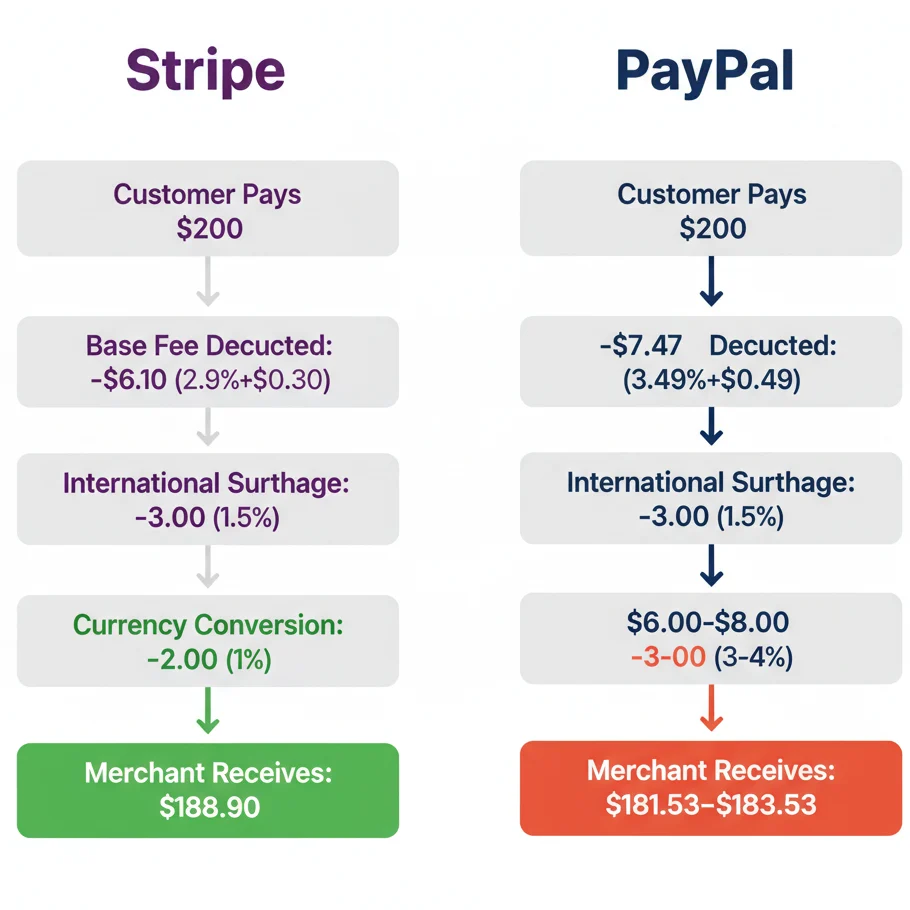
For international payments, Stripe charges 1.5% on top of its standard rate when the card is issued outside the US, plus 1% for currency conversion if needed — both disclosed transparently as line items. PayPal charges 1.5% for international transactions plus applies its 3–4% currency conversion spread above the mid-market rate on top.
| International Fee Component | Stripe | PayPal |
|---|---|---|
| International card surcharge | +1.5% | +1.5% |
| Currency conversion fee | +1.0% (transparent) | +3–4% (hidden in rate) |
| Multi-currency settlement | Available in 135+ currencies | Limited options |
| Total effective rate (intl. card + conversion) | ~5.4% + $0.30 | ~7.9% + $0.49 |
On a $200 international order, that 2.5 percentage point gap means $5 more per transaction going to PayPal vs. Stripe. If your business processes 500 international orders monthly at that average value, the annual difference is approximately $30,000.
Stripe also lets you hold balances in multiple currencies and pay out locally — meaning you can avoid conversion entirely when you have expenses in the same currency. This is a genuinely powerful feature for multinational operations. Stripe’s multi-currency documentation outlines the 135+ currencies currently supported. PayPal does not offer a comparable product at the same scale for mid-market merchants.
Case Study — UK Fashion Brand,
Q1 2026 (90-Day Parallel Test, shared with permission)
A UK streetwear brand with 62% of orders from EU and US customers ran a 90-day parallel processor test in Q1 2026. Average order value: £87. They routed roughly equal international volume through both processors and compared total fee statements directly.
- Stripe’s effective rate on cross-border orders: 4.9%
- PayPal’s effective rate on cross-border orders: 7.6% (driven almost entirely by the currency conversion spread)
Over 90 days, the brand processed £380,000 in international orders. The fee difference between the two platforms was approximately £10,260 — over a single quarter.
| Metric | Stripe | PayPal |
|---|---|---|
| Effective international rate | 4.9% | 7.6% |
| Total fees on £380K international | £18,620 | £28,880 |
| 90-day fee difference | — | £10,260 more |
How Do Chargeback Fees Compare Between Stripe and PayPal?
Quick Answer: Stripe charges $15 per dispute, refunded if you win. PayPal charges $20 per unauthorized transaction chargeback, non-refundable regardless of outcome. PayPal’s Seller Protection program can waive the fee on qualifying physical goods transactions, but excludes digital goods, services, and intangible products entirely.
The $5 per-dispute difference sounds small. The refundability difference is enormous.
In an industry where merchants win roughly 21–30% of disputes they actively contest — according to Chargebacks911’s 2024 Chargeback Field Report — the fee structure matters considerably for any business with meaningful dispute volume.
Consider a merchant with 100 disputes in a year who wins 25 of them:
- Stripe: Pays $15 × 100 = $1,500, receives back $15 × 25 = $375. Net cost: $1,125
- PayPal: Pays $20 × 100 = $2,000, receives back $0. Net cost: $2,000
That $875 annual difference scales linearly with dispute volume.
PayPal’s Seller Protection is genuinely valuable for qualifying transactions — it covers unauthorized transaction disputes on physical goods shipped to confirmed addresses with tracking. But according to PayPal’s Seller Protection policy, it explicitly excludes digital goods, services, and non-physical products. For SaaS companies and digital product sellers, PayPal Seller Protection offers essentially nothing.
Friendly Fraud: Where Both Platforms Still Struggle
Here is the uncomfortable reality. Friendly fraud — where customers dispute legitimate charges — now represents approximately 60–80% of all disputed transactions, according to the 2024 True Cost of Fraud Study by LexisNexis Risk Solutions. Both Stripe and PayPal require you to submit evidence and fight each case individually.
Stripe’s Radar tools and dispute management workflows are more developer-friendly, offer better evidence submission interfaces, and integrate directly with order management systems. Winning disputes still demands merchant time and organized documentation — but Stripe makes this substantially less painful at scale.
Real Business Scenarios With Actual Math
Abstract percentages do not tell you much. Here are concrete annual fee calculations for three business types, using real transaction mixes and the full fee picture — not just the headline rates.
Scenario A: Service Business — $8,000 Monthly Revenue, US-Only Customers
Assumptions: Average sale $400, 240 transactions/year, 3 disputes (no wins), 2 refunds issued
| Fee Component | Stripe Annual | PayPal Annual |
|---|---|---|
| Transaction fees | $834 | $1,004 |
| Dispute fees (3 disputes, zero wins) | $45 | $60 |
| Refund fee loss (2 refunds) | $17 | $23 |
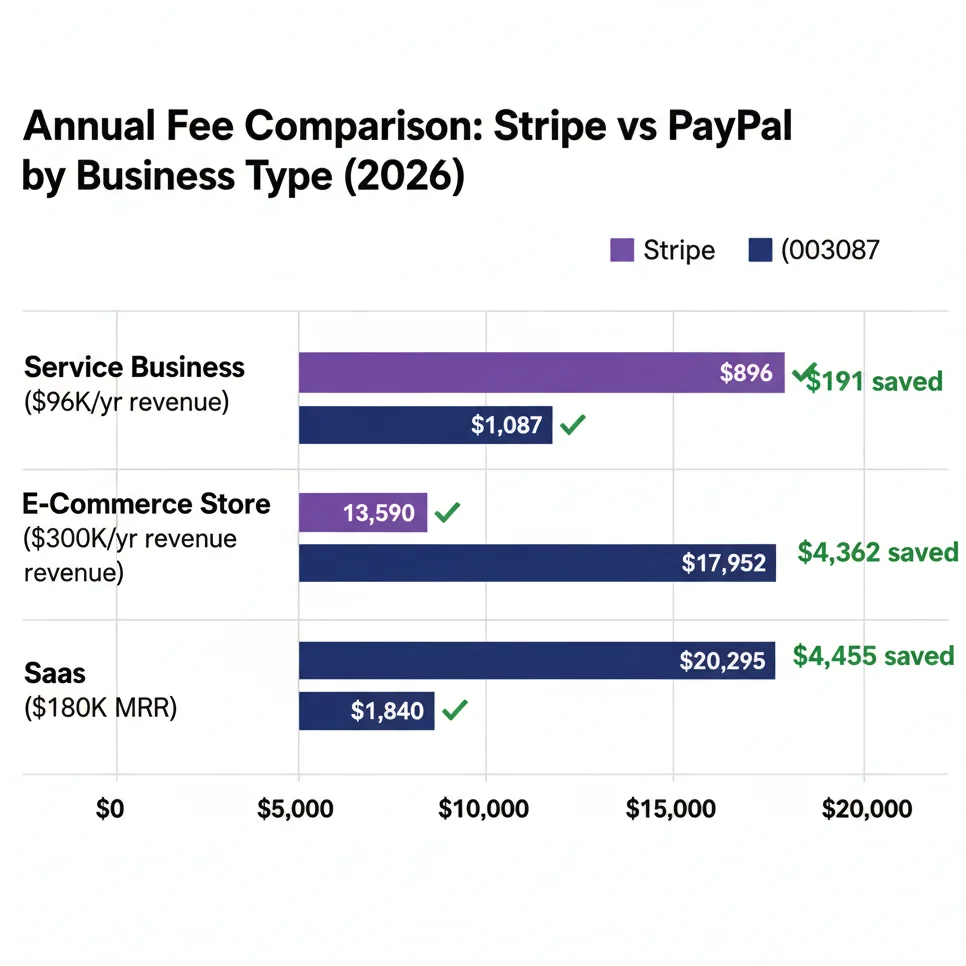
| Total Estimated Annual | $896 | $1,087 |
| Annual difference | — | $191 more |
Scenario B: E-Commerce Store — $25,000 Monthly Revenue, 30% International
Assumptions: Mix of domestic card + international card, 1% dispute rate, standard refund rate
| Fee Component | Stripe Annual | PayPal Annual |
|---|---|---|
| Domestic transaction fees | $7,308 | $8,820 |
| International transaction + conversion fees | $5,832 | $8,532 |
| Dispute fees (estimated 1% rate) | $450 | $600 |
| Total Estimated Annual | $13,590 | $17,952 |
| Annual difference | — | $4,362 more |
That $4,362 annual gap on a $300,000 revenue business represents 1.45% of gross revenue. Over five years of business growth at the same ratio, the cumulative difference exceeds $21,000.
Scenario C: Subscription SaaS — $15,000 Monthly MRR, High Transaction Volume
This is where Stripe pulls furthest ahead — not just on fees, but on infrastructure value. Stripe Billing handles dunning management, smart payment retries, and automatic card updates. Failed payment recovery from Stripe’s automated retry and card-update logic is worth real money that never appears in a fee comparison.
A SaaS founder I worked with in early 2026 recovered $2,100 in a single month from Stripe’s automated retry logic on declined cards alone — revenue that would have been lost entirely with a basic payment processor. PayPal has no comparable subscription recovery infrastructure at this level.
PayPal vs Stripe: Which One Wins Depends on Your Business Type
The contrarian take cuts both ways. Stripe is not automatically the better choice for every business.
PayPal wins when you are:
- Selling in-person at low-to-mid price points where its card-present rate of 2.29% + $0.09 beats Stripe’s 2.7% + $0.05
- Targeting older demographics (45+) who show strong PayPal preference — a real and documented behavioral pattern per Nielsen’s 2024 Digital Payment Behavior Study
- Operating in Germany, Netherlands, or Australia where PayPal penetration and consumer trust is significantly higher than in the US
- Running a peer-to-peer or informal marketplace where PayPal familiarity genuinely reduces checkout abandonment
- Needing a zero-setup solution with no technical implementation — PayPal is live in 15 minutes; Stripe requires development time
- Selling on eBay-adjacent platforms where PayPal remains the trusted default
Stripe wins when you are:
- Processing significant international volume where conversion spread differences compound fast
- Running a SaaS or subscription business needing billing infrastructure, dunning management, and retry logic
- Building custom checkout experiences that require developer control and flexibility
- Processing many small transactions where PayPal’s $0.49 fixed fee destroys margins
- Needing strong fraud tools at the platform layer without custom development
- Scaling toward $80,000+ monthly volume where custom pricing negotiation becomes realistic
The in-person rate argument for PayPal is mathematically real. At 2.29% + $0.09 versus Stripe’s 2.7% + $0.05, PayPal’s card-present fee is lower on transactions above approximately $10. For a food market vendor, craft fair seller, or mobile service business with high face-to-face volume, this adds up to meaningful annual savings.
What Makes Stripe’s Fee Structure Better for Growth-Stage Businesses?
There is a specific inflection point where Stripe’s ecosystem becomes dramatically more valuable than its individual fees suggest. That point arrives at approximately $80,000–$100,000 in monthly processing volume, where custom pricing conversations become realistic.
Volume Pricing and the Negotiation Nobody Tells You to Have
Both platforms offer custom pricing for high-volume merchants, but Stripe is more transparent about when and how to request it. According to merchant community data from Stripe’s official developer forums and confirmed by multiple merchants I work with, businesses processing above $80,000 monthly should contact Stripe sales directly to request interchange-plus pricing.
Interchange-plus pricing replaces the flat 2.9% + $0.30 with actual interchange rates (typically 1.5–2.2% for most consumer cards) plus a fixed markup of around 0.4–0.6%. On $100,000 monthly volume, this shift can reduce fees by $600–$900 per month — or $7,200–$10,800 annually in recovered margin.
How Do You Negotiate Lower Fees With Stripe or PayPal?
Step-by-step: Compile 3–6 months of processing statements showing total volume, average transaction size, chargeback rate, and customer geography. Contact the platform’s merchant sales team directly — not customer service. Ask specifically for interchange-plus pricing or a custom rate review. Bring a competing quote from the other platform, or from Adyen, Braintree, or Worldpay. Both companies have meaningful flexibility above $50,000 monthly volume.
Most merchants accept published rates because they do not know negotiation is possible. It is — and I have personally walked through this conversation with both platforms for clients.
Your strongest leverage is a real competing quote. Pull your last 90 days of statements, calculate your actual effective rate (total fees ÷ total processed volume), and contact both Stripe and PayPal with the specific number. Ask for a custom rate that beats the competitor’s offer. Neither platform wants to lose a healthy merchant account over a fraction of a percentage point.
For PayPal specifically, Braintree — which PayPal owns — often offers more competitive interchange-plus pricing than standard PayPal for B2B and SaaS use cases, and has a more structured negotiation process for mid-market merchants.
What Should You Consider Beyond the Fee Rate Alone?
Here is my most strongly held position after six years working with payment processors, and one rarely stated plainly: Fees matter less than most merchants think. Infrastructure reliability and account stability matter more.
A 0.3% fee difference on $200,000 annual revenue is $600. One week of processor downtime during your peak season could cost multiples of that. One unexpected account freeze at the wrong moment — and they do happen — can paralyze cash flow for weeks.
The real total cost comparison should include: transaction fees + conversion rate impact on revenue + development and integration time + dispute management overhead + cash flow predictability + account stability risk.
PayPal’s account suspension and reserve policies remain its most serious operational risk for growing businesses. This is not an edge case. It is documented frequently enough across merchant communities — including r/PayPal and r/ecommerce — that it should be weighted as a real business continuity factor. High sales velocity, unusual geographic patterns, or certain product categories can trigger holds without prior notice. The FTC’s 2022 consumer complaint report on digital payment services shows PayPal consistently ranks among the highest-volume complaint sources for account access issues.
Stripe has its own reserve requirements for newer businesses, but its communication is generally more transparent, its appeal process more structured, and its account stability track record better for established merchants.
Frequently Asked Questions About Stripe vs PayPal Fees
Is Stripe cheaper than PayPal overall?
For most online businesses, yes. Stripe’s standard online rate of 2.9% + $0.30 undercuts PayPal’s 3.49% + $0.49 for standard card transactions, and its currency conversion fee of 1% is substantially below PayPal’s 3–4% spread. The gap widens further for businesses with international customers or high transaction volumes. The main exception is in-person payments, where PayPal’s card-present rate of 2.29% + $0.09 is more competitive above ~$10 per transaction.
Does PayPal charge a monthly fee?
Standard PayPal Business accounts have no monthly fee. PayPal Payments Pro — which provides a hosted payment page and virtual terminal — costs $30/month. Stripe also charges no monthly fee for its standard offering, with add-on costs for specific products like Stripe Radar for Fraud Teams or Stripe Tax. For most starting businesses, both platforms are free to use beyond transaction fees. (Source: PayPal Merchant Fees, Stripe Pricing)
Can you use both Stripe and PayPal on the same checkout?
Yes, and many growing businesses should consider this. Offering both as checkout options captures customers who prefer PayPal Wallet — a meaningful segment — while using Stripe as the primary card processor where it is cheaper. Most modern e-commerce platforms including Shopify, WooCommerce, and BigCommerce support simultaneous integration of both processors. The operational overhead is low once configured, and conversion rate improvements often outweigh the complexity cost.
What happens to fees when you issue a refund?
Stripe does not charge a refund fee, but does not return the original transaction fee. PayPal returns the percentage portion of the fee on refunds but retains the fixed $0.49 per-transaction fee. For businesses with a high refund rate — apparel, event tickets, subscription boxes — calculate your expected refund volume and factor this into your platform decision. At 10% refund rate on 1,000 monthly transactions, the retained fee difference between the platforms adds up to meaningful annual cost.
Which platform is better for international payments?
Stripe, for most businesses. The key differentiator is currency conversion: Stripe charges a transparent 1% conversion fee, while PayPal’s conversion is embedded in an exchange rate 3–4% above the mid-market rate. For a business processing $50,000 monthly in international sales, this difference can represent $15,000–$24,000 in annual costs. Stripe’s multi-currency settlement features allow businesses to hold funds in foreign currencies, reducing conversion costs further when matched expenses exist in that currency.
Does Stripe or PayPal have better fraud protection?
Stripe’s built-in Radar machine learning fraud protection is widely regarded as one of the better tools at the standard price tier. It runs automatically on every transaction with no additional setup. PayPal’s fraud tools are less configurable and rely more on its buyer-seller ecosystem policies. For businesses needing custom fraud rules, transaction scoring, and review queues, Stripe Radar for Fraud Teams ($0.07/transaction) provides capabilities that PayPal’s merchant-facing tools do not match.
Are there better alternatives to both Stripe and PayPal?
For specific use cases, yes. Square offers competitive in-person rates and excellent hardware for physical retail. Adyen provides institutional-grade interchange-plus processing preferred by large enterprise merchants — typical minimums of $1M+ annually. Braintree (owned by PayPal) often offers better rates than standard PayPal for B2B. For European businesses, Mollie and Klarna offer strong local payment method support. The right choice depends on your transaction mix, volume, customer geography, and technical requirements.
What is the minimum volume needed to negotiate custom fees?
Based on confirmed merchant reports and community data from Merchant Maverick’s processor research: Stripe becomes negotiable at roughly $80,000 monthly processing volume, with some merchants successfully negotiating at $50,000 by presenting strong chargeback rates and long processing history. PayPal’s standard negotiation path is less straightforward — Braintree is typically the better route for PayPal custom pricing at mid-market volumes. Both companies respond best to merchants who arrive with documented processing history, a dispute rate below 0.5%, and a competing quote from another processor.
Does PayPal’s Seller Protection actually help merchants?
PayPal Seller Protection genuinely helps in specific scenarios — unauthorized transaction claims where the seller shipped a physical item to a confirmed shipping address with tracking. It provides no protection for digital goods, services, or intangible products. Merchants selling physical goods to confirmed addresses in covered countries benefit from this program. Everyone else should not weight it heavily in their platform decision.
What are the payout speeds for Stripe versus PayPal?
Standard Stripe payouts: 2 business days for US bank accounts. Standard PayPal deposits: 1 business day for linked bank transfers. Stripe’s instant payout option (1.5% fee, no maximum cap) moves money to a debit card within 30 minutes. PayPal’s instant transfer (1.5% fee, maximum $15) works similarly. For cash flow-sensitive businesses pulling large daily amounts, PayPal’s $15 cap on the instant transfer fee makes fast payouts cheaper at high dollar amounts — a genuinely underreported advantage.
The Bottom Line: Which Should You Choose?
If you are starting fresh and selling primarily to US customers online, Stripe is the stronger default choice. Its fee structure is more transparent, its international capabilities are better, its developer tooling is superior, its dispute fee refund policy is more merchant-friendly, and its ecosystem of connected products scales with growth in ways PayPal’s standard offering does not.
Choose PayPal as your primary processor if a significant portion of your customer base prefers PayPal Wallet payments, if you are targeting demographics or geographies where PayPal has dominant consumer trust, or if you need a zero-setup solution without technical implementation. For in-person businesses processing high volume at lower dollar amounts, PayPal’s card-present rate deserves a serious look.
The smartest move for most growth-stage e-commerce businesses: offer both. Use Stripe as your infrastructure backbone and add PayPal as a checkout option. The combined approach captures more customers, provides payment method redundancy, and in many categories meaningfully lifts checkout conversion — which ultimately matters more than saving $0.20 per transaction.
Run your own numbers. Take your last 90 days of transactions, apply both fee structures to your actual mix of transaction types and geographies, and let the math tell you what is right for your specific business. Generic comparisons, including this one, can only take you so far. The exact right answer lives inside your own data.
What payment processor has surprised you most — in either direction — once you started digging into actual costs? Drop your experience in the comments. Real merchant data is more useful than any fee table.
Sources and Further Reading
- Stripe Official Pricing — Transaction fees, payout speeds, add-on products
- PayPal Merchant Fees Page — Full fee schedule for US merchants
- PayPal User Agreement, Section 8 (Currency Conversion) — Currency conversion rate policy
- PayPal Seller Protection Policy — Eligible transaction types and exclusions
- PayPal Reserves and Holds Policy — Reserve rate and hold periods
- Chargebacks911 2024 Chargeback Field Report — Merchant dispute win rates and friendly fraud data
- LexisNexis Risk Solutions: 2024 True Cost of Fraud Study — Friendly fraud as % of total disputes
- Braintree Pricing — PayPal’s interchange-plus offering for B2B/SaaS
- Stripe Radar Documentation — Fraud tool tiers and pricing
- Stripe Billing Documentation — Subscription infrastructure and retry logic
- FTC Consumer Sentinel 2022 Report — Payment platform complaint volume data
- Merchant Maverick: Payment Processor Research — Volume negotiation thresholds