


When your EHR and your practice management system aren’t talking to each other, the fallout is predictable: staff burns hours on duplicate data entry, billing errors stack up, and patient experience quietly deteriorates.
The encouraging part is that getting these systems integrated is far more achievable than most practice owners assume. And the returns kick in fast.
Automated data entry and record management systems reduce errors by 50–80% compared to manual processes. That single statistic should stop you mid-scroll. When your EHR and your practice management system are properly synced, scheduling, billing, and insurance workflows no longer operate in separate silos; they reinforce each other. The whole operation gets sharper.
Let’s break down exactly how to make that happen.
Table of Contents
Key Strategies for EHR Practice Management Integration
None of this works by accident. Strong EHR PMS integration demands deliberate choices upfront, about architecture, data standards, and how information actually moves between platforms, long before any configuration begins.
Choose the Right Integration Model
You’re essentially choosing between two paths here. A unified platform means your EHR and PMS share a single database, no data “crossing a bridge” because there’s no bridge needed. Everything lives in one place.
The alternative is keeping separate, best-in-class tools and linking them through middleware or APIs. That second path gives you more vendor flexibility, but it requires thoughtful interface design. Data conflicts and sync gaps don’t announce themselves politely.
Leverage Modern Interoperability Standards
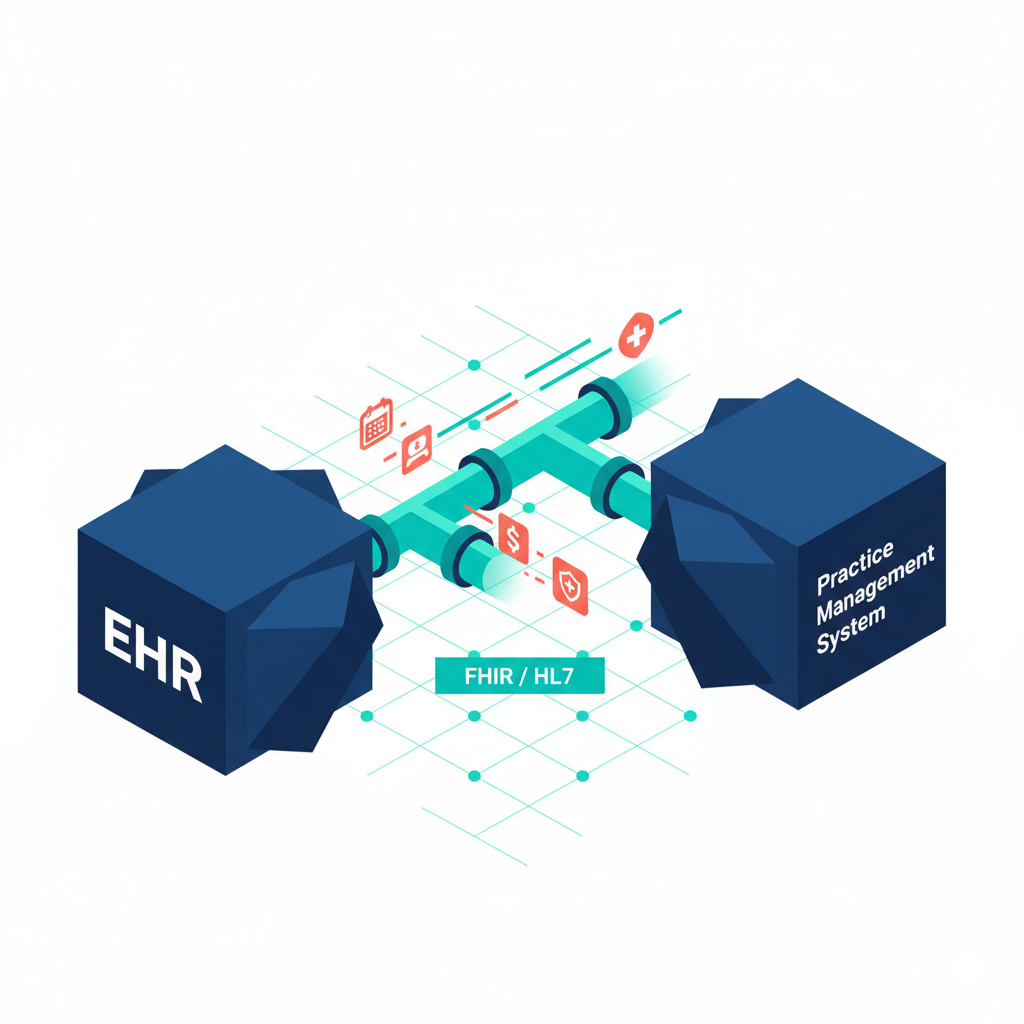
Once your integration model is locked in, the next question is how your systems will communicate. This is where standards like HL7 and FHIR stop being abstract buzzwords and start being genuinely important.
FHIR R4 and SMART on FHIR offer structured, scalable frameworks that platforms like Athenahealth and Cerner already support through pre-built APIs. Achieving real EHR and PMS interoperability depends on selecting systems that speak the same technical language. Without that common ground, even well-designed integrations fracture under real-world data volume.
Plan Seamless Data Synchronization Workflows
Standards set the foundation, but they don’t move data on their own. You need to map your core data flows explicitly: patient demographics, appointment records, charge capture, and insurance eligibility checks.
Think carefully about synchronization frequency, too. Clinical data may need real-time writebacks, while financial updates can sometimes tolerate hourly or daily syncs depending on how busy your practice runs.
Compliance, Security, and Performance
Here’s a truth that gets skipped too often: efficient data flows are only valuable if they’re secure. Every integration handling protected health information requires end-to-end encryption, detailed audit trails, and HIPAA-compliant access controls, no exceptions.
Define your uptime benchmarks before going live (99.9% is a solid target), and establish data accuracy thresholds in advance. Trying to define “good enough” after launch is a guaranteed headache.
Implementation Best Practices and Emerging Innovations
Strategy is one thing. Execution is where integrations actually win or quietly collapse.
Workflow Mapping and Stakeholder Alignment

Pull your administrative, clinical, and IT staff into the room together early. Cross-team workflow assessments expose bottlenecks that no single department sees on its own, and those blind spots are exactly where integrations stall.
Before launch, set measurable KPIs: reduce manual entry by a specific percentage, improve first-pass claims acceptance, and track patient retention. Concrete targets keep teams accountable and reveal whether the integration is actually delivering.
Phased Rollout and Training
Running legacy and new workflows in parallel during early adoption reduces your risk exposure considerably. Rushing a full cutover almost always generates costly rollbacks, been there, done that.
Designate super-users in each department, staff who go deep on the system and become peer resources throughout the transition. Role-specific training matters far more than generic software walkthroughs nobody fully retains.
FHIR Middleware and Real-Time Sync Architecture
The technical backbone behind reliable bidirectional data exchange is a well-built FHIR middleware layer. Achieving dependable FHIR EHR PMS sync means deploying a cloud-based or on-premises orchestration layer with secure APIs, event-driven data triggers, and comprehensive logging.
Done right, clinical data flows into billing automatically, administrative updates reflect in clinical records without manual input, and your staff stops bridging gaps by hand.
AI and Intelligent Automation
Real-time FHIR synchronization creates the conditions for something more powerful downstream. By 2024, 71% of acute-care hospitals had already adopted predictive AI integrated with their EHR systems.
Integrating large language models with FHIR-structured data can surface clinical summaries automatically, flag coding inconsistencies before a claim goes out, and interpret complex records in context. Practices still running static integrations simply can’t access that layer.
Seven Actionable Steps: Planning Through Optimization
Here’s the full journey, condensed into steps you can actually follow:
- Define your integration objectives and document your current workflows honestly.
- Select your integration model and confirm HL7/FHIR standards support from vendors.
- Design your synchronization plan, which data flows, at what frequency.
- Build or configure your middleware layer, or select a unified platform.
- Pilot with a small team, test thoroughly, then train staff and go live.
- Monitor KPIs monthly and gather candid user feedback, not just from managers.
- Iterate continuously, refine sync logic, tighten compliance controls, and explore AI enhancements.
Frequently Asked Questions
What are the real benefits of EHR and PMS interoperability?
Faster billing cycles, fewer data-entry errors, improved scheduling accuracy, and better patient communication. Every team member gets a complete, real-time picture of each patient without hunting across disconnected systems.
How does FHIR EHR PMS sync work in real time?
A FHIR middleware layer listens for data events, a completed clinical note, a new appointment booking, and immediately pushes structured updates to the connected system. No manual steps, no scheduled batch uploads.
How long does integration take, and what does it cost?
Timelines run from a few weeks for pre-built API connections to six-plus months for custom middleware builds. Costs range from a few thousand dollars for basic interfaces to six-figure investments for enterprise-scale FHIR architectures.
What are the most common pitfalls?
Underestimating training needs, skipping workflow mapping, and failing to define data ownership between systems. Rushed go-lives without a phased pilot are consistently the most expensive mistakes practices make.
Closing Thoughts
Integrating your EHR and practice management system isn’t a one-time IT project; it’s a fundamental shift in how your practice operates.
The right model, grounded in FHIR standards, supported by phased rollout and targeted training, turns fragmented workflows into something coherent and manageable. Layer in AI-driven capabilities, and you’re not just keeping pace, you’re genuinely ahead.
Practices making this investment now will spend far less time firefighting administrative chaos, and far more time doing what they actually set out to do: delivering excellent care.