
Table of Contents
1. Sangfor aSV Hypervisor
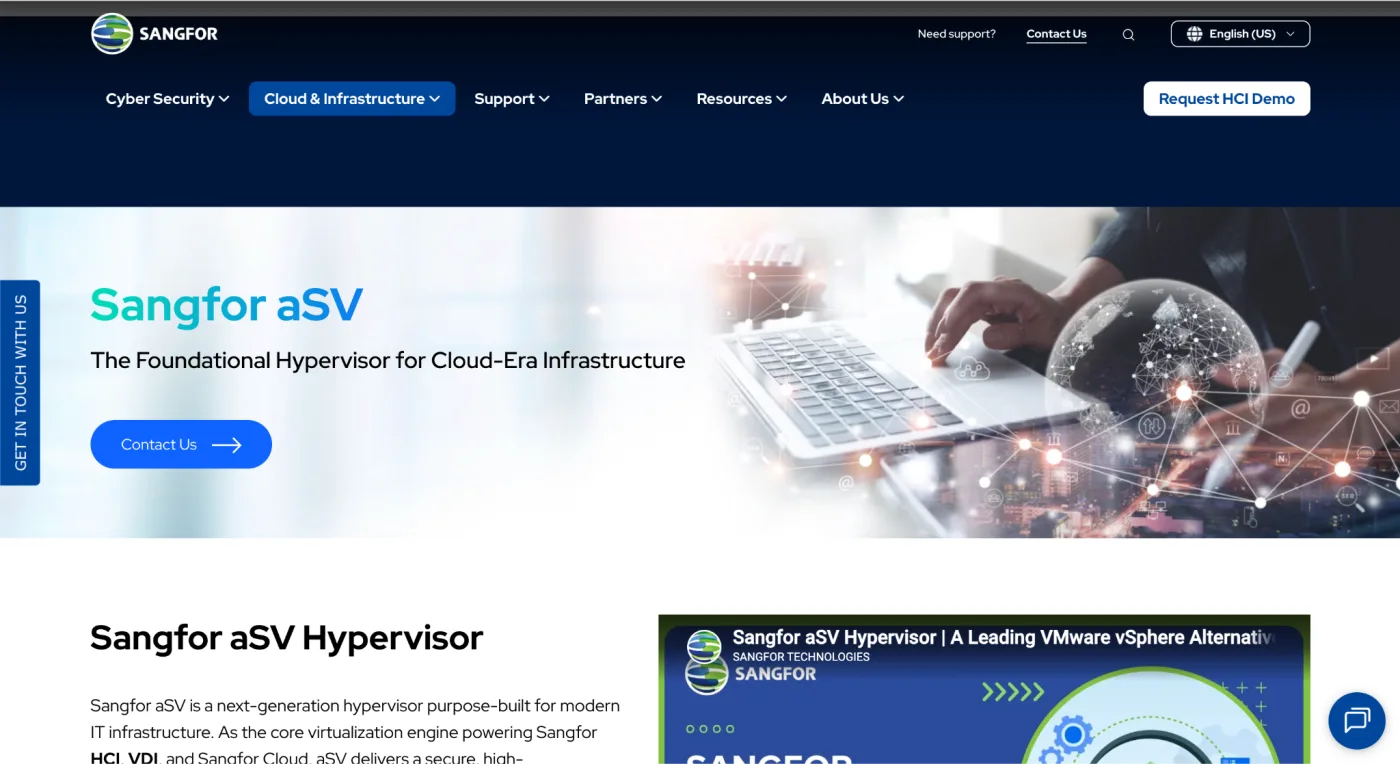
Sangfor aSV is a type-1, KVM-based bare-metal hypervisor from Sangfor Technologies, serving as the compute virtualization layer inside Sangfor’s HCI and Cloud Platform stack. It’s built for VMware vSphere users who want a familiar operational experience without rebuilding their automation tooling from scratch. The platform ships a CLI of 230+ commands equivalent to VMware’s PowerCLI, and its web console mirrors vCenter workflows closely enough that existing vSphere admins don’t face a steep relearning curve.
What sets aSV apart from other VMware alternatives is what’s included by default. Networking (aNET), storage (aSAN), and security (aSEC) are all bundled into the same license, no separate NSX or vSAN purchases required. The security layer features intelligent micro-segmentation plus a built-in WAF and IPS through the integrated Cloud Security Center. Sangfor reports more than 12,000 completed VMware migrations and 28,000+ cloud customers worldwide; on Gartner Peer Insights, the platform holds a 4.9 overall rating with 100% Willingness to Recommend across 23 verified enterprise reviews.
Features
- 230+ PowerCLI-equivalent CLI commands for VMware admin continuity
- Bundled networking, storage, and security in one license
- Proactive HA 2.0 with predictive failure detection
- Live migration with under 3 seconds of measured performance impact
- Automated VMDK-to-Sangfor conversion tooling for VMware migrations
- AI-optimized distributed resource scheduling
Pros
- 4.7/5 on G2 across 94 reviews; G2 Leader badge in Server Virtualization, Summer 2026
- Reviewer-reported cost savings of 30 to 40% versus VMware (PeerSpot)
- Runs on mainstream x86 hardware from Dell, HPE, and Lenovo, no narrow certified hardware list
- Built-in security controls replace separate third-party appliances
2. VMware
VMware remains a reference point in enterprise virtualization even after Broadcom’s acquisition overhauled its commercial model. The platform’s headquarters sit in Palo Alto, California, and it reported $13.4 billion in revenue as of 2023, with 38,300 employees. Its core products – VMware Cloud Foundation and VMware vSphere Foundation – support a multi-cloud portfolio that spans application modernization, cloud management, infrastructure, networking, and security.
The 2025 Tech Innovation CUBEd Awards named VMware Cloud Foundation a top cloud infrastructure solution for that year. Documented deployments include Grinnell Mutual, which saved $1 million in infrastructure costs using VMware Cloud Foundation, and GCI, an Alaska-based communications provider that deployed VMware Cloud Foundation alongside Tanzu Data Services. VMware maintains 287 published customer case studies.
Features
- VMware Cloud Foundation and vSphere Foundation as flagship compute platforms
- Advanced services including Disaster Recovery, Private AI, and Edge Orchestration
- NSX for software-defined networking (licensed separately)
- vSAN for software-defined storage (licensed separately)
- Container support through Tanzu
Pros
- Largest ecosystem of third-party tooling, trained talent, and community resources
- Large case study library across industries
- Strong multi-cloud integration story
3. Nutanix
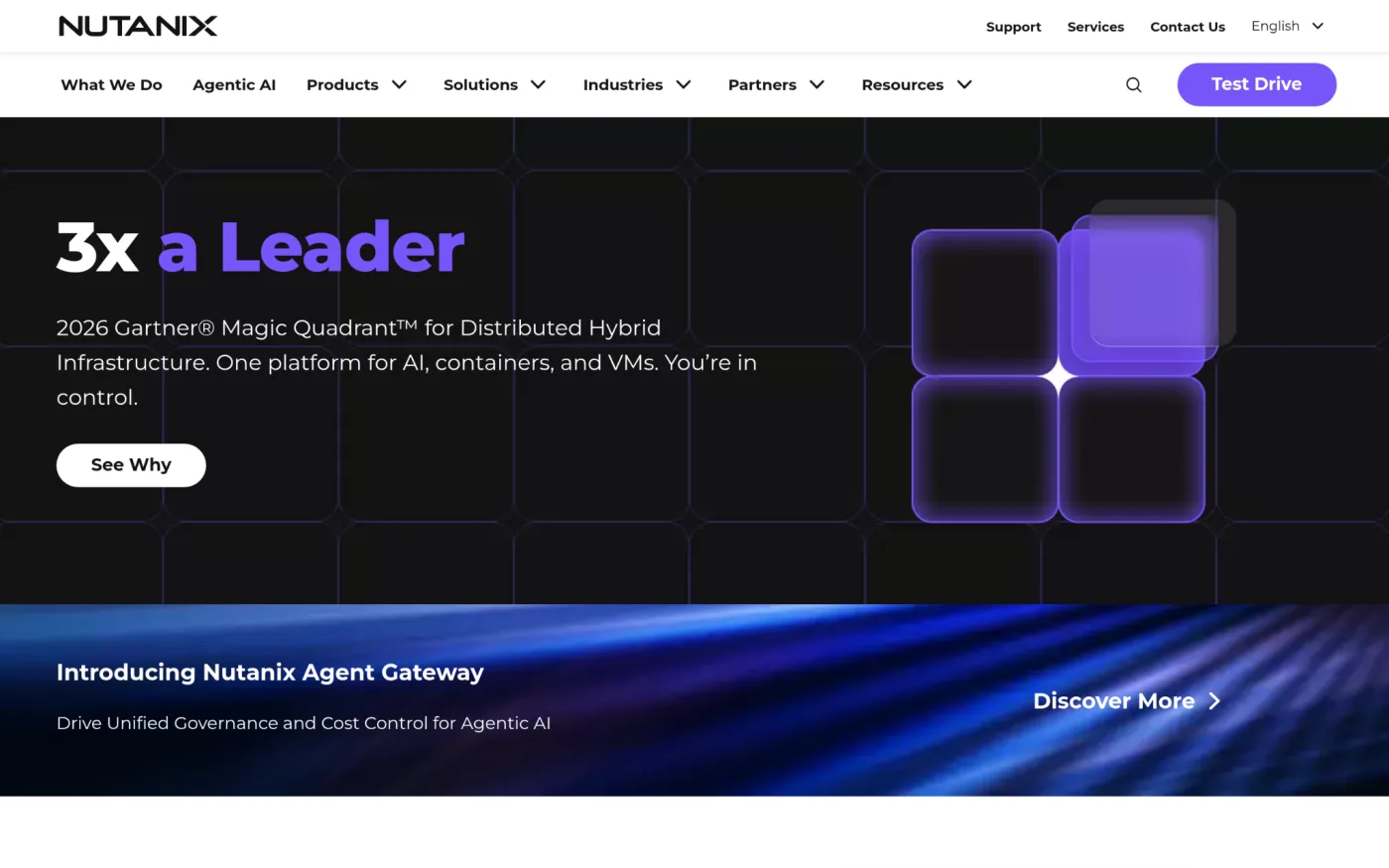
Nutanix is a publicly traded cloud computing company (NASDAQ: NTNX) founded in 2009 and headquartered in San Jose, California, with approximately 7,800 employees. Its primary product, the Nutanix Cloud Platform, brings together AOS storage, AHV virtualization, Nutanix Flow networking, Kubernetes support via the Nutanix Kubernetes Platform, and database-as-a-service through Nutanix Database Service. It’s built for hybrid and multicloud environments where organizations want to run applications and data across on-premises and public cloud without juggling separate tooling layers.
The 2026 Gartner Magic Quadrant named Nutanix a Leader in Server Virtualization Platforms with the highest score in Execution, a distinction that carries weight for enterprise procurement teams. It also holds a Challenger position in the 2026 Gartner Magic Quadrant for Container Management.
Features
- AHV hypervisor bundled within the Nutanix Cloud Platform
- Nutanix Flow for software-defined networking
- Nutanix Kubernetes Platform for containerized workloads
- Nutanix Enterprise AI for AI workload deployment
- Unified storage (files, objects, volumes, and block)
Pros
- 2026 Gartner Magic Quadrant Leader in Server Virtualization Platforms, highest in Execution
- Strong hybrid and multicloud management story
- Full-featured database-as-a-service offering
4. Proxmox
Proxmox Server Solutions GmbH was founded in February 2005 by Martin Maurer and Dietmar Maurer, and is headquartered in Vienna, Austria. The company had 68 employees as of August 2026 and manages more than 1.5 million hosts globally across 142+ countries, with 1,000+ reseller partnerships that include NVIDIA and Veeam. Customers range from the European Space Agency and YouTube to Huawei Technologies and Northrop Grumman.
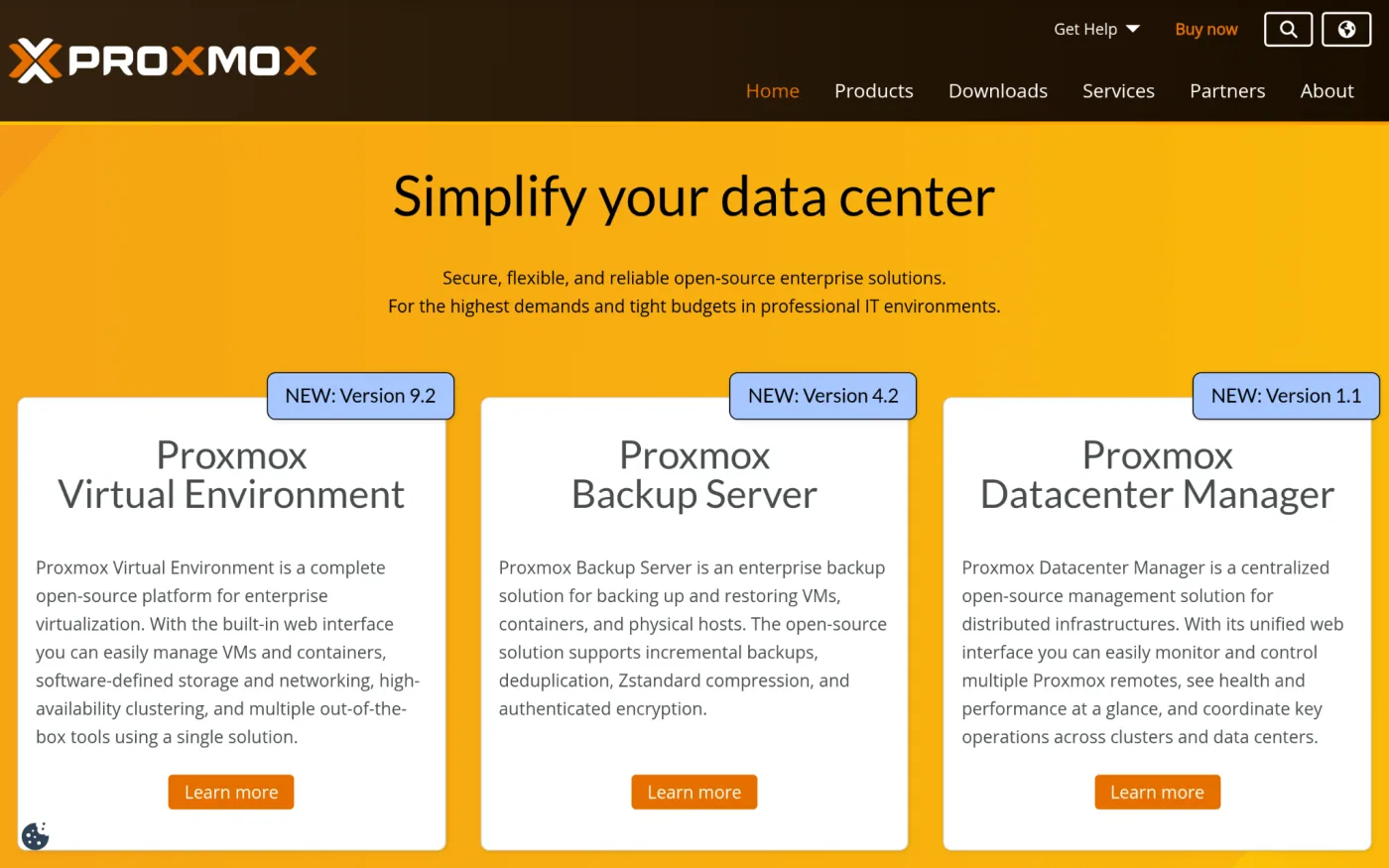
Proxmox Virtual Environment was the first platform to combine a KVM hypervisor and container-based virtualization on a single interface. It’s genuinely free and open source. The complete feature set works without a paid subscription, though commercial support subscriptions are available for those who want them. Proxmox estimates that approximately 95% of VMware setups could migrate to Proxmox VE without major changes, and for organizations where budget is the top constraint, few alternatives can compete with a zero-license-cost starting point.
Features
- KVM hypervisor plus LXC container support in one platform
- Proxmox Backup Server for enterprise-grade backup
- Proxmox Datacenter Manager for centralized multi-site management
- Web-based management interface with no separate license cost
- Integration with NVIDIA and Veeam
Pros
- Fully open source with no mandatory subscription fee
- 1.5+ million hosts managed globally; large independent community
- Broad hardware compatibility across standard x86 servers
5. Red Hat
Red Hat is an American software company founded in 1993 and headquartered in Raleigh, North Carolina, with 19,000 employees. It’s been an IBM subsidiary since 2019. Its product portfolio centers on Red Hat Enterprise Linux (RHEL), OpenShift Container Platform, Ansible Automation Platform, and Red Hat AI, collectively covering operating systems, container orchestration, and automation across cloud and on-premises environments.
For virtualization specifically, Red Hat OpenShift Virtualization lets teams run traditional VM workloads alongside containerized applications on the same OpenShift platform. Red Hat supports more than 90% of Fortune 500 companies and serves sectors from financial services and healthcare to automotive and telecommunications. It’s also no stranger to industry recognition; the company was named a Leader in the 2026 Gartner Magic Quadrant for Cloud-Native Application Platforms for the third consecutive year.
Features
- OpenShift Virtualization for running VMs alongside containers
- Red Hat Enterprise Linux as the platform foundation
- Ansible Automation Platform for IT automation
- Multi-cloud and hybrid deployment support
- Red Hat AI integrated within the platform stack
Pros
- 2026 Gartner Magic Quadrant Leader in Cloud-Native Application Platforms, third consecutive year
- Strong fit for organizations already standardized on RHEL or OpenShift
- Backed by IBM with enterprise-grade support infrastructure
What to look for in a hypervisor replacement
Choosing among this list of best server virtualization software for VMware replacement comes down to a few concrete factors.
Migration tooling matters more than anything else at the start. Platforms that offer automated VMDK conversion or CLI parity with PowerCLI cut weeks off a migration project. Without it, teams are rewriting automation scripts that already work.
Bundled versus à la carte pricing changes the total cost significantly. VMware’s model separates NSX, vSAN, and the base hypervisor, so compare fully loaded costs, not just the hypervisor license. Some platforms include networking, storage, and security in a single price; others don’t.
Hardware flexibility is worth checking before shortlisting. Some platforms require vendor-certified hardware; others run on any standard x86 server. For teams with existing Dell, HPE, or Lenovo infrastructure, that distinction can simplify the transition or complicate it.
Support model is the factor that often surfaces late. Open-source platforms with community-only support work well for teams with strong internal Linux expertise; they’re a rough match for organizations that need vendor SLAs and a dedicated escalation path.
It also helps to be clear about how much virtualization you actually need to run yourself. Smaller teams with a handful of workloads may be better served by a hosted option, and our guide to choosing the right VPS hosting plan explains how virtualization works at that scale. If you’d rather hand off day-to-day infrastructure work entirely, see how managed service models change the cost and responsibility equation.
Bottom Line
No single platform fits every team’s situation. The best server virtualization software for VMware replacement depends on what’s actually driving the move: licensing costs, a desire to consolidate tooling, a shift toward containers, or simply the need for a supported vendor alternative. Open-source shops with internal expertise have different needs than enterprises running hundreds of VMs under strict SLAs. The vendors on this list cover that entire range. The right choice is the one that matches the specific mix of migration difficulty, support requirements, and total cost the team is actually working with.