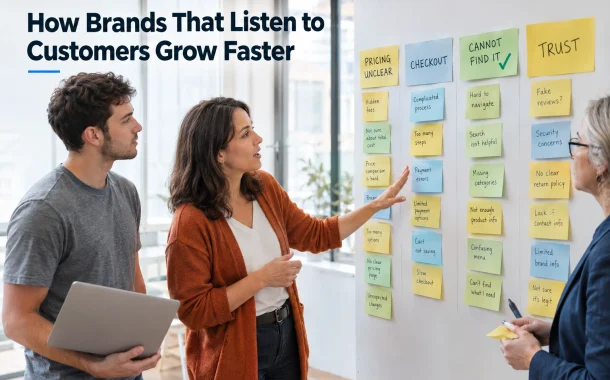
Most articles on this subject argue that listening to customers matters. That part is settled. The harder question is what happens to a piece of feedback between the moment a customer types it and the moment something on your site is different because of it. That path is where feedback programmes die, and it is what separates the brands that grow from the brands that merely survey.
This guide covers the four stages, the structural bias that makes your survey data misleading, how to collect feedback that is actually representative, what to do when feedback contradicts itself, and how to turn a themed pile of complaints into specific changes on a website.
Table of Contents
How to Build a Customer Feedback Loop That Changes Your Website
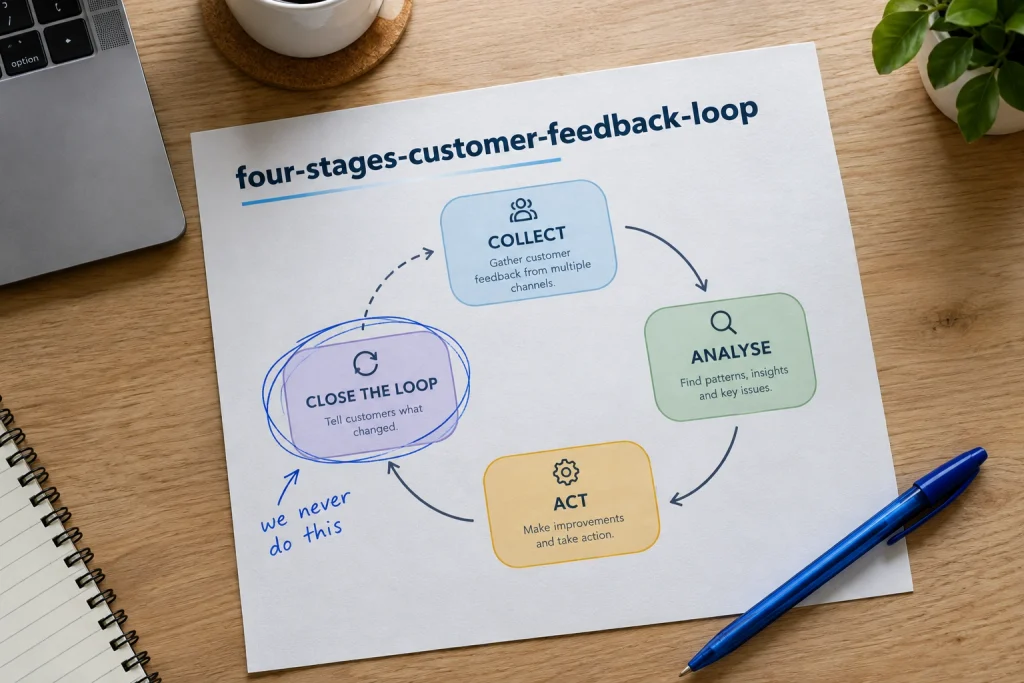
A customer feedback loop is a repeating four-stage cycle: you collect feedback, you analyse it, you act on it, and you tell the customer what changed. The fourth stage is what makes it a loop rather than a survey, and it is the one most businesses skip. Skipping it is why response rates fall and why the same complaints keep arriving.
Building one is less about tooling than about deciding in advance who acts on what. The stages below are ordered by how often each one fails rather than by how much attention each usually gets.
The Four Stages of a Customer Feedback Loop
| Stage | What happens | Where it usually breaks |
|---|---|---|
| 1. Collect | Surveys, interviews, support tickets, reviews, behavioural data | Only one channel is used, so the data is one-sided |
| 2. Analyse | Feedback is tagged into themes and ranked by frequency and revenue impact | Comments are read individually and never aggregated |
| 3. Act | A specific change is made to the product, site, or process | Themes are reported to leadership and nothing ships |
| 4. Close the loop | The customer is told what changed because of their input | Almost never happens |
Stages 1 and 2 are where businesses spend their money. Stages 3 and 4 are where the return lives. A programme that stops at stage 2 produces quarterly insight decks, and a programme that reaches stage 4 produces customers who answer your next survey.
Fewer Customers Are Telling You Anything
This is the part that changes how you should plan. Direct feedback to companies is not holding steady. It is falling.
Qualtrics XM Institute surveyed 23,730 consumers across 23 countries in Q3 2024. After a very poor experience, only 32% sent feedback directly to the company. After a very good one, 31% did. Both figures dropped against the same study in 2021: down 7.7 points for poor experiences and 6.5 points for good ones.
| Finding | Figure |
|---|---|
| Consumers who give feedback directly after a very poor experience | 32% |
| Consumers who give feedback directly after a very good experience | 31% |
| Change since 2021, poor experiences | Down 7.7 points |
| Change since 2021, good experiences | Down 6.5 points |
| US consumers who did nothing at all after a poor experience | 24% |
| Most common response to both good and bad experiences | Telling friends and family |
Qualtrics XM Institute, Global Consumer Study, 23,730 respondents, Q3 2024.
Read the last row again. The most common thing a customer does after an experience with you is talk about it to someone who is not you. Roughly two thirds of your customers never tell you directly, and that share is growing.
The practical consequence: you cannot build a feedback loop on survey volume alone, and you cannot treat a quiet inbox as a sign that things are fine. Average B2B survey response rates sit around 12.4% by CustomerGauge’s own measurement. You are planning around a tenth of your customer base at best.
Your Survey Data Is Biased Toward Happy Customers
Here is the finding that almost nobody writes about, and it should change how you read your own dashboard.
The same XM Institute study broke feedback down by channel, and the channels are not neutral. Surveys were 14 points more likely to be used after a good experience. Email was 21 points more likely after a poor one.
So your survey tool is structurally collecting a more positive sample than reality, and your angriest customers are routing around it into your support inbox, where nobody is tagging themes.
| Channel | Skew | What this means for your data |
|---|---|---|
| Surveys and NPS | 14 points more likely after a good experience | Your NPS is flattering you |
| 21 points more likely after a poor experience | Your real problems are sitting in support, untagged | |
| Website feedback forms | 40% of direct poor-experience feedback | Second-biggest negative channel |
| Friends and family | Most common channel overall | Invisible to you entirely |
Channel figures from the same XM Institute study. Email use for poor experiences rose 9.5 points since 2021; website feedback rose 4.6 points.
Three things follow from this.
Your NPS is not a measure of your customers. It is a measure of the customers willing to fill in a survey, who skew positive. Treating a rising NPS as proof that things improved is a mistake if your support volume rose at the same time.
Support tickets are your highest-value feedback source and you are probably not analysing them. They are where the negative signal concentrates, they cost nothing extra to collect, and almost no business tags them into themes the way it tags survey verbatims.
The quiet middle never answers. Delighted customers answer surveys. Furious ones email. The large group in between, who are mildly dissatisfied and would leave for a competitor without ever complaining, say nothing. They are usually most of your revenue. The only way to reach them is to go and ask, which means interviews and behavioural data rather than waiting for inbound.

How to Collect Feedback That Is Actually Representative
The fix for channel bias is more channels, weighted deliberately rather than by whatever is easiest to set up.
| Method | What it is good at | What it misses | Cost |
|---|---|---|---|
| In-product or post-purchase survey | Volume, trend tracking, NPS or CSAT scores | Skews positive; shallow on reasons | Low |
| Support ticket theme analysis | The real problems, at no extra collection cost | Only customers who bothered to contact you | Low, analysis is the work |
| Customer interviews | Why, not just what. The reasoning behind a choice | Small samples, interviewer bias | Medium |
| Churn or exit interviews | The reason people actually left | Hard to get; most leavers ignore the request | Medium |
| Session recordings and heatmaps | Where people stall on the site, unprompted | Shows behaviour, never motive | Low |
| Review site monitoring | Unfiltered opinion, plus competitor comparison | Self-selected extremes | Low |
| Social listening | Conversations that never reach you | Noisy, hard to attribute | Low to medium |
| Video comments and replies | Unprompted reaction at scale, blunter than any survey | Skews toward the engaged and the annoyed | Low |
| Behavioural and category research | Decision drivers customers cannot articulate | Needs specialist interpretation | High |
That last row is the one most businesses get wrong on their own. Behavioural and category research produces data that genuinely does not interpret itself, and reading it as though it were survey results leads to confident wrong conclusions. Brands at that stage usually work with a consumer insights company that can translate the raw behavioural data into direction, rather than treating a correlation as a finding.
A workable minimum for a small business: one post-purchase survey, themed support tickets, five customer interviews a quarter, and session recordings on your three highest-value pages. That costs almost nothing and covers both the positive-skewed and negative-skewed channels. Smaller teams can run this at a standard that holds up against much larger competitors, which is the wider point in how growing startups create enterprise-level customer experiences.
Closing the Loop: The Stage Everyone Skips
Closing the loop means going back to the specific person whose feedback led to a change and telling them it led to a change. Not a thank-you auto-reply. A follow-up that names the thing that is now different.
It works for a reason that has nothing to do with politeness. CustomerGauge’s research found that 42% of companies running voice-of-customer programmes set no goals for them at all, and only around 30% of B2B brands connect their feedback data to financial metrics. A programme with no goal and no financial link produces no pressure to ship anything, which means there is never anything to tell the customer about.
The sequence that works:
- Acknowledge within 48 hours. Not a fix, just confirmation that a human read it.
- Route it to whoever can act. Feedback that lands in a marketing inbox and concerns checkout is dead on arrival.
- Decide and record. Either it ships, or it does not and you write down why. Both are outcomes.
- Ship the change.
- Tell the person who raised it, by name, what changed.
- Tell everyone else. A public changelog or a short “you asked, we changed” email does the work of step 5 at scale.
Step 3 is the one that matters most and gets skipped most. A decision to say no, recorded with a reason, is a functioning loop. An undecided item sitting in a backlog for nine months is not.
Turning Feedback Into Changes on the Site
A themed list of complaints is not an action plan. The translation step is where most of the value is created, and it is also where most reports stop.
| What customers say | What they usually mean | What changes on the site |
|---|---|---|
| “The pricing was confusing” | They could not work out which plan applied to them | A comparison table, a recommended plan, pricing above the fold |
| “I wasn’t sure it would work for my business” | No proof from anyone resembling them | Case studies segmented by industry or size, near the CTA |
| “Checkout was a hassle” | Too many steps, or a surprise at the final step | Guest checkout, shipping cost shown earlier, fewer form fields |
| “I couldn’t find what I needed” | Navigation labels use your words, not theirs | Rename nav items to the customer’s phrasing, add site search |
| “I didn’t know you did that” | A service exists but has no page | A dedicated page per service, linked from the nav |
| “It felt slow” | Measured load time, or perceived slowness from layout shift | Core Web Vitals work, image optimisation, skeleton states |
| “I wasn’t sure if I could trust you” | No signals of legitimacy above the fold | Real photos, named team, verifiable reviews, clear contact details |
Two rules make this translation reliable.
Change one thing at a time and measure it. Three simultaneous changes to a checkout flow tell you nothing about which one moved the number. This is the difference between a feedback-driven redesign and a redesign with feedback mentioned in the brief, which is covered in more depth in how a WordPress redesign quietly transforms conversions.
The same translation applies to paid channels. Ad copy written from themed customer feedback consistently outperforms copy written in a vacuum, which is why the better agencies start with the feedback rather than the keyword list, as covered in our review of B2B SaaS Google Ads agencies.
Weight by revenue, not by volume. Five complaints from enterprise accounts worth $40,000 each outrank forty complaints from free-tier users. Frequency alone will push you toward fixing whatever your least valuable segment is most vocal about. Pairing the qualitative feedback with behavioural data is how you avoid that, and it is the argument behind data-driven design decisions generally.
Metrics That Tell You Whether the Loop Works
Most businesses track the score and not the loop. The score tells you how customers feel. These tell you whether your programme is functioning.
| Metric | What it measures | How to read it |
|---|---|---|
| NPS | Likelihood to recommend, −100 to +100 | Directional only, and positively biased. Never the sole measure |
| CSAT | Satisfaction with a specific interaction | Best immediately after a defined touchpoint |
| CES | How much effort a task took the customer | The strongest predictor of repeat behaviour for support and checkout |
| Closed-loop rate | Share of feedback that got a follow-up | The real health metric. Under 20% means the loop is open |
| Time to acknowledge | Hours between feedback and first human reply | Target under 48 |
| Time to resolution | Feedback to shipped change | Reveals whether stage 3 exists |
| Response rate trend | Whether participation is rising or falling | Falling response rate usually means the loop is not closing |
| Theme recurrence | Whether the same complaint keeps returning | A recurring theme means stage 3 failed, not that collection failed |
Closed-loop rate and theme recurrence are the two that no dashboard shows by default and the two that actually diagnose the problem. If the same complaint appears every quarter, collecting more of it changes nothing.
What to Do When Feedback Contradicts Itself
It will. Half your customers want a simpler interface and half want more features. This is not a data problem and it does not mean the research failed.
Segment before you reconcile. Contradictory feedback almost always means you are hearing from two different groups. New users want simplicity; power users want depth. Both are right about themselves. The question is which segment you are building for, which is a strategy decision rather than a research one.
Weight by value and intent. A request from a growing account carries more weight than the same request from someone about to churn for unrelated reasons.
Trust behaviour over stated preference where they disagree. Customers routinely say they want a feature and then never use it once it ships. If your survey says one thing and your analytics say another, the analytics are describing what people did. Stated preference describes what people believe about themselves.
Look for the shared underlying need. “Make it simpler” and “add more options” are often the same complaint: people cannot find the thing they already need. Progressive disclosure satisfies both. The contradiction was in the proposed solutions, not in the problem.
Comment threads are worth reading the same way. Replies on a video or a post are blunter than anything a survey returns, and they arrive unprompted, which is part of why video marketing works better when it responds to what customers actually say.
Mistakes That Break Feedback Loops
| Mistake | Consequence |
|---|---|
| Running research once and parking it for two years | You are optimising for a customer who has moved on |
| Surveying only after successful transactions | Guarantees a positive sample and a flattering score |
| Never tagging support tickets | Your most negative, most useful data is unread in aggregate |
| Reporting themes without assigning an owner | Insight decks, no shipped changes |
| Asking for feedback with no intention to act | Response rates fall and the brand looks performative |
| Treating NPS as the goal | The score becomes the target and gets gamed |
| Fixing by volume instead of revenue | You serve your loudest, least valuable segment |
| Changing five things at once | No attribution, so no learning |
| No owner for the question | Everyone agrees it matters and nobody does it |
Who Should Own This
In a large organisation, feedback usually sits with a dedicated insights function or inside marketing. In a smaller business it falls to whoever is closest to the customer, which is often the founder, a product lead, or a support manager.
The title matters less than two things being true: one named person owns the question of what customers want, and that person has the authority to get a change shipped. A researcher who can gather and theme feedback but cannot get anything onto a roadmap produces reports, not improvements. That is the single most common structural reason feedback programmes fail, and it is an org-chart problem rather than a research one.
Frequently Asked Questions
What is a customer feedback loop? A repeating cycle with four stages: collect feedback, analyse it into themes, act on it by making a specific change, then tell the customer what changed. The fourth stage is what distinguishes a loop from a survey programme. Without it, participation declines and the same issues keep resurfacing.
How do you close a customer feedback loop? Acknowledge the feedback within 48 hours, route it to whoever can act, record a decision either way, ship the change, then tell the person who raised it specifically what is now different. Publishing a changelog or a short “you asked, we changed” update handles the same job at scale.
What are the four stages of a feedback loop? Collect, analyse, act, and close the loop. Most programmes execute the first two well, because those are the stages software handles. The third and fourth require someone with authority to ship a change and the discipline to follow up, which is why most loops stay open.
How many customers actually give feedback? Far fewer than most businesses assume. Qualtrics XM Institute found 32% of consumers give feedback directly to a company after a very poor experience and 31% after a very good one, both down more than six points since 2021. The most common response to any experience is telling friends and family, which you never see.
Is NPS still worth measuring? As a directional trend alongside other measures, yes. As a single verdict on customer sentiment, no. Survey channels are around 14 points more likely to be used after a good experience than a bad one, so NPS over-samples satisfied customers by design. Read it next to support volume and churn rather than on its own.
What is the difference between NPS, CSAT, and CES? NPS asks how likely someone is to recommend you, scored −100 to +100, and measures overall sentiment. CSAT asks about satisfaction with one specific interaction and works best immediately after it. CES asks how much effort a task required, and tends to predict repeat behaviour better than the other two for support and checkout.
What is the difference between market research and consumer insights? Market research describes what is happening in a category: sizes, shares, trends. Consumer insights explain why it is happening, by getting at the motivations and decisions behind the numbers. Research gives you the terrain. Insights tell you what to do about it.
How often should a business collect customer feedback? Continuously for transactional feedback such as CSAT after support contacts, and at least annually for deeper research. Treating research as a one-off project is the most common failure, because a study commissioned two years ago describes a customer who has since changed what they want.
Can a small business run a feedback loop without a research budget? Yes, and the low-cost methods are some of the most useful. Themed support tickets, five customer interviews a quarter, session recordings on your highest-value pages, and one post-purchase survey cover both positively and negatively skewed channels. The expensive part of feedback is not collection, it is having someone act on it.
Why don’t customers respond to our surveys? Usually because previous feedback went nowhere. Average response rates sit around 12.4% in B2B, and they fall further when customers see no evidence anything changed. Surveys that are too long, badly timed, or sent after every interaction compound the problem. Closing the loop is the most reliable way to raise participation.
How do I get feedback from customers who already left? Ask quickly, keep it to one question, and accept a low response rate. An exit survey triggered at cancellation, with a single open field asking what would have kept them, outperforms a long questionnaire. For higher-value accounts, a personal email from a named person asking for ten minutes gets answers a form never will.
How long before a feedback loop shows results? Operational changes such as fixing a confusing checkout step can move conversion within weeks. Shifts in loyalty metrics and retention take two to four quarters, because they depend on customers experiencing the improved version repeatedly. Expect the first measurable wins from site and process fixes, not from the score.
Should I respond to every piece of negative feedback? Respond to all of it that reaches you directly, and publicly to reviews. Acting on all of it is a different question: prioritise by revenue impact and recurrence rather than by volume or how forcefully it was expressed. A recorded decision not to act, with a reason, still counts as closing the loop.
The Bottom Line
The argument for listening to customers is not in dispute. What separates businesses that benefit from it is what happens in stages 3 and 4: whether a themed complaint becomes a specific shipped change, and whether anyone tells the customer about it.
Two facts should shape how you set this up. Only about a third of your customers will tell you anything directly, and that share is falling. And the channel they choose depends on how they feel, so surveys will always hand you a more positive picture than your support inbox. Plan for both, or you will be optimising a flattering number while your real problems sit untagged in email.
Start with the cheapest high-signal source you already own. Tag last quarter’s support tickets into themes, rank them by revenue affected, pick one, fix it, and tell the people who raised it. That is a complete loop, and it costs nothing but attention.
If feedback has already told you what is wrong with your site and the problem is getting it built, Webzeto’s team handles the part between the insight and the shipped change.