


That ratio is why a video marketing virtual assistant is worth hiring, and it is also why most delegation attempts fail. Founders hand over “video stuff” as one blob, the VA guesses at brand voice, the founder rewrites everything, and both conclude delegation does not work. This guide splits the work into individual tasks with hour estimates, names which ones actually transfer, prices the decision against real 2026 rates, and states plainly which parts you should never hand off.
A video marketing virtual assistant handles the work around filming: research, scripting support, clip repurposing, captions, platform uploads, descriptions, scheduling, and analytics reporting. Offshore VAs run roughly $5 to $22 per hour in 2026. Delegating six to eight hours of post-production per video is the usual starting point.
Table of Contents
What a Video Marketing Virtual Assistant Actually Does
A video marketing virtual assistant takes over the repeatable work that surrounds filming. That means topic research, script outlines, clip selection, caption files, platform-specific descriptions and tags, thumbnail assembly from a template, upload scheduling, comment triage, and a monthly performance summary. Filming and on-camera delivery stay with you.
The distinction that matters is between judgement work and process work. Deciding what your brand says is judgement. Turning one recording into eleven published assets is process. A VA is hired for the second category, and expecting the first is where most engagements break down.
The four stages a VA can own
- Pre-production. Topic research, competitor monitoring, script outlines, shot lists, asset gathering, and scheduling the shoot around your calendar.
- Post-production coordination. Clip selection from raw footage, handoff to an editor, version tracking, and file organization.
- Publishing. Platform uploads, titles, descriptions, tags, captions, thumbnails, and scheduling.
- Measurement. Monthly reporting on views, retention, and which topics held attention.
Stage three is where the hours are, and it is the safest place to start. It has clear right answers, so mistakes are visible and correctable within a week.
The Video Delegation Ledger
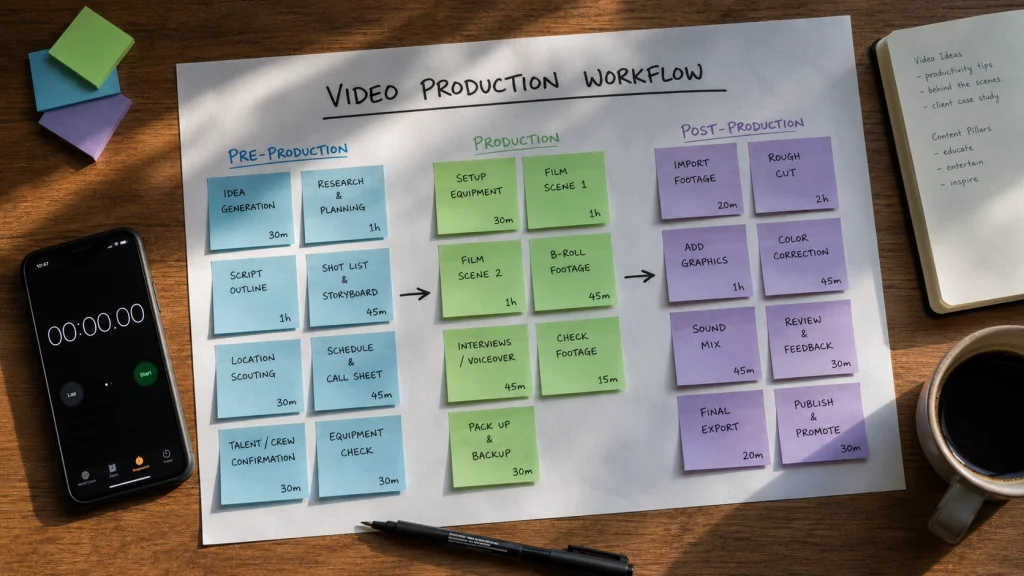
Here is the task-by-task breakdown for turning one eight to ten minute recording into a full publishing cycle across YouTube, LinkedIn, and three short-form platforms. Hours are per video. The last column is the honest answer on whether the task transfers.
| Task | Typical hours | Who should own it | Transfers cleanly? |
|---|---|---|---|
| Topic research and angle selection | 1.0 | VA drafts, you approve | Partly. VA finds options, you pick |
| Script outline or talking points | 0.75 | VA drafts, you rewrite | Partly. Voice stays yours |
| Shot list and asset prep | 0.5 | VA | Yes |
| Filming | 0.75 | You | No |
| Rough cut and edit | 2.0 | Editor, VA coordinates | Yes, to a specialist |
| Clip selection for short-form | 1.0 | VA | Yes |
| Captions and transcript | 0.5 | VA with a captioning tool | Yes |
| Thumbnail from template | 0.5 | VA | Yes |
| Titles, descriptions, tags, five platforms | 1.5 | VA drafts, you spot-check | Yes after four weeks |
| Uploading and scheduling | 0.75 | VA | Yes |
| Comment triage, first 48 hours | 0.5 | Split. VA sorts, you answer substance | Partly |
| Monthly analytics summary | 0.5 per month | VA | Yes |
Hour estimates are editorial, based on a talking-head format with light editing. Complex production, multi-camera shoots, or heavy motion graphics run considerably higher.
Total per video sits near 10 hours. Roughly 7 of those transfer to a VA or an editor. Filming, script voice, and substantive comment replies stay with you, which is about 2.5 hours. That is the real shape of the decision, and it is very different from “hire a VA to do my videos”.
Read the ledger before you write the job post
Two things fall out of this table. First, if you publish four videos a month, you are handing over roughly 28 hours, which is a part-time engagement rather than a full-time hire. Second, editing is the single largest block and it is a specialist skill, so a generalist VA coordinating a dedicated editor usually beats one person attempting both.
What a Video Marketing VA Costs in 2026
Virtual assistant rates in 2026 vary by region more than by skill. Philippines-based VAs generally run $5 to $15 per hour for general work, Latin America sits around $10 to $22, and US-based VAs run $20 to $45. Specialist video and marketing skills add a premium of roughly 30% to 60% over generalist admin rates at every tier.
| Sourcing region | General admin rate | Video and marketing specialist rate | Main trade-off |
|---|---|---|---|
| Philippines | $5 to $15 per hour | $12 to $25 per hour | Deepest talent pool, largest time zone gap for US teams |
| Latin America | $10 to $22 per hour | $18 to $35 per hour | Overlapping US hours, higher rate than Southeast Asia |
| India | $4 to $18 per hour | Varies by specialization | Strong for technical and analytical work |
| United States | $20 to $45 per hour | $40 to $75 per hour | Same time zone and cultural context, highest cost |
Rate ranges compiled from multiple 2026 virtual assistant market reports, checked August 2026. Managed agencies bundle vetting and replacement into the rate. Direct hires cost less per hour and shift that work to you.
Time zone overlap is the variable most people underweight. Publishing work has same-day deadlines, so a VA whose working hours overlap yours by four hours resolves questions in an afternoon rather than a day. That is why teams selling to US buyers often pay the Latin America premium. Working with a virtual assistant based in Mexico or elsewhere in the region buys same-day turnaround on the publishing steps, which is worth more than a few dollars an hour once a launch is running.
Is Delegation Worth It? The Break-Even Math
Delegation pays when the hourly value of your own time exceeds the VA rate plus your management overhead. Management overhead is real and most calculations skip it. Budget 20% of delegated hours as your review time in the first month, dropping to about 5% by month three once feedback loops shorten.
Work it out in three steps.
Step 1. Price your hour. Take your monthly revenue and divide by hours worked. A founder billing $12,000 a month across 160 hours is at $75 per hour. If your time goes to client delivery, use your billable rate.
Step 2. Price the delegated block. Seven transferable hours per video at four videos monthly is 28 hours. At a $18 per hour specialist VA rate, that is $504. Add 20% review time in month one, which is 5.6 of your hours.
Step 3. Compare. Doing it yourself: 28 hours at $75 is $2,100 of opportunity cost. Delegating: $504 plus 5.6 hours of your time at $75, so $924 all in. The gap is $1,176 monthly, and it widens as review time drops.
The comparison against hiring in-house is starker. US film and video editors had a median annual wage of $70,980 in May 2024, according to the Bureau of Labor Statistics, with a median hourly wage of $36.26 in the May 2025 wage survey. Before benefits and payroll costs, one in-house editor is a commitment most small teams cannot justify at four videos a month.
The math flips against you in one case: if your videos are irregular and low volume, the fixed cost of onboarding and documentation outweighs the savings. Below roughly two videos a month, do it yourself or buy per-project editing.
What a Virtual Assistant Cannot Do for Your Video Marketing
A VA cannot supply the thing that makes video work, which is your point of view. They can research what is trending, structure a script, and publish flawlessly, and the output will still underperform if the underlying opinion is generic. Delegation multiplies whatever strategy exists. It does not create one.
Be specific about the limits before you hire:
- Brand voice. A VA can match a documented voice. They cannot invent one. If you have not written down how you sound, expect four to six weeks of drift.
- Subject expertise. In technical or regulated fields, a VA writing descriptions will produce plausible sentences with wrong details. Spot-check every claim for the first month.
- On-camera presence. Nobody can delegate being the person on screen.
- Strategy calls. Which topics to abandon, which format to double down on, whether to leave a platform. These need context a contractor does not have.
- Substantive comment replies. A VA can sort and flag. When a prospect asks a real question in the comments, they want you.
The honest failure mode is subtler than any of these. It is the founder who delegates publishing, stops looking at the content, and discovers three months later that the videos are technically perfect and say nothing. Stay close to the output even after you stop touching it.
Tools That Make the Handover Work
The tool stack matters less than the documentation, but a few categories remove real friction. Pick one tool per job and stop there, since a VA managing seven overlapping platforms spends more time on tool admin than on the work.
| Job | What to use | Why it matters for delegation |
|---|---|---|
| Task and content calendar | Notion, Trello, or Asana | One place where video status is visible without asking |
| File handoff | Google Drive or Dropbox with a fixed folder structure | Version confusion is the most common delay |
| Captions and transcripts | A dedicated captioning service | Removes the slowest manual step in publishing |
| Scheduling | Buffer, Hootsuite, or native platform schedulers | Lets the VA work ahead rather than at your posting time |
| Async feedback | Loom | Showing an edit note takes 90 seconds, writing it takes 10 minutes |
Captions deserve a specific mention because they carry two jobs at once. They make content watchable without sound, which is how most social video is consumed, and they give search engines a text transcript of your video. Tools that generate video captions automatically turn a 30-minute manual task into a review step.
One rule on tool access: give your VA their own login on every platform, never a shared one. Shared credentials make it impossible to see who published what, and they turn offboarding into a password reset scramble.
Hiring: What to Screen For and What to Ignore
Screen for platform fluency and process discipline, not for video editing skill. The best video marketing virtual assistant is usually a strong coordinator who knows what performs on each platform, because editing can be handed to a specialist while coordination cannot.
Skills that predict success:
- Has run a content calendar across at least three platforms
- Knows current aspect ratio and length conventions per platform
- Comfortable in analytics dashboards, can explain what retention means
- Writes clean English at the level your audience expects
- Asks clarifying questions before starting, rather than after finishing
Signals that predict trouble:
- Portfolio shows finished videos but no evidence of the process behind them
- Cannot name a video that underperformed and why
- Agrees with every instruction in the interview without pushing back once
- Quotes a rate far below the regional band. Below the floor you are buying a problem
Four interview questions worth asking
- “Here is a 10-minute recording. Which three moments would you cut for short-form, and why those?” This tests judgement, not software skill.
- “A video underperforms badly. What do you check first?” Look for retention curve and thumbnail click-through, not “post more”.
- “How would you adapt this same message for LinkedIn versus TikTok?” Reveals whether they understand audience or just formats.
- “What would you need from me in week one to work independently by week four?” The good answer includes documentation and examples, not just access.
If you are hiring across borders at any scale, the employment structure becomes its own decision. Our guide on scaling a team across borders using an employer of record covers when a contractor arrangement stops being the right fit.
The First 30 Days: A Handover Sequence That Works
Most delegation fails in week two, not week one. Week one has attention and enthusiasm. Week two is when the VA hits an undocumented decision, guesses, and gets corrected, and confidence drops on both sides. This sequence front-loads the documentation that prevents that.
Days 1 to 5. Watch, do not delegate. Have the VA shadow one full publishing cycle. They document every step as you do it, in their own words. That document becomes the SOP, and it will be more accurate than one you write yourself because it captures the steps you do unconsciously.
Days 6 to 12. They do it, you watch. VA runs one full cycle with you reviewing before anything publishes. Expect to correct 10 to 15 things. Log every correction rather than fixing it silently, since each one is a missing line in the SOP.
Days 13 to 20. Review at the last checkpoint only. VA runs the cycle and you approve at one gate, right before publishing. Corrections should drop to under five.
Days 21 to 30. Publish without pre-approval on low-risk assets. Short-form clips and platform descriptions go live unreviewed. Keep approval on anything making a claim about your product or service.
By day 30 you should be spending under two hours a week on video, and you should have a written SOP that survives a VA leaving. That second outcome is worth as much as the first. The Word Counter is a small help here for keeping platform descriptions inside character limits during the drafting stage.
For a wider view of where else this delegation pattern applies in a business, see our breakdown of the top uses of virtual assistance services that actually drive growth. The content that comes out of this process performs better when it responds to what customers actually say, which we cover in how brands that listen to customers grow faster.
Frequently Asked Questions
What does a video marketing virtual assistant do?
They handle the work surrounding filming: topic research, script outlines, clip selection, captions, thumbnails, platform-specific titles and descriptions, uploading, scheduling, comment triage, and monthly performance reporting. Filming, brand voice, and strategy decisions stay with you. Editing is usually handed to a specialist the VA coordinates.
How much does a video marketing virtual assistant cost?
Rates depend on region. Philippines-based VAs run roughly $5 to $15 per hour for general work and $12 to $25 for marketing specialists. Latin America sits at $10 to $22 general and $18 to $35 specialist. US-based VAs run $20 to $45 general and higher for specialists.
How many hours per week do I need?
Around seven transferable hours per published video. At four videos monthly that is 28 hours, which is a part-time engagement. Add 20% of that as your own review time in month one, falling to about 5% by month three as documentation improves.
Can a virtual assistant edit videos?
Some can handle basic cuts, trimming, and simple assembly. Most generalist VAs cannot produce polished edits with color, sound work, and motion graphics. The common structure is a VA coordinating a dedicated editor, since coordination is harder to replace than editing.
Should I hire a VA or a video agency?
Hire a VA when you produce consistently and want process handled at low cost. Hire an agency when you need creative direction, production quality, or campaign strategy. Agencies cost several times more per deliverable. VAs need documentation from you that agencies supply themselves.
When is a video marketing VA not worth it?
Below roughly two videos a month. The fixed cost of onboarding, documentation, and management outweighs the hours saved at low volume. Buy per-project editing instead, and revisit the decision once your publishing cadence is steady.
What should I document before the VA starts?
Brand voice with three examples of good and bad, your platform list with posting conventions, a folder structure for files, thumbnail templates, and a description template per platform. Anything not written down becomes a guess, and guesses arrive back as corrections.
How do I measure whether the VA is working?
Track hours you spend on video weekly, corrections per publishing cycle, and time from filming to fully published. All three should fall month over month. Views are the wrong early metric, since content performance depends on your strategy more than on execution quality.
Should my VA have their own platform logins?
Yes, always. Individual accounts with the minimum permission level each platform allows. Shared credentials hide who published what and make offboarding a password reset across every tool. Most platforms support delegated access without giving up account ownership.
Do captions actually help video performance?
They help two ways. Most social video is watched without sound, so captions keep viewers watching. They also give platforms and search engines a text transcript to index, which is why a captioned video is more discoverable than an identical uncaptioned one.
Delegate the Process, Keep the Point of View
Go back to that eight-minute recording and the six hours behind it. Nothing about that ratio changes when you hire help. What changes is who spends the six hours, and whether they run on a documented process or on your memory of what you did last time.
The teams that make this work treat the first month as documentation rather than output. They accept a slower month one to buy a faster year. The teams that fail hand over access, expect results, and discover their process only existed in one person’s head.
So the useful question is not whether to hire a video marketing virtual assistant. It is which of your ten hours per video are actually yours to keep. Look at your last three videos honestly and count them. Most founders find the number is smaller than they expected, and the rest has been waiting to be handed over.goes now, identify what only you can do, and delegate everything else to capable team members who multiply your effectiveness.