Legacy systems often store records in formats that AI models cannot use reliably, while data definitions vary across departments. Teams may spend months preparing inputs before users see the first AI feature, even when budgets assume a faster return.
This guide compares 10 top enterprise software development companies by build focus, team structure, and published work. It also covers current AI-readiness data, the requirements for an AI-ready system, and how enterprise development budgets break down across each phase.
Table of Contents
Market Data on Enterprise AI Readiness
AI adoption continues to grow, but measurable returns remain limited. These five figures show how data and delivery problems affect enterprise readiness:
- According to a Gartner forecast, 60% of AI projects may be abandoned through 2026 because they lack AI-ready data.
- 63% of organizations lack the right AI data practices or remain unsure whether they have them, according to Gartner’s survey of data management leaders.
- 37% of organizations reported enterprise-level EBIT impact from AI in McKinsey’s 2026 State of AI survey of 1,719 respondents across 97 countries. The result was nearly unchanged from the previous year.
- About 5% of generative AI pilots achieve rapid revenue growth, according to MIT NANDA’s 2025 report, based on 150 executive interviews, 350 employee surveys, and 300 public AI deployments.
- Purchased AI tools and vendor partnerships succeed about 67% of the time, MIT NANDA reports. Internal enterprise builds succeed at roughly one-third that rate.
10 Top Enterprise Software Development Companies for AI-Ready Systems
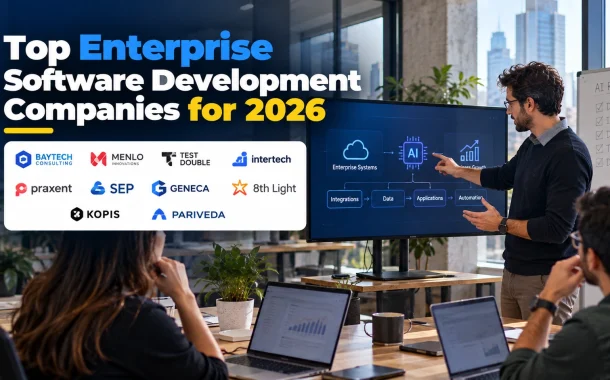
Enterprise software development companies build, integrate, and maintain the business systems that AI features depend on. This review identified 10 U.S.-based providers. The table below compares their primary build focus and team structure.
| Company | Build focus | Team arrangement |
| Baytech Consulting | AI and data layers inside existing business systems | Founder-led onshore in-house team |
| Menlo Innovations | Custom software with user research up front | Pairing-based in-house team |
| Test Double | Legacy modernization, Rails upgrades, pragmatic AI | Remote consultants embedded in client teams |
| Intertech | .NET and Java enterprise applications, cloud migration | Remote, hybrid, or on-site teams |
| Praxent | Financial services platforms and modernization | Augmented, hybrid, or fully managed teams |
| SEP | Cloud, desktop, embedded, mobile, and web software | Employee-owned full-service team |
| Geneca | Custom enterprise apps, IoT, systems integration | 100% US-based agile team |
| 8th Light | Digital products for regulated industries | Cross-functional strategy, design, and engineering team |
| Kopis | Custom software, modernization, Microsoft Cloud | Long-term partnership team |
| Pariveda | AI, data, and integration programs | Employee-owned consulting teams |
1. Baytech Consulting
- Core services: Legacy modernization, AI integration, CRM and ERP systems, and cloud deployment
- Delivery method: Fixed-scope agreements with direct founder oversight
- Track record: More than 120 projects for clients ranging from small businesses to Fortune 500 companies
Baytech Consulting is one of the best enterprise software development companies for AI and data capabilities within existing business systems. Its fully in-house, onshore engineering team doesn’t use offshore subcontractors. Founders Bryan Reynolds and Jeff Skvorc oversee each engagement and document the cost, schedule, scope, and technical strategy before development begins.
Projects typically start with consolidating and preparing business data. Delivery then moves through phased releases, with each phase producing a working part of the system.
For RealSource, Baytech Consulting consolidated fragmented records into a single SQL Server database, automated spatial data collection, and developed an interactive mapping tool. Its case study reports an 85% reduction in manual work and 800% revenue growth within two years. Other published AI project outcomes include a 60% cost reduction, three times faster access to insights, and 99% accuracy.
The company also built a web application for MedData that connects patients with coverage programs they may qualify for.
2. Menlo Innovations
- Core services: Custom software, High-Tech Anthropology, and process consulting
- Delivery method: The Menlo Way, with pairing as a core principle
- Track record: 25 years of operation
Pairing is at the center of The Menlo Way, the delivery process Menlo Innovations uses for custom software projects. Before making design decisions, the team applies High-Tech Anthropology, its method for observing end users and understanding how they work.
Beyond software delivery, Menlo offers transformation consulting, process consulting, keynote presentations, and experience events for organizations adopting similar practices. Published clients include Ford, Daimler, American Family, Snap-on, BD, Nationwide, and CHR. The company marked 25 years in business in 2026.
3. Test Double
- Core services: Software delivery, legacy modernization, and pragmatic AI
- Delivery method: Remote consultants embedded within client teams
- Track record: Operating since 2011
Senior remote consultants join client engineering teams to improve delivery, modernize legacy systems, and address technical bottlenecks. Test Double reports that its software consultants average 15 years of experience.
Todd Kaufman and Justin Searls founded the firm in 2011. An employee stock ownership plan now holds 100% of the company.
Services cover software delivery, DevOps, product strategy, Rails upgrades, legacy modernization, pragmatic AI, and technical assessments. Published clients include GitHub, Zendesk, Gusto, Betterment, New Relic, CircleCI, and Root Insurance.
4. Intertech
- Core services: Architecture, software development, cloud and DevOps, AI, and low-code development
- Delivery method: Remote, hybrid, or on-premises teams
- Track record: Founded in 1991
Since 1991, Intertech has designed, built, and modernized applications using .NET, Java, JavaScript frameworks, and microservices. Its cloud practice supports migrations across AWS, Microsoft Azure, and Google Cloud.
Architecture services include system assessments and modernization roadmaps. A separate AI and low-code practice handles intelligent automation, machine learning proofs of concept, and application development.
Clients can choose fully remote, hybrid, or on-premises delivery. Pricing models include time and materials, fixed-price projects, and dedicated monthly teams. Published clients include Optum, Medtronic, Mayo Clinic, Boeing, Cargill, and Wells Fargo.
5. Praxent
- Core services: Engineering, UX and product design, AI consulting, and modernization
- Delivery method: Fixed-budget agile engagements
- Track record: More than 25 years in business
Financial services products are the main focus of Praxent’s design and engineering work. Its sector experience covers banking, lending, insurance, payments, and wealth management.
Projects use fixed budgets and controlled scope under Scrum or Kanban. Clients can select staff augmentation, a hybrid model led by a Praxent Delivery Lead, or a fully managed team.
The service portfolio also includes AI consulting, DevOps setup, user research, modernization, and ongoing product support. Delta-v Capital made a strategic growth investment in Praxent in April 2026. Published clients include Ameritas, Open Lending, Nymbus, Dimensional, and Texas Mutual.
6. SEP
- Core services: AI, data, design, development, maintenance, and strategy
- Delivery method: Full-service teams working across five platforms
- Track record: Founded in 1988
5 delivery platforms define SEP’s technical range: cloud, desktop, embedded, mobile, and web. Supporting services include AI, data engineering, product design, software development, maintenance, and strategy.
Employees have owned the company since 2010, and its workforce includes 180 people. SEP works with organizations ranging from growing startups to Fortune 100 companies.
Sector experience includes aerospace, defense, automotive, pharmaceuticals, medical devices, banking, energy, agriculture, heavy machinery, aviation, and life sciences. The company has operated since 1988.
7. Geneca
- Core services: Custom software, IoT, and systems integration
- Delivery method: Agile sprints with a U.S.-based team
- Track record: Founded in 1998
Every Geneca team member works from the United States, with delivery organized through agile sprints. The firm develops custom business software, web and mobile applications, IoT products, and integrations for existing systems.
The firm’s industry experience spans healthcare, retail, manufacturing, insurance, financial services, and management consulting. Its portfolio includes work for established organizations and funded startups.
Geneca also provides staff augmentation, software consulting, modernization, and ongoing support for the products it develops. Prospective clients can begin with a free consultation. The company was founded in 1998.
8. 8th Light
- Core services: Product strategy, experiential design, engineering, and agentic AI
- Delivery method: Cross-functional product teams
- Track record: More than 140 team members
Cross-functional teams of strategists, designers, and engineers lead delivery at 8th Light. The company develops digital products and technical solutions for regulated industries, combining product strategy, experiential design, engineering, and agentic AI.
Published clients include Capital One Services, BNY Mellon, Pfizer, Medline Industries, LegalZoom, Grubhub, and Ticketmaster. Its insurance portfolio includes American Family Mutual Insurance and Munich Re Digital Partners.
Nonprofit organizations such as the Center for Policing Equity and Women Employed also appear on the client list. The company reports a team of more than 140 people.
9. Kopis
- Core services: Software development, modernization, generative AI, and business intelligence
- Delivery method: Long-term partnerships beginning with discovery
- Track record: More than 25 years of operation
Kopis combines custom software and mobile development with application modernization, generative AI, workflow automation, and business intelligence. SQL managed services sit within its wider cloud practice.
Microsoft Cloud implementation and support form a separate service line, while the Smart Government practice works with public-sector organizations. Published case studies include the South Carolina Election Commission and Palmetto Care Connections.
The company’s product portfolio includes Honeybrain, an AI-based quality control platform. Engagements begin with a 20-minute discovery call before moving into project definition and delivery.
10. Pariveda
- Core services: AI, data and analytics, integrations, and technology strategy
- Delivery method: Phased 3D Engagement Model
- Track record: Certified B Corporation
Pariveda delivers through its 3D Engagement Model, a phased approach that connects strategy, implementation, and measurable business outcomes.
Its services cover technology strategy, AI, data and analytics, integrations, application development, business strategy, and customer experience. Alliances with AWS and Microsoft support cloud and platform delivery.
Employees own the company, which also holds Certified B Corporation status. Published clients include Engie, Wellstar, Globe Life, Liberty Tax, and Boise Cascade. The company has also published case studies for Finalsite and 48forty.
What AI Readiness Means for Enterprise Software Development
AI readiness describes your systems’ condition before you introduce a model. It determines how difficult and expensive it will be to build, approve, and maintain future AI features.
An AI-ready environment needs 3 foundations:
- Clean, governed data: Records require consistent identifiers, shared definitions across departments, and a clear owner for each source. A customer, product, or order should mean the same thing across every system.
- Reliable integration layers: APIs and event streams allow models to retrieve current records and return results to ERP, CRM, and case management platforms. Employees can then use AI without leaving their existing tools or relying on manual exports.
- Production controls: Access rules, audit logs, prompt and model versioning, and usage monitoring allow security and compliance teams to review AI features like any other production change.
Budget Phases of an AI-Ready Enterprise Build
Enterprise programs divide spending across 3 phases. Each phase reduces risk in the next.
1. Discovery and data profiling
The team maps business processes, systems, integrations, and data sources. It then profiles the records that future AI models will use.
This stage identifies gaps, duplicates, outdated values, and conflicting definitions before development begins. A few weeks of analysis can prevent more expensive rework later.
2. Build and integration
Most of the budget usually goes into application development and systems integration. Engineers connect the product to ERP, CRM, identity, and data platforms.
Contract tests define the expected inputs and outputs for every integration. This helps teams detect breaking changes before each release reaches production.
3. Operation, monitoring, and retraining
Costs continue after launch. Hosting, model-drift monitoring, periodic retraining, security reviews, and support keep the system reliable as data and business processes change.
Including these costs in the first-year budget prevents performance from declining after the initial deployment.
Final Thoughts
Enterprise AI depends on the software, integrations, and data beneath it. When those foundations remain fragmented, models produce unreliable results, users lose trust, and pilots fail to create lasting operational value.
A poor-fit partner may leave behind a model connected to inconsistent data, undocumented integrations, and no retraining plan. Best enterprise software development companies provide a more complete handoff, including profiled data, tested interfaces, monitoring requirements, and an operating budget the client can manage.
Before signing a contract, ask each provider to show how it handed these assets to a previous client.