That is the normal state of a SaaS marketing stack, and it happens because tools get bought in response to problems rather than as part of a plan. This guide covers the five categories that genuinely matter, what the main tools cost in 2026 including the billing layers that do not appear on pricing pages, and what to buy at each stage of growth.
SaaS marketing tools fall into five categories: SEO research, content optimization, product analytics, in-product messaging, and attribution. Most early-stage companies need two or three, not seven. Budget roughly $300 to $600 a month under $1M ARR, and watch for usage-based fees that can exceed the advertised seat price.
Table of Contents
What Makes a SaaS Marketing Tool Different
SaaS marketing tools track behavior after signup, not just before purchase. An ecommerce tool optimizes for a single checkout event. A SaaS tool has to follow a user through trial activation, feature adoption, conversion to paid, and retention, because the revenue arrives monthly rather than once.
That difference shows up in what the tools measure. Ecommerce platforms report conversion rate and average order value. SaaS platforms report trial-to-paid conversion, activation rate, and product-qualified leads. Buying a tool that cannot distinguish a signup from an activated user means paying for reporting that answers a question you do not have.
The practical consequence is narrower than most guides suggest. Plenty of general tools work fine for SaaS. The ones that genuinely do not are the platforms that stop tracking at the purchase event, because for a subscription business that is where the interesting part starts.
The Five Categories You Actually Need
Five jobs cover most SaaS marketing tooling. Almost every product on the market belongs to one of them, and understanding which job you are buying for prevents the duplicate-purchase problem in the opening paragraph.
| Category | What it answers | Typical tools |
|---|---|---|
| SEO and keyword research | What should we write about, and can we rank for it? | Ahrefs, Semrush, SE Ranking |
| Content optimization | Will this specific page rank once published? | Clearscope, Surfer, MarketMuse |
| Behavior analytics | What are people actually doing on the site? | Hotjar, Microsoft Clarity, FullStory |
| In-product messaging | How do we move trial users toward activation? | Fin (formerly Intercom), Userpilot, Appcues |
| Attribution and analytics | Which channel produced this customer? | GA4, PostHog, Amplitude |
Two of these have credible free options that early teams underuse. Microsoft Clarity covers heatmaps and session recordings at no cost, and GA4 handles basic attribution. Starting free in those two categories frees budget for the ones where paid tools genuinely outperform.
Notice also that content optimization is a separate job from keyword research. Teams frequently buy an SEO platform expecting it to tell them how to write the page, then buy an optimization tool three months later after the content fails to rank. Knowing they are two jobs saves that sequence.
What These Tools Cost in 2026
Published pricing for the main SaaS marketing tools has moved significantly in the past year, and two of the changes are large enough to invalidate most guides written before 2026.
| Tool | Published 2026 pricing | Notes |
|---|---|---|
| Ahrefs | $29 Starter, $129 Lite, $249 Standard, $449 Advanced, from $1,499 Enterprise | Starter tier added January 2026, roughly 70% below the previous entry price |
| Fin (formerly Intercom) | $29, $85, or $132 per seat per month on annual billing | Plus $0.99 per AI resolution, with a 50-outcome monthly minimum |
| Microsoft Clarity | Free | Heatmaps and session recordings, no paid tier |
| Hotjar | Free tier plus paid plans | Verify current tiers, pricing has changed |
| Clearscope | Paid only | Verify current tiers, pricing has changed |
Figures reflect published 2026 pricing at the time of writing. Confirm against each vendor’s own pricing page before budgeting, because all five have revised pricing within the past eighteen months.
Watch the Second Billing Layer
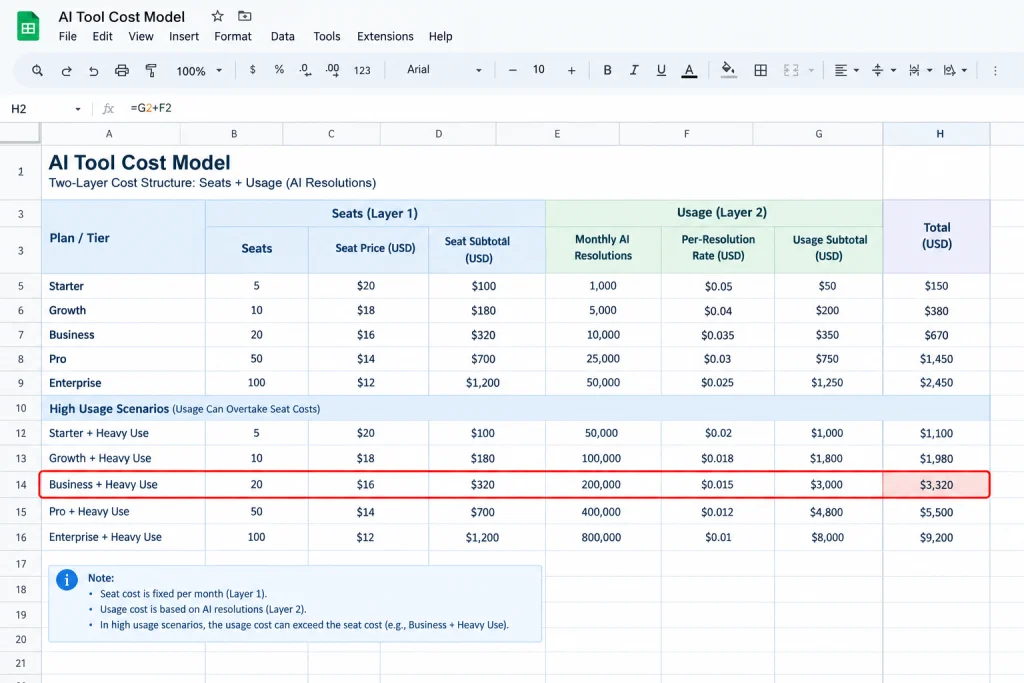
Here is the part that breaks budgets, and it applies to more tools every year. The advertised price is increasingly the smaller of two numbers.
Fin is the clearest example. Seats run $29 to $132 per person per month on annual billing, which looks manageable. Then the AI agent bills $0.99 per resolved conversation on top, with a 50-outcome monthly minimum and no volume discount. A team running 500 AI resolutions a month adds roughly $495 to the bill. At 4,000 resolutions it approaches $4,000 a month on its own, more than the seats cost.
The uncomfortable part of that model is the incentive. The better the AI gets at resolving conversations without a human, the higher your bill goes. That is not hidden, but it is rarely modeled before purchase.
Ahrefs has a quieter version of the same structure. The plan price buys a seat and an allowance, then report credits, crawl credits, API units, and additional seats meter on top. Agencies managing multiple client sites hit those limits well before they expected to.
So when you compare two tools, compare them at your actual expected volume rather than at the sticker price. The cheaper-looking option frequently is not.
Intercom Is Now Fin, and Salesforce Is Acquiring It
If you are evaluating Intercom, two things have changed that most comparison articles have not caught up with.
The company renamed itself Fin in May 2026, after the AI agent that drives its growth. And on 15 June 2026, Salesforce signed a definitive agreement to acquire it for approximately $3.6 billion, with the Fin agent folding into Salesforce’s Agentforce platform. The deal was signed but not closed as of mid-2026.
Nothing about the pricing model changed on announcement. The per-seat plans and the $0.99 per-outcome fee still work the same way. But packaging frequently shifts after an acquisition closes, so if you are signing a multi-year contract, build in a re-evaluation clause rather than assuming today’s terms hold.
One more detail worth knowing before you buy it for onboarding. Product tours are not included in any base plan. They sit in a separate add-on alongside surveys, in-app posts, and mobile push. Guides recommending Intercom for automated trial onboarding routinely omit that, and onboarding is exactly what most SaaS teams buy it for.
What to Buy at Each Stage
Tool needs change with revenue, and buying ahead of your stage is the most reliable way to waste money on software. The pattern below is about sequencing rather than exact thresholds.
| Stage | Priority | Realistic monthly budget |
|---|---|---|
| Pre product-market fit | Free tools only. Clarity plus GA4. Spend on talking to users | $0 |
| Under $1M ARR | One SEO tool, one behavior tool, one messaging tool | $300 to $600 |
| $1M to $5M ARR | Add content optimization and proper attribution | $800 to $2,000 |
| Beyond $5M ARR | Consolidation, integration, and usage-based costs dominate | Varies widely |
The pre-PMF row is the one founders skip and should not. Before you know who your customer is, a keyword research tool tells you what strangers search for, which is not yet a useful question. Tooling accelerates a marketing strategy. It does not produce one.
For the under-$1M stage, specialized tools generally beat all-in-one platforms. A focused stack at a few hundred dollars a month tends to outperform an enterprise platform at several thousand, because you use all of the former and about a fifth of the latter. Our guide to SaaS marketing strategies for B2B brands covers the strategy side that should come first.
How to Tell If a Tool Is Working
Traffic is the metric most stacks report and the least useful one for SaaS. A tool earns its cost by moving a revenue metric, and there are four worth tracking.
- Activation rate. The share of signups that reach the moment your product becomes useful. Define that moment specifically, because “logged in twice” is not it.
- Trial-to-paid conversion. The clearest measure of whether in-product messaging and onboarding tools are doing anything.
- Customer acquisition cost by channel. Not blended. Blended CAC hides which channel is failing.
- Payback period. How many months of subscription revenue it takes to recover the cost of acquiring a customer. This is the number that decides whether growth is fundable.
Run each tool against one of those four. If a tool has been in the stack for two quarters and you cannot name the metric it moved, that is an answer.
Attribution is genuinely hard in SaaS, because the path from first touch to paid conversion often runs months and crosses devices. Perfect attribution is not available. Directionally correct attribution is, and it is enough to decide where next quarter’s budget goes. Our overview of data analytics tools for SaaS platforms covers the measurement layer in more detail.
The Mistakes That Waste the Budget
Four patterns account for most wasted marketing tool spend, and all four are avoidable.
Buying before strategy. Tools bought to answer “what should we do about marketing” produce dashboards nobody acts on. Decide the acquisition approach, then buy the tools that serve it.
Duplicate coverage. Two tools doing the same job is the single most common line item in a bloated stack. Audit by category, not by tool name, and the duplicates become obvious immediately.
Annual contracts signed during a trial. The discount is real and so is the lock-in. Run monthly for one full quarter before committing to a year on anything.
Ignoring the cost of switching. Historical data, integrations, and team familiarity all have value that does not appear in a price comparison. A tool that is 20 percent cheaper and requires rebuilding six months of tracking is not cheaper.
Retention deserves a mention here too, because acquisition tooling gets the budget and churn quietly undoes the results. Our breakdown of SaaS tools for customer retention covers the other half of the equation.
Frequently Asked Questions
What are the best digital marketing tools for SaaS products?
It depends on the job. For SEO research, Ahrefs and Semrush lead. For content optimization, Clearscope and Surfer. For behavior analytics, Microsoft Clarity is free and Hotjar is the common paid choice. For in-product messaging, Fin, Userpilot, and Appcues. Most early-stage companies need two or three, not one of each.
What is the minimum budget for SaaS marketing tools?
Around $300 to $600 a month covers a functional stack under $1M ARR, and it can be less. Microsoft Clarity is free, GA4 is free, and Ahrefs now has a $29 Starter tier introduced in January 2026. Pre product-market fit, the correct number is zero.
How much does Ahrefs cost in 2026?
Published pricing runs $29 for Starter, $129 for Lite, $249 for Standard, $449 for Advanced, and from $1,499 for Enterprise, with roughly 17 percent off for annual billing. The $29 Starter tier arrived in January 2026 and cut the entry price substantially. Credits, API units, and extra seats meter on top.
Is Intercom still called Intercom?
No. The company renamed itself Fin in May 2026 after its AI agent, and on 15 June 2026 Salesforce signed an agreement to acquire it for roughly $3.6 billion. Pricing did not change on announcement, but packaging often shifts after acquisitions close, so avoid long commitments without a re-evaluation clause.
Why is my Intercom bill higher than the plan price?
Because seats are only one layer. Fin bills $0.99 per resolved conversation with a 50-outcome monthly minimum, and that usage charge frequently exceeds the seat cost. Product tours, surveys, and in-app messages sit in a separate paid add-on, and WhatsApp and SMS bill per message.
Should I use an all-in-one platform or specialized tools?
Under roughly $1M ARR, specialized tools usually win. You use all of a focused stack and a fraction of an enterprise platform, while paying for the whole thing. All-in-one becomes more compelling once integration overhead between separate tools starts costing real engineering time.
How long before SEO tools produce results?
Plan on 90 days minimum before evaluating content marketing return, since new content needs time to rank. Conversion tooling is different: heatmaps and session recordings surface problems in days. Judge each category on its own timeline rather than reviewing the whole stack at once.
Can marketing tools replace hiring a marketer?
No. Tools amplify judgement rather than supplying it. A capable marketer with a modest stack consistently outperforms a large stack with nobody to interpret it. If you are choosing between the two, hire first.
What free SaaS marketing tools are worth using?
Microsoft Clarity for heatmaps and session recordings, which covers most of what paid behavior tools do. GA4 for baseline attribution. Google Search Console for actual query data, which no third-party tool replicates. Ahrefs Webmaster Tools gives limited free access for domains you own.
How do I audit an existing marketing stack?
List every tool by category rather than by name. Duplicates surface immediately. Then for each, name the revenue metric it moved in the last two quarters. Anything without an answer is a cancellation candidate, and anything with an upcoming annual renewal should be reviewed first.
Where to Start
The team in the opening did not have a tool problem. They had seven tools and no framework for deciding which job each one was doing, which is how duplicate purchases and forgotten subscriptions accumulate.
So run the category audit before you buy anything else. Five columns, one row per tool, and the duplicates and gaps both become visible in about twenty minutes. Then fill the gaps in stage order: free behavior analytics first, then SEO research, then content optimization once you are publishing regularly, then in-product messaging once you have enough trials for it to matter.
One question is worth answering before the next renewal lands. For each tool you pay for, which number on your revenue dashboard would move if you cancelled it tomorrow?