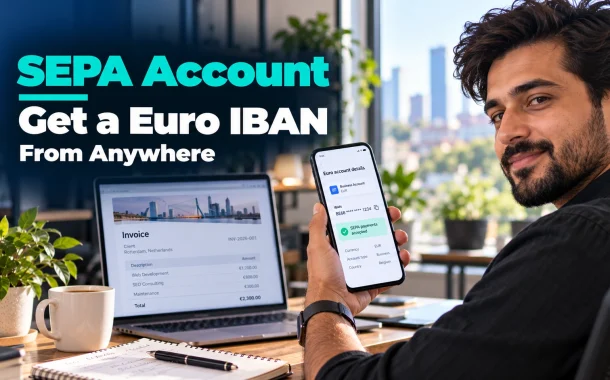
That’s what a SEPA account really is. It’s a euro account whose IBAN sits inside the 41-country SEPA zone, so European clients can pay you like a local supplier. You don’t need to live in Europe to have one. You do need to pick the right kind. Some are cheap and in your name, some charge on every payment, and some get refused by payers who don’t know the law.
A SEPA account is a euro account with an IBAN from one of the 41 SEPA countries. It can send and receive SEPA transfers and direct debits. Non-residents can get one through Wise, Revolut, Payoneer or a business account provider. Pakistani and US bank accounts aren’t SEPA accounts, even in euros, because those countries aren’t in SEPA.
Table of Contents
What Is a SEPA Account?
A SEPA account is any payment account that holds euros and has an IBAN from a SEPA country. Examples include Germany (DE), Belgium (BE), Ireland (IE) and Lithuania (LT). It can receive SEPA credit transfers, often SEPA Instant payments, and SEPA direct debits. It can be a bank account, an e-money account or a payment institution account.
The country code at the start of the IBAN decides whether an account is reachable by SEPA, not the currency alone. A euro account in Karachi or New York can hold euros but can’t receive a SEPA payment. Our guide to the Single Euro Payments Area lists all 41 countries, and what an IBAN is explains how to read the country code.
Is a SEPA Account a Bank Account?
Not always. Many euro IBANs used by freelancers come from e-money or payment institutions such as Wise or Payoneer’s partners, not banks. They work the same for receiving SEPA payments. The difference is protection: bank deposits are covered by deposit insurance, while e-money balances are safeguarded instead. For a working account that money passes through, either is fine.
SEPA Account vs Euro Foreign Currency Account
| SEPA account (European IBAN) | Euro account at a non-SEPA bank | |
|---|---|---|
| Example | Wise BE IBAN, Revolut LT IBAN, Payoneer EUR receiving account | Euro account at a bank in Pakistan, the US or Australia |
| How clients pay you | SEPA transfer, like a local payment | SWIFT wire |
| Speed | Seconds to the next business day | Usually one to five business days |
| Typical cost for the payer | Same as a domestic euro payment, often free | International wire fee |
| Name check before payment | Yes, from euro-area banks | No |
| Direct debits | Usually yes | No |
How to Get a SEPA Account as a Non-Resident
Most people outside Europe get a SEPA account from a fintech provider rather than a European bank. Wise, Revolut and Payoneer issue euro IBANs online in minutes to days. Traditional European banks generally require residency or a registered European company. The EU’s right to a basic bank account covers people living in the EU, not abroad.
| Option | IBAN country | Who can open it | Receiving cost | Best for |
|---|---|---|---|---|
| Wise euro account details | Belgium (BE) | Residents of many countries, including the US, UK and Australia. Not Pakistan | No receiving fee for SEPA, per Wise | Freelancers and travellers in supported countries |
| Revolut euro IBAN | Lithuania (LT) | Customers in the EEA and the UK | Usually free | Everyday banking and spending in euros |
| Payoneer EUR receiving account | EU partner bank | Freelancers and businesses in many countries, including Pakistan | Free in your local currency, 1% for a non-local currency such as euros in Pakistan | Pakistani freelancers and marketplace sellers |
| Business account providers (WorldFirst, others) | Varies | Registered businesses, country rules vary | Varies by provider | Agencies and exporters |
| European bank account | Bank’s country | Usually EU residents or EU companies | Bank’s tariff | People moving to Europe or with an EU company |
What You Need to Open One
- A valid passport or national ID card.
- Proof of address, such as a utility bill or bank statement, for some providers.
- For business accounts, company registration documents and details of what you sell.
- For freelancers, often a link to your profile or a sample invoice to show where payments come from.
IBAN in Your Name vs Shared Collection Account
Some euro IBANs are in your own name. Others are virtual IBANs that route into a pooled account the provider holds, with you as the beneficiary. Both receive SEPA payments, but the name a payer’s bank sees can differ. Since euro-area banks now check the name before every payment, a mismatch can show the payer a “close match” or “no match” warning.
Before you share a new IBAN, ask your provider exactly which account name to put on invoices. Then send a small test payment from a European account if you can. A clean “match” saves awkward emails with a client’s finance team later.
How to Get a SEPA Account in Each Country
Where you live decides which SEPA account you can open. US, UK and Australian residents can usually choose between Wise and Revolut or a business provider. Pakistani residents can’t open Wise or Revolut, so Payoneer or a business account provider is the usual route. EU residents can open a normal local bank account.
| Where you live | Easiest SEPA account | Watch out for |
|---|---|---|
| United States | Wise euro account details | A euro account at a US bank still needs SWIFT |
| United Kingdom | Wise or Revolut, or a UK bank’s euro account if it offers SEPA | Check whether your UK bank’s euro account has a GB IBAN that payers can reach by SEPA |
| Europe | Your own local bank | Nothing special, it’s already a SEPA account |
| Australia | Wise euro account details | Australian banks’ foreign currency accounts receive by SWIFT |
| Pakistan | Payoneer EUR receiving account | 1% receiving fee on euros, plus conversion and withdrawal costs |
From the US or Australia
Neither country is in SEPA, so a euro account at Chase or Commonwealth Bank only receives euros by SWIFT. Wise is the simplest fix. It gives US and Australian customers euro account details with a Belgian IBAN, and Wise says there shouldn’t be a receiving fee for SEPA payments. You then convert to dollars in the app at the mid-market rate plus Wise’s fee.
From the UK
The UK is in SEPA, so some UK banks’ euro accounts can already receive SEPA transfers. Many freelancers still use Wise or Revolut, because their euro IBANs are free, fast to open, and convert to pounds cheaply. Our Wise vs Revolut comparison explains which suits receiving and which suits spending.
From Pakistan
Pakistani banks offer euro foreign currency accounts. State Bank of Pakistan rules let freelancers keep 50% of export earnings or $5,000 a month, whichever is higher, in foreign currency. But those accounts have PK IBANs and receive by SWIFT. For a true SEPA account, most Pakistani freelancers use a Payoneer EUR receiving account, covered in how to receive money with Payoneer.
Payoneer’s fees page lists receiving into a non-local currency account at 1%, with a $1 minimum. For a Pakistani user, euros count as non-local. That’s still usually cheaper than a SWIFT wire with fees on both ends, and much faster. The State Bank of Pakistan’s retention rules apply once you bring the money home.
IBAN Discrimination: When a Payer Refuses Your IBAN
IBAN discrimination is when a company refuses to pay into, or collect from, an IBAN because it comes from another EU country. It’s illegal under Article 9 of the EU SEPA Regulation (EU 260/2012). Employers, landlords, utilities and public bodies in the EU must accept any euro IBAN from another EU country, including Belgian Wise or Lithuanian Revolut IBANs.
What to Do If Your IBAN Is Refused
- Tell the company, politely, that EU law requires it to accept IBANs from any EU country.
- Send a formal written complaint if it still refuses.
- Report it to the competent authority in that country. In Spain, for example, the Banco de España handles cases involving banks and businesses.
- Log the case on acceptmyiban.org, the industry campaign Wise and others support.
When the Rule Doesn’t Help
Article 9 protects EU IBANs. A payer in the UK or Switzerland isn’t bound by it. And nobody has to accept a non-SEPA IBAN, such as a Pakistani one, for a SEPA payment. If a non-EU client refuses your IBAN, ask what their bank needs, or offer a second set of details in a currency they can pay locally.
SEPA Account Fees and Getting Your Money Home
Receiving a SEPA payment is usually free or cheap. The costs come later, when you convert euros to your own currency and withdraw to your local bank. Compare the whole route: receiving fee, conversion and withdrawal. A free IBAN with a poor exchange rate can cost more than a paid one with a fair rate.
| Cost | Wise | Revolut | Payoneer |
|---|---|---|---|
| Receive euros by SEPA | No receiving fee | Usually free | Free if euros are your local currency, otherwise 1% |
| Convert euros | Mid-market rate plus a fee shown upfront | Fee-free up to a monthly limit on the free plan, extra at weekends | 0.5% between balances, more when withdrawing in another currency |
| Withdraw to a local bank | Local transfer, usually small or free | Local transfer, usually free | $1.50 to a local bank in your currency in supported countries |
| Account fee | None | Free plan, paid plans optional | $29.95 a year if you receive under $6,000 in 12 months |
Can You Send Money From a SEPA Account?
Yes, from most of them. Wise and Revolut let you pay European IBANs by SEPA, often instantly. Payoneer is built mainly for receiving and withdrawing, with sending options that vary by country. Our step-by-step guide on how to make a SEPA payment covers the details you need and the name check before you send.
Setting Up a SEPA Account for Client Payments
Once your SEPA account is open, the details you put on invoices decide whether payments arrive cleanly. Show the IBAN, the exact account name your provider gives you, the BIC if a UK or Swiss client asks, and a reference. Say clearly whether you can receive instant payments, so clients don’t assume the money landed.
- Copy the IBAN and account name exactly from your provider’s app.
- Add the invoice number as the payment reference.
- Ask a European friend or client to send a small test payment and check the name-match result.
- Note whether your account receives SEPA Instant Payments or only standard transfers.
- For recurring card or bank billing, consider Stripe’s SEPA options, which give each customer a virtual IBAN.
If a client outside Europe pays you instead, they’ll need a different route, usually a SWIFT wire. Our guide to what a SWIFT code is covers the details they’ll ask for and why those payments sometimes arrive short.
Frequently Asked Questions
Short answers to the SEPA account questions people ask most.
Can a non-resident open a SEPA account?
Yes, through fintech providers. Wise gives euro account details to residents of many countries, including the US, UK and Australia, and Payoneer offers EUR receiving accounts in many more, including Pakistan. Traditional European banks usually need you to live in the EU or own an EU company. The EU right to a basic bank account applies to people resident in the EU, not abroad.
Is a Wise account a SEPA account?
Yes. Wise’s euro account details come with a Belgian IBAN, and Wise holds euro accounts in Belgium and Estonia that are both SEPA-compliant. European clients can pay you by SEPA transfer, and Wise says there shouldn’t be a receiving fee. Payments arrive within minutes when the sender’s bank supports SEPA Instant, or within a working day otherwise.
Is a Revolut IBAN a SEPA account?
Yes. Revolut gives customers in the EEA and the UK a euro IBAN, usually from Lithuania where Revolut Bank UAB is licensed. It sends and receives SEPA transfers and SEPA Instant payments. If an employer or landlord in the EU refuses it because it isn’t a local IBAN, that’s IBAN discrimination, which EU law bans.
Can I get a SEPA account in Pakistan?
Not from a Pakistani bank. A euro account at HBL, Meezan or another local bank has a PK IBAN and receives by SWIFT, because Pakistan isn’t in SEPA. Pakistani freelancers usually use a Payoneer EUR receiving account, which has a European IBAN. Payoneer lists a 1% fee for receiving in a non-local currency, which includes euros for Pakistani users.
Can my US bank account receive SEPA payments?
No. US banks aren’t in SEPA, so a European payer’s bank can only reach them by SWIFT, even if you hold a euro account. To receive SEPA payments in the US, open euro account details with a provider such as Wise, which gives you a European IBAN. You can then convert the euros to dollars and move them to your US bank by ACH.
Does a SEPA account have to be in euros?
For SEPA payments, yes. SEPA only moves euros. Many multi-currency accounts hold pounds, dollars and other currencies alongside euros, but only the euro balance with its European IBAN works as a SEPA account. A UK account receiving pounds uses Faster Payments, and a US account receiving dollars uses ACH or wire transfers instead.
What is IBAN discrimination?
IBAN discrimination is when an employer, landlord, utility or public body in the EU refuses an IBAN because it comes from another EU country. Article 9 of the SEPA Regulation bans it. If it happens, tell the company the rule, complain in writing, then report it to the national authority. You can also log it on acceptmyiban.org.
What is a virtual IBAN?
A virtual IBAN routes payments into an account held by a provider, rather than a separate account opened in your name at a bank. Payment providers and platforms like Stripe use them to give each customer or seller unique details. They receive SEPA payments normally, but the account name a payer sees may differ, so check it before sharing.
Can I receive SEPA direct debits into a fintech IBAN?
You don’t receive direct debits, you get debited by them. Most Wise and Revolut euro accounts accept SEPA direct debits from EU merchants, so you can pay subscriptions and bills. Collecting direct debits from your own customers is different and needs a creditor setup, usually through a provider like Stripe. Our SEPA direct debit mandate guide explains both sides.
Is it safe to keep money in a SEPA account from a fintech?
For day-to-day money, yes. Regulated e-money providers like Wise must safeguard customer money separately from their own. That’s different from deposit insurance, which covers bank deposits such as those at Revolut’s licensed banks. If you hold large savings, keep them at a bank covered by deposit protection, and use the fintech account for receiving and converting.
A European IBAN Without Moving to Europe
Our Rotterdam client never needed to change anything on their side. Once we sent an IBAN inside the SEPA zone, their system paid it like any Dutch supplier. The money arrived the next morning instead of days later by SWIFT. The 1% receiving fee was smaller than the wire fees we’d have paid, and the client stopped asking awkward questions about our bank.
That’s the point of a SEPA account. Pick the provider that’s open to you: Wise in the US, UK and Australia, Revolut in the UK and Europe, Payoneer in Pakistan. Put the exact account name on your invoices, test the name check once, and know your rights if an EU payer refuses a foreign IBAN. Then compare the full cost of getting the money home. A small test payment today can save a week of chasing a wire next month. Which of your European clients is still paying you by SWIFT?