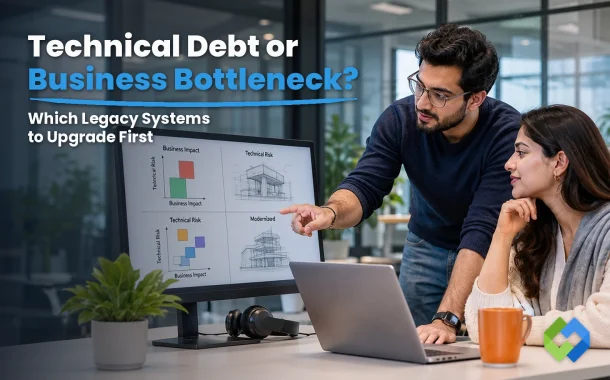
For CTOs and IT managers, the real question is therefore not simply which systems are old. It is which systems create the greatest combination of business risk, operational friction, and future constraints.
Table of Contents
Understanding the Difference Between Technical Debt and Business Bottlenecks
What Is Technical Debt?
Technical debt refers to the future cost created by shortcuts, outdated technologies, poor architecture, or deferred maintenance. Like financial debt, it can be manageable when the cost of carrying it remains low. It becomes problematic when maintenance consumes increasing amounts of time and resources.
What Is a Business Bottleneck?
A business bottleneck occurs when a system or process limits the organization’s ability to achieve an important business outcome.
For example, an aging internal reporting application may have outdated code but still perform reliably with minimal maintenance. Meanwhile, a relatively modern order-processing system might prevent the company from handling increasing transaction volumes efficiently.
This distinction matters because technology age alone should not determine modernization priorities.
Assessing Which Legacy Systems Deserve Attention First
Start With Business Criticality
The first step is to identify what each application actually supports. Systems involved in revenue generation, customer transactions, regulatory compliance, supply chains, or core operations generally deserve closer attention than applications with limited business impact.
IT teams can classify applications according to factors such as:
- Revenue or customer impact
- Number and type of users
- Operational dependency
- Regulatory or security exposure
- Availability requirements
- Integration with other critical systems
- Cost of downtime
- Difficulty of replacing the system
This creates a business-oriented view of the application portfolio. A technically outdated system may remain a low priority if its failure has limited consequences, while a moderately aging platform may require immediate investment because several critical processes depend on it.
Measure the Cost of Keeping the System
An application does not need to be replaced simply because maintenance is inconvenient. Organizations should estimate the actual cost of keeping it in operation.
Direct costs may include infrastructure, licensing, support contracts, and specialized maintenance. Indirect costs can be more significant. These include developer time spent resolving recurring problems, delays caused by difficult releases, manual workarounds, and the inability to introduce new capabilities quickly.
A useful question is: What does the organization lose by keeping this system unchanged for another two or three years?
If the answer is minimal, modernization may not be urgent. If the system is already delaying product launches, increasing operational workload, or creating customer-facing problems, its priority should rise.
Identifying the Signs of High-Risk Systems
Look for Signs of a Business Bottleneck
Certain symptoms indicate that an application is affecting business performance rather than merely creating technical inconvenience.
Slow transaction processing is one example. Another is excessive manual work caused by systems that cannot exchange data efficiently. Frequent application outages, long release cycles, and limited integration capabilities can also become business constraints.
The strongest signals often come from teams outside IT. Finance may report delays in closing processes. Operations may rely on spreadsheets because an application cannot support a required workflow. Customer service may spend significant time correcting errors caused by disconnected systems.
These observations help connect technical problems with measurable business outcomes.
Evaluate Technical Debt Separately
Once business impact is understood, teams can assess the technical condition of each system.
Important indicators include outdated dependencies, unsupported operating environments, fragile integrations, insufficient test coverage, security vulnerabilities, poor documentation, and a shortage of developers with relevant expertise.
Technical debt should be evaluated based on its trajectory, not just its current state. A system that requires little maintenance today but becomes increasingly difficult to support may represent a growing future risk.
Teams should also consider whether the architecture prevents incremental improvements. A system may function adequately while making every future change disproportionately expensive.
Building a Framework for Modernization Prioritization
Use a Simple Priority Matrix
A practical way to compare applications is to score them across two dimensions: business impact and technical risk.
- High business impact and high technical risk: These systems should generally receive the earliest attention because failure or continued limitations can materially affect the organization.
- High business impact but lower technical risk: They may not require immediate replacement but should have a clear maintenance and evolution plan.
- Low business impact and high technical risk: Consider isolating, retiring, replacing, or maintaining them with limited investment.
- Low business impact and low technical risk: These systems may simply remain in operation.
This approach prevents modernization budgets from being consumed by technically interesting projects that have little business value.
Validate Assumptions Before Committing Investment
Prioritization should not rely entirely on internal perceptions. Teams may believe a particular application is difficult to maintain without knowing whether its limitations actually affect users.
An independent code review can provide an additional perspective on architectural quality, maintainability, security concerns, and areas of accumulated technical debt. The findings can then be compared with operational data and business priorities rather than treated as a modernization mandate on their own.
This distinction is important because technical recommendations should support business decisions, not replace them.
Choosing the Right Modernization Strategy
Match the Approach to the Underlying Problem
Not every high-priority system needs a complete rewrite. Depending on the underlying problem, organizations may choose different responses.
Refactoring can address problematic code while preserving existing functionality. Replatforming can move an application to a more sustainable environment without redesigning everything. Replacing a specific component may remove a bottleneck without disturbing the rest of the system.
In some cases, modernizing legacy software incrementally is more appropriate than undertaking a large-scale replacement. Teams can separate business capabilities, improve interfaces, and gradually move functionality while keeping the existing system operational.
Retirement should also remain an option. If an application no longer provides meaningful value, eliminating it may create more benefit than investing in its modernization.
Making Modernization Prioritization an Ongoing Process
Application portfolios change as businesses change. A system that was low priority two years ago may become critical after a new product launch, acquisition, regulatory requirement, or change in customer behavior.
For that reason, modernization prioritization should be reviewed periodically rather than treated as a one-time exercise.
The most useful framework is not “old versus new.” It is business value versus risk and constraint. Technical debt matters, but it becomes strategically urgent when it increases operational risk, raises costs, or limits the organization’s ability to execute.
By separating technical debt from genuine business bottlenecks, technology leaders can direct modernization investment toward the systems where change is most likely to improve resilience, efficiency, and long-term business performance.