

Their plan could not take payments, could not run a custom theme, and was roughly a hundred subscribers from a forced upgrade, because Ghost counts free readers against the member cap the same way it counts paying ones. Nothing had gone wrong. They had simply chosen on a headline price two years earlier and never had reason to read the tier comparison again.
That is the conversation a Ghost vs WordPress guide should prepare you for, and almost none do. Both platforms are good. The decision rarely turns on which has nicer themes. It turns on what each one costs at your scale, what the cheap tier quietly excludes, and whether your audience is subscribers or visitors. This guide covers the real 2026 numbers on both sides.
Ghost suits paid newsletters and subscription publications, with Ghost(Pro) from $15 monthly and 0% revenue share. WordPress suits everything else, especially sites needing ecommerce, custom functionality, or ad revenue. Ghost’s cheap tier blocks paid subscriptions. WordPress costs less at scale but demands more maintenance.
Table of Contents
The Short Answer
Choose Ghost if your business model is paid subscriptions and your output is writing. Choose WordPress if you need ecommerce, complex functionality, custom post types, or advertising revenue. Ghost is a publishing platform that does one job extremely well. WordPress is a general-purpose CMS that does most jobs adequately and some jobs exceptionally.
The market split reflects that. WordPress runs roughly 41% of all websites and about 59% of sites using a known CMS as of mid-2026, while Ghost sits near 0.1% of all websites. That gap is not a quality verdict. Ghost is a focused tool for a specific job, and the comparison only makes sense once you know which job you have.
What Ghost and WordPress Actually Are
WordPress is an open-source, general-purpose CMS released in 2003 by Matt Mullenweg and Mike Little, forked from an earlier tool called b2/cafelog. It powers blogs, stores, membership sites, directories, and enterprise publications, with roughly 69,000 free plugins and over 30,000 themes.
Ghost is an open-source publishing platform launched in 2013 after a Kickstarter campaign, built by John O’Nolan and Hannah Wolfe as a deliberately narrower alternative. It ships with newsletters, memberships, and paid subscriptions built into the core product rather than added by plugins.
One correction worth making, because it appears in a lot of comparisons: Ghost is not a headless CMS. It has its own front end and its own theme system built on Handlebars, and a standard Ghost site renders pages the same way WordPress does. Ghost does expose a Content API, so you can run it headless with a separate front end, but that is an option rather than the default. Describing Ghost as headless implies you need to build your own front end, which is not true.
WordPress can also run headless through its REST API, so this is a capability both share rather than a difference between them.
What Each One Actually Costs in 2026
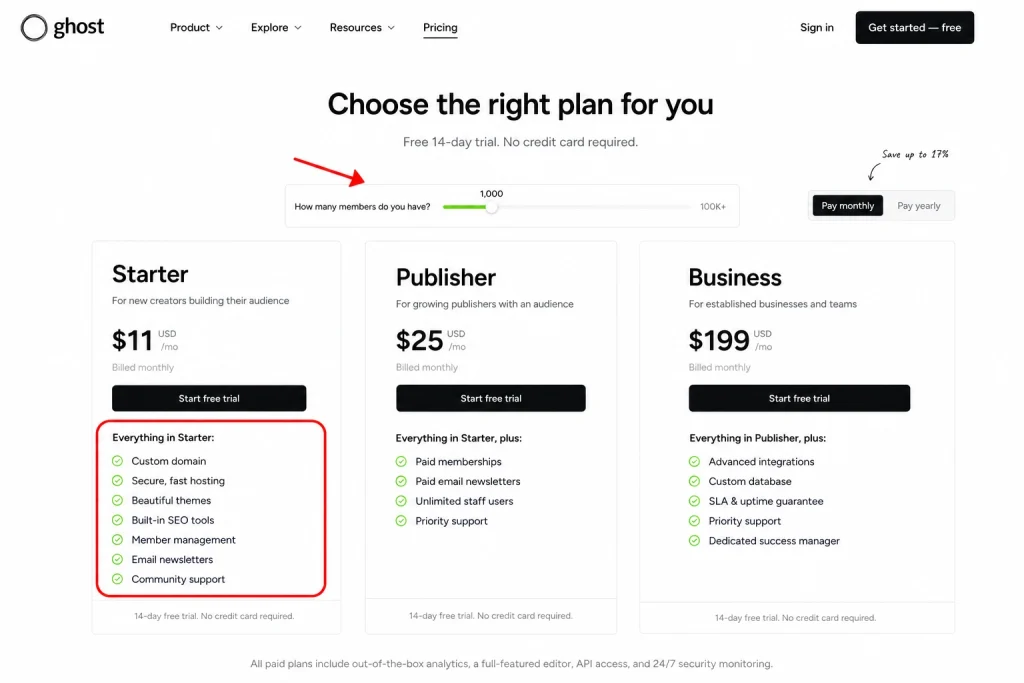
Ghost(Pro) runs $15 to $199 per month on annual billing, priced by member count. WordPress software is free, with real costs in hosting, themes, plugins, and maintenance. The comparison flips depending on scale: Ghost is often cheaper for a small publication, WordPress is almost always cheaper for a large site.
Ghost(Pro) pricing
| Plan | Annual billing | Monthly billing | Members included | Staff users | Paid subscriptions? |
|---|---|---|---|---|---|
| Starter | $15/month | $18/month | 1,000 | 1 | No |
| Publisher | $29/month | $35/month | 1,000, scales up | 3 | Yes |
| Business | $199/month | $239/month | 1,000, scales up | 15 | Yes |
| Enterprise | Custom | Custom | Custom | Custom | Yes |
Ghost(Pro) rates verified against multiple 2026 pricing trackers, August 2026. Annual billing runs roughly 17% below monthly. Ghost takes 0% of subscription revenue on paid plans, though Stripe’s processing fee of about 2.9% still applies.
Two traps sit inside that table, and both catch people after they have committed.
The Starter plan cannot take money. A July 2025 change removed paid subscription support from Starter and locked it to a single theme. It went from around $9 to $15 in the same update, and has since reached $18 on monthly billing. If your reason for choosing Ghost is monetization, your real entry price is Publisher at $29, not the $15 headline.
Free members count against your cap. Both free and paying subscribers count equally toward the member limit. A publication with 800 free readers and 200 paying members has hit the 1,000 ceiling and must upgrade, even though only a fifth of that audience generates revenue. Pricing scales with audience size rather than revenue, which means a large free list costs you money without earning any. On the Business plan, going from 1,000 to 100,000 contacts moves the price from around $50 to $329 a month.
WordPress pricing
WordPress software is free. What you pay for is everything around it.
| Cost | Typical annual range | Notes |
|---|---|---|
| Shared or managed hosting | $60 to $600 | Managed WordPress hosting sits at the upper end |
| Domain | $10 to $20 | Same for either platform |
| Premium theme | $0 to $100 one-time | Thousands of free themes exist |
| Plugins | $0 to $500+ | Free options cover most needs. Membership and SEO plugins are the common paid ones |
| Maintenance | $0 to $1,200+ | Zero if you do it yourself. This is the honest hidden cost |
A small WordPress blog on shared hosting genuinely runs $60 to $100 a year. The same site on Ghost(Pro) Starter runs $180. At that scale WordPress is cheaper on paper, and the gap is your own time.
Self-hosting Ghost is not free
The original version of this comparison, like most others, said you can self-host Ghost for free. The software is free. Running it is not.
Ghost’s own documentation estimates self-hosting at roughly $72 per month once you include CDN, analytics, backups, and email delivery. That is above Ghost(Pro) Starter and above Publisher. Self-hosted Ghost also needs you to configure an external SMTP service for newsletters, since email delivery is bundled only on Ghost(Pro).
Self-hosting Ghost makes sense if you already run infrastructure and have engineering time. For a solo writer it usually costs more, not less, once you price your hours.
The Monetization Comparison That Actually Matters
This is where the two platforms genuinely diverge, and it is the strongest reason to pick one over the other. Ghost is built for subscription revenue and takes none of it. WordPress is built for everything else and takes none of it either, but requires plugins to do what Ghost does natively.
| Revenue model | Ghost | WordPress |
|---|---|---|
| Paid subscriptions | Built in, 0% platform fee, Publisher plan and up | Via plugin. MemberPress, Paid Memberships Pro, others |
| Email newsletters | Built in, delivery included on Ghost(Pro) | Via plugin plus a separate email service |
| Display advertising | No built-in support. Possible via theme edits | Native. AdSense and ad management plugins |
| Affiliate marketing | Works. Just links in content | Works, plus link management and cloaking plugins |
| Selling physical products | Not supported meaningfully | WooCommerce, roughly 30% of the ecommerce plugin market |
| Digital products and courses | Limited, usually via external tools | Extensive plugin options |
| Sponsored content | Works on both | Works on both |
The Substack comparison worth running
Ghost’s 0% revenue share is its strongest financial argument, and it is easiest to see against a platform that takes a cut.
A creator earning $1,000 a month from subscriptions at a $10 price point pays roughly $29 for Ghost Publisher plus about $59 in Stripe fees, so around $88 total. The same revenue on Substack costs about $100 in platform fees plus the same $59 in Stripe, so around $159. Ghost becomes cheaper above roughly $290 a month in subscription revenue, because 10% of $290 equals Ghost’s monthly bill.
That break-even is the actual argument for Ghost, and it has nothing to do with WordPress. If you are choosing between Ghost and WordPress for a paid newsletter, both take 0% and the decision comes down to whether you want the feature built in or assembled from plugins.
Performance, Maintenance, and What Goes Wrong
Ghost is faster out of the box because it does less. WordPress performance depends almost entirely on hosting quality, plugin count, and configuration, which means a well-built WordPress site is fast and a neglected one is slow. The maintenance burden splits the same way.
Ghost runs on Node.js with a lean default stack. On Ghost(Pro), updates, backups, SSL, and CDN are handled for you. There is very little to break because there is very little to configure.
WordPress runs on PHP and gives you thousands of extension points, each of which is a thing that can break. Plugin conflicts, abandoned plugins, and PHP version changes are the routine maintenance load. Our guide on preparing a WordPress site for PHP 8 covers one recurring example, and the same pattern applies to plugin updates generally.
The honest framing: Ghost trades flexibility for fewer decisions. WordPress trades simplicity for the ability to build anything. Neither is free of maintenance, but WordPress asks for more of it, and asks continuously. If you run several sites, that compounds, which is the problem our guide to WordPress management across multiple websites addresses.
One more difference that matters for SEO work. WordPress has mature SEO plugins, structured data controls, and redirect management as standard. Ghost handles SEO fundamentals well by default but gives you fewer levers when you need something specific.
Content Creation and Design
Ghost’s editor is cleaner. WordPress’s editor is more capable. Which one wins depends on whether you are writing articles or building pages.
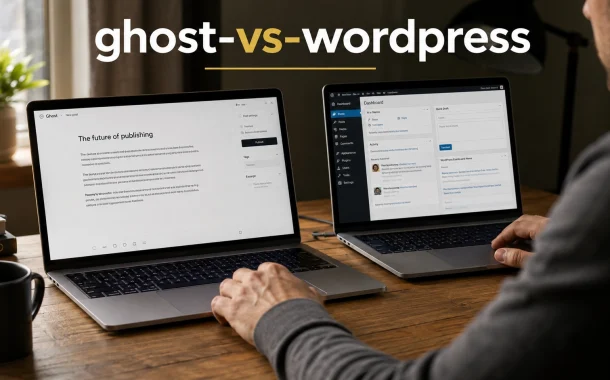
Ghost’s editor is markdown-friendly, distraction-free, and built for long-form writing, with cards for images, embeds, and newsletter-specific elements. WordPress uses the block editor, which handles complex layouts, custom post types, and page building at the cost of more interface.
On design, WordPress has over 30,000 themes plus page builders like Elementor. Ghost has a smaller, more curated theme library built around content presentation. Both let you edit theme code directly.
Note one Ghost restriction here too: custom themes require the Publisher plan. Starter locks you to the default. If theme control matters, the $15 tier is out. For teams doing structured publishing on WordPress, our guide to building a WordPress post template covers the conventional approach.
Worth saying plainly, since Webzeto builds WordPress sites: the theme count is a weak argument. Most of those 30,000 themes are poor. What WordPress actually gives you is the ability to build exactly what you want, which is a different thing from choosing from a large catalog. If a curated set of good themes covers your needs, Ghost’s smaller library is not a disadvantage.
Which One Should You Pick?
Match the platform to your revenue model and your content type, not to feature counts. The decision is usually clear once you name what the site has to do.
Choose Ghost if:
- Your primary revenue is paid subscriptions or a paid newsletter
- Your content is writing, not products or services
- You want newsletters and memberships built in rather than assembled
- You would rather pay a flat fee than maintain infrastructure
- Your audience will stay in a member-count band you can afford
Choose WordPress if:
- You need ecommerce, now or later
- Advertising or affiliate income is part of the plan
- You need custom post types, directories, or functionality beyond publishing
- You have a large free audience, since Ghost charges for it and WordPress does not
- You want to own the full stack and can handle maintenance
- Budget is tight at scale
The case most people get wrong: a business site with a blog attached. That is WordPress, not Ghost. Ghost is excellent at publishing and weak at everything a business site needs around the publishing. If you are also planning to sell, the plugin ecosystem matters, and our guide to adding PayPal to WooCommerce is the kind of thing that has no Ghost equivalent.
That was the consultancy client from the top of this article. Once we listed what they actually needed, the platform question answered itself. A service page with lead capture, a course to sell, gated content for paying members, and a blog. Three of those four are outside what Ghost does, and the fourth is the only thing Ghost does better. We moved them to WordPress.
The part worth passing on is what the migration cost them, because it was not the build. Their articles imported cleanly. What took the time was rebuilding the subscriber flow, redirecting old URLs, and re-establishing the email sending reputation on a new provider. If they had picked WordPress at the start, that work would not have existed. The lesson is not that Ghost was the wrong tool. It is that they chose before knowing what the site would need to do eighteen months later.
Migration is possible in both directions and both platforms have import tools, but expect to rebuild layouts and redo internal links. Choosing well now is worth more than choosing fast.
If you want help deciding, a WordPress web design company or specialist developer can scope the work before you commit to a platform.
Frequently Asked Questions
Is Ghost better than WordPress?
Neither is better in general. Ghost is better for paid newsletters and subscription publications, since memberships and email are built in and it takes 0% of revenue. WordPress is better for everything else, particularly ecommerce, advertising-supported sites, and anything needing custom functionality beyond publishing.
How much does Ghost cost compared to WordPress?
Ghost(Pro) runs $15 to $199 monthly on annual billing, priced by member count. WordPress software is free, with hosting from around $60 yearly. A small WordPress blog costs $60 to $100 a year against $180 for Ghost Starter. At larger scale WordPress stays cheaper because it does not charge per subscriber.
Can you make money with Ghost’s cheapest plan?
No. The Starter plan lost paid subscription support in July 2025 and only supports free memberships. To charge readers you need Publisher at $29 monthly on annual billing. Starter also locks you to the default theme, so custom design requires the same upgrade.
Do free subscribers count toward Ghost’s member limit?
Yes, and this surprises most publishers. Free and paying members count equally. A site with 800 free readers and 200 paying members has hit the 1,000-member cap and must upgrade. Pricing scales with audience size rather than with revenue.
Is Ghost a headless CMS?
Not by default. Ghost has its own front end and Handlebars theme system, and renders pages conventionally. It offers a Content API so you can run it headless with a separate front end, but that is optional. WordPress also supports headless use through its REST API, so this is a shared capability.
Is Ghost faster than WordPress?
Ghost is typically faster out of the box because it does less and its default stack is lean. A well-optimized WordPress site on good hosting with few plugins performs comparably. WordPress performance varies enormously with configuration, while Ghost’s is more consistent because there is less to configure.
Can you self-host Ghost for free?
The software is free, but running it is not. Ghost’s own documentation estimates roughly $72 monthly once you include CDN, analytics, backups, and email delivery, which is more than Ghost(Pro) Starter or Publisher. Self-hosting suits teams already running infrastructure.
Can Ghost do ecommerce?
Not meaningfully. Ghost handles subscriptions and memberships, not product catalogs, carts, inventory, or shipping. If you need to sell physical products, WordPress with WooCommerce is the practical option. Some Ghost sites embed third-party checkout, but it is a workaround.
Is WordPress losing market share?
Slightly. W3Techs put WordPress at roughly 41% of all websites in mid-2026, down from a peak above 43%. The decline reflects faster growth by hosted builders like Wix and Shopify rather than sites leaving WordPress. It still holds around 59% of the known CMS market.
Can you migrate from WordPress to Ghost or back?
Yes, both directions, and both platforms provide import tools that move posts, images, and basic metadata. What does not transfer cleanly is layout, plugin functionality, and custom fields. Plan to rebuild the presentation layer and audit internal links after any migration.
Choosing Between Ghost and WordPress Without Regret
Go back to that consultancy and their 900 subscribers. Nothing about their original choice of Ghost was wrong. They picked on a headline price that did not include the three things they would eventually want, and by the time they wanted them, moving cost more than choosing well would have.
That is the whole lesson of Ghost vs WordPress. Both platforms are well built and both will serve you for years. What catches people is the gap between the advertised entry price and the tier that actually does the job, and on Ghost that gap is $15 versus $29 plus a member cap that counts readers who pay you nothing.
So the useful question is not which platform is better. It is what your site has to do in eighteen months, and which platform charges you least for doing it. Write that down before you look at either pricing page, and the answer usually picks itself. What does your site need to do that you have not budgeted for yet?