

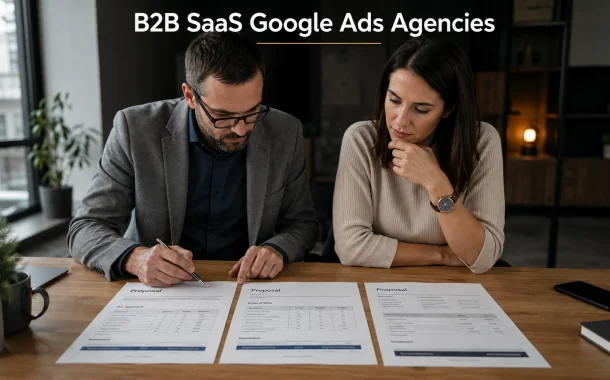
That gap is the actual problem with choosing a B2B SaaS Google Ads agency. Every list ranks agencies on adjectives, then leaves out the two things that decide the engagement: what it costs, and whether the pricing model pays your agency to do the right thing. This guide covers both, alongside the benchmark numbers you will be quoted in a sales call and why they disagree with each other by a factor of seven.
A B2B SaaS Google Ads agency typically charges $1,500 to $25,000 per month, either as a flat retainer or 10% to 20% of ad spend. Specialist SaaS agencies cluster at $3,000 to $12,000. Flat fees align incentives better than percentage-of-spend, which pays the agency more as your budget grows.
Table of Contents
Disclosure
Webzeto is a digital agency. We build websites and run marketing work, which means several companies on this page compete with us in adjacent areas. No agency below reviewed it before publication.
Read that as a reason to check our reasoning rather than trust our ranking. Every claim about cost comes from a published source, named inline. Where an agency does not publish its pricing, we say so instead of inventing a number.
What a B2B SaaS Google Ads Agency Actually Costs
Published rates in 2026 run from about $1,500 to $25,000 or more per month. Specialist B2B SaaS agencies cluster in the $3,000 to $12,000 range, with enterprise engagements above that. Percentage-of-spend arrangements typically run 10% to 20% of monthly ad budget, and some sources put the upper band nearer 30%.
| Pricing model | Typical 2026 range | What it optimizes for | Where it goes wrong |
|---|---|---|---|
| Flat monthly retainer | $1,500 to $12,000, enterprise $12,000 to $30,000+ | Predictability. Fee does not move when budget moves | Scope creep. Low retainers exclude landing pages, tracking setup, creative testing |
| Percentage of ad spend | 10% to 20% of monthly spend, some quote up to 30% | Scaling with account complexity | Pays the agency more when you spend more, whether or not performance improves |
| Hybrid | Base retainer plus 5% of spend above a threshold | Balance of both | Two things to negotiate instead of one, and the threshold is where the argument lives |
| Performance-based | Rare in PPC, more common in lead gen | Alignment on outcomes | Needs attribution both sides trust. In long SaaS cycles, that is hard |
| Project-based | $1,000 to $50,000+ per engagement | Defined work like an account rebuild | No ongoing optimization, which is where most of the value is |
Ranges compiled from published 2026 agency pricing guides, checked August 2026. Individual quotes vary widely by scope.
The ratio that matters more than the number
A useful sanity check circulating among agency operators: management fees should sit around 10% to 20% of ad spend, or below 15% of the revenue the agency is responsible for driving. An agency charging $15,000 a month to manage $30,000 in spend is taking half your media investment in fees. That only works if they can roughly double your return.
Apply this before you compare quotes. A $3,000 flat fee on $50,000 of spend is 6%. The same $3,000 on $10,000 of spend is 30%. Same invoice, completely different deal.
Why the pricing model matters more than the price
Percentage-of-spend has one structural problem: it pays the agency more when your budget grows, regardless of whether performance improved. That does not make it a bad model, and it does reflect that bigger accounts genuinely take more work. It does mean the incentive needs a check on it.
If you sign a percentage deal, tie budget increases to performance in writing. More spend should require CAC, ROAS, or lead quality to be holding or improving. Without that clause, the model quietly rewards a recommendation you cannot easily audit.
The Benchmark Numbers You Will Be Quoted
Ask what a Google Ads click costs a B2B SaaS company in 2026 and credible published answers range from about $3.33 to $25. That is not one source being wrong. It is different agencies measuring different account mixes, using different definitions, and rarely saying which.
| Source and date | Reported B2B SaaS CPC | What it measures |
|---|---|---|
| Ryze, June 2026 | $3.33 | B2B category, all campaign types, blended |
| ROA Marketing, July 2026 | $3.80 | Technology/SaaS, Search Network, weighted |
| Kampaio citing Involve Digital, June 2026 | $5.34 | Non-branded Search, up 29% year over year |
| GrowthSpree, April 2026 | $8.50 to $14.00 | Median non-brand Search, by vertical |
| GrowthSpree, by vertical | $7 to $9 DevTools, $16 to $18 cybersecurity and FinTech | Non-brand Search |
The spread is the finding. “Average CPC” is not a fact about Google Ads, it is a fact about whose accounts got averaged. Blended figures include cheap branded clicks, which is why they land near $3. Non-brand figures exclude them, which is why they land near $10. Any agency quoting you a single average without saying which one it is has told you nothing.
Two patterns hold across every credible source. Cost rises with regulatory weight and deal size, so cybersecurity pays roughly 2.4 times what DevTools pays per click. And conversion rate, not CPC, is where 2026 gains came from. One agency dataset tracking the same accounts across two years found CPC flat year over year while conversion rates rose about 48%.
Use these to sanity-check your own trailing 90 days, not to grade yourself against someone else’s account mix. And when an agency opens with a benchmark, ask which definition it uses. The answer tells you a lot about how carefully they handle data.
Cost per lead spreads even wider. Published 2026 figures run $50 to $200 per MQL for typical B2B SaaS, $87 to $200 for SMB, $200 to $900 mid-market, and $1,500 to $4,500 for enterprise. One agency reports around $855 cost per lead as the norm for technical SaaS. If someone promises you a $50 lead for an enterprise product, they are either measuring something else or selling you something.
How to Evaluate a B2B SaaS Google Ads Agency
Judge on four things: whether they can connect spend to pipeline, whether their pricing model aligns with your outcomes, whether senior people stay on the account, and whether they will tell you when Google Ads is the wrong channel. Everything else is secondary.
Revenue attribution, not lead reporting. Any agency reports leads. Fewer connect spend to pipeline value and closed-won revenue. Ask how they integrate with your CRM and whether they use offline conversion imports. A vague answer here is disqualifying, because it is the whole job.
SaaS buying cycle experience. B2B software purchases run 30 to 120 days depending on deal size, with a buying committee rather than one decision-maker. Campaigns have to work across awareness, evaluation, and decision rather than optimizing to a single conversion event.
Demand capture versus demand generation. Google Ads captures existing demand well. A good agency knows when to run high-intent search, when to layer YouTube or Display for awareness, and when paid search is not the answer at all. Related channels sit alongside it rather than competing with it, and a partner running Meta Ads or LinkedIn should be able to explain how each channel earns its place rather than defaulting to running all of them.
Who actually works on your account. Agencies sell you a senior strategist and staff you with a junior. Ask who runs day-to-day optimization, how many accounts that person carries, and what happens if they leave.
Cost per acquisition in context. A $200 CPA producing $50,000 ACV deals beats a $50 CPA producing unqualified demos. If an agency leads with CPA and cannot discuss lead-to-opportunity and opportunity-to-close rates, they are measuring the easy thing.
Contract exit path. Avoid 12-month commitments with no performance clause. Month-to-month makes an agency re-earn the account every 30 days. If a long contract is non-negotiable, get a defined performance break clause in it.
The paid channel decision sits inside a broader go-to-market picture, which our guide to SaaS marketing strategies for B2B brands covers in more depth.
Ten Agencies Worth Evaluating
These are established B2B SaaS or B2B-heavy paid media agencies. This is not a ranking, and the order is not a recommendation. None of them publish full pricing, so where cost is unknown we say so.
Hey Digital
Website: heydigital.co
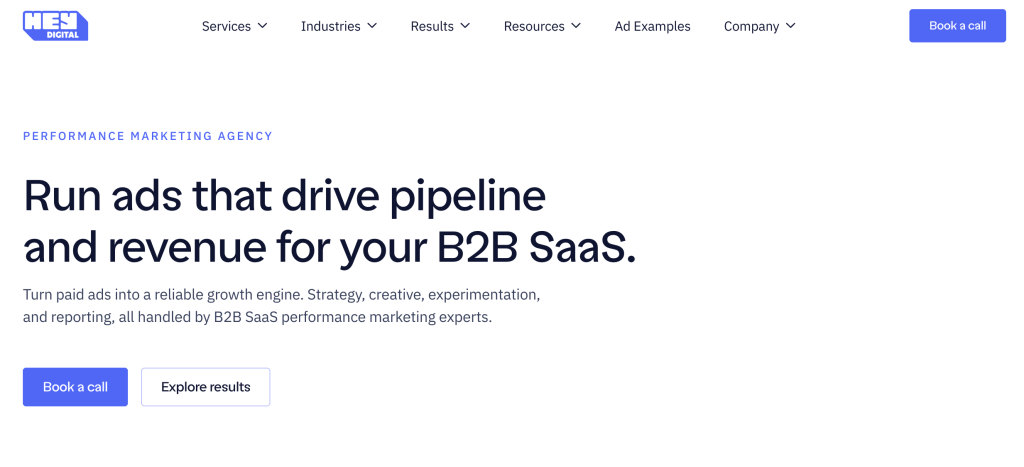
A B2B SaaS performance marketing agency working exclusively with software companies, across Google Ads, LinkedIn, Meta, and other paid channels. The specialization is the pitch: narrow focus, SaaS-experienced leadership, structured testing built around each client’s ICP and funnel stage rather than generic templates.
They state having worked with over 200 B2B SaaS companies. That figure comes from the agency, not an independent audit, so treat it as a claim to verify rather than a fact.
Likely fit: Series A through Series C SaaS with product-market fit, scaling paid acquisition with pipeline accountability. Pricing: Not published. Ask for the model, not just the number.
Directive Consulting
Website: directiveconsulting.com
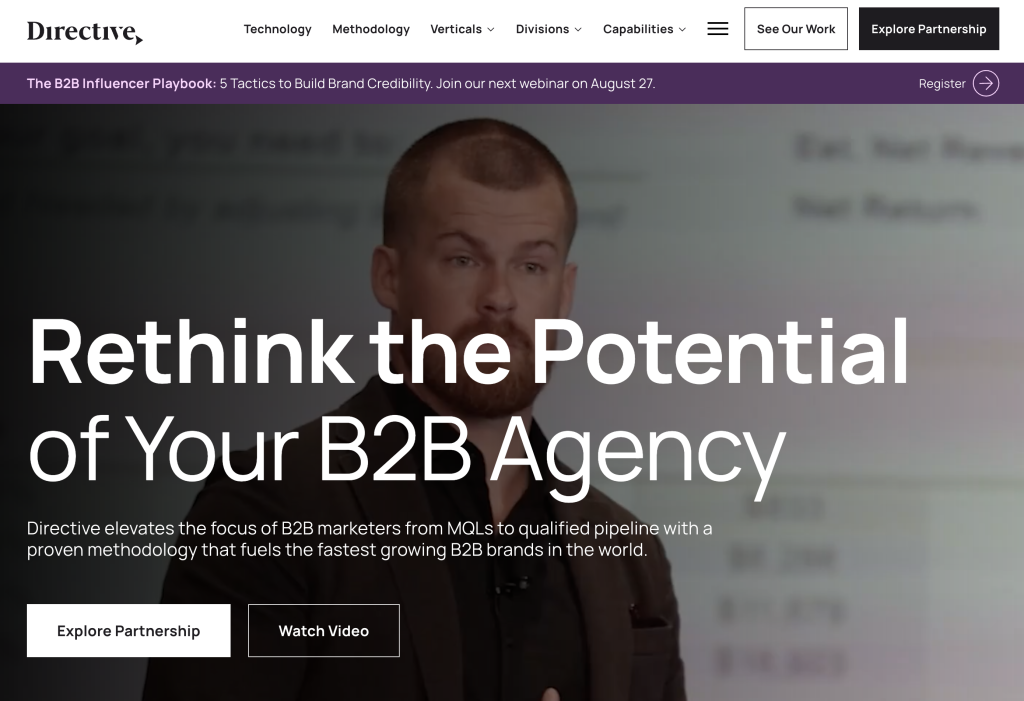
A performance marketing agency focused on the technology sector, known for its Customer Generation methodology, which prioritizes lifetime value over lead volume. Their Google Ads work centers on pipeline attribution with deep CRM integration.
Likely fit: Mid-market and enterprise SaaS running sophisticated attribution and account-based strategies. Pricing: Not published. Reported to work with larger ad budgets.
KlientBoost
Website: klientboost.com
Pairs PPC management with conversion rate optimization, testing landing pages, creative, and offers together rather than in sequence. That combination suits companies whose problem is funnel efficiency rather than traffic volume.
Likely fit: Growth-stage SaaS that wants aggressive testing and fast iteration. Pricing: Not published.
Single Grain
Website: singlegrain.com
Brings a content and SEO practice alongside paid, which helps when you want organic and paid to reinforce each other rather than run as separate programs. Experience across both product-led and sales-led motions.
Likely fit: SaaS companies wanting integrated paid, content, and SEO rather than a paid-only partner. Pricing: Not published.
Aimers
Website: aimers.io
Focused on Google Ads and paid media for SaaS and technology companies, with emphasis on attribution tracking and senior strategists staying involved in day-to-day decisions rather than handing off to junior staff.
Likely fit: SaaS companies wanting a dedicated paid media partner with senior-led account management. Pricing: Not published.
Powered by Search
Website: poweredbysearch.com
Serves enterprise B2B SaaS with complex products and multiple buyer personas, integrating paid search with account-based marketing. Suited to selling into buying committees with technical evaluators, champions, and economic buyers.
Likely fit: Enterprise SaaS running ABM alongside paid search. Pricing: Not published.
Refine Labs
Website: refinelabs.com
Built its reputation on demand creation over demand capture, challenging the MQL-focused lead gen model. Note the change in leadership: founder Chris Walker exited in July 2025, with CEO Megan Bowen becoming majority owner and Grandin Holdings investing. Much of the agency’s public reputation was built around Walker’s content, so if that was the draw, ask what the current team looks like.
Independent reviews put their engagements at roughly $20,000 a month and up, and note the framework works less well for companies with deal sizes under about $25,000 ACV.
Likely fit: Established SaaS brands building a full-funnel demand strategy with paid search as the capture layer. Pricing: Reported at $20,000+ per month. Not officially published.
Disruptive Advertising
Website: disruptiveadvertising.com
Performance marketing with a stated focus on unit economics, tracking what leads are worth months after conversion rather than at the point of capture. Attribution through to closed-won revenue.
Likely fit: Scale-ups and enterprise SaaS wanting revenue-focused PPC management. Pricing: Not published.
WebFX
Website: webfx.com
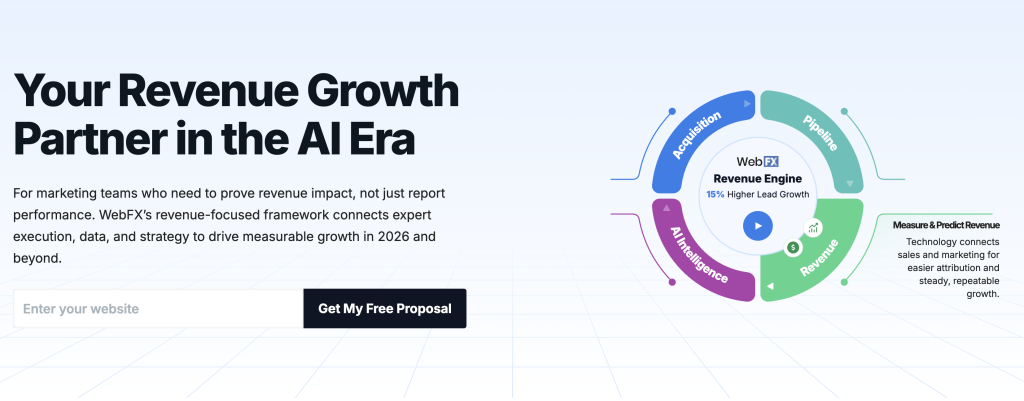
Large full-service agency with a proprietary reporting platform, suited to organizations with complex product suites needing segmented campaign strategies. Their own 2026 cost guide is one of the more transparent published sources on agency pricing, putting typical retainers at $1,000 to $12,000+ monthly and enterprise at $12,000 to $30,000+.
Likely fit: Enterprise SaaS wanting a full-service partner with scale. Pricing: Publishes ranges rather than rates.
9AM
9AM agency serves the technology and SaaS sector, making it a potential partner for software businesses looking for marketing support tailored to their industry. Its dedicated Tech & SaaS offering makes it relevant to companies evaluating agencies that understand the needs of technology-driven businesses.
Likely fit: B2B SaaS and technology companies seeking industry-focused marketing support. Pricing: Not published; contact the agency for details.
Six Questions That Separate Real Answers From Sales Answers
Ask these in the first call. The quality of the answer matters more than the answer itself.
1. “Which CPC benchmark are you quoting, blended or non-brand?” Good: they name the distinction immediately and explain their own account mix. Bad: they treat it as a trick question, or repeat the number.
2. “How do you get closed-won revenue back into Google Ads?” Good: offline conversion imports, specific CRM, named mechanism. Bad: “we integrate with your CRM” with no detail.
3. “Who optimizes my account daily, and how many other accounts do they carry?” Good: a name, a number, and it is under about ten. Bad: “a dedicated team.”
4. “What would make you tell us to spend less?” Good: a specific scenario, ideally one they have actually had. Bad: nothing comes to mind.
5. “Show me an account where you underperformed and what you changed.” Good: a real one, with the diagnosis. Bad: only case studies with percentages going up.
6. “What is in the retainer and what is billed separately?” Good: an itemized answer covering landing pages, tracking setup, and creative. Bad: “everything you need.”
The fourth question is the most useful of the six. An agency on percentage-of-spend that cannot name a situation where it would recommend cutting budget has told you exactly how its incentives run.
Choosing by Stage and Budget
Match the agency to your spend level and go-to-market motion, not to their reputation. The right partner for a $10,000-a-month account is a poor fit for a $100,000 one, and the reverse is worse.
Under $10,000 monthly spend. Percentage-of-spend rarely makes sense here, since 15% of $10,000 will not fund serious work and a flat fee at that level eats 30% of your budget. Look at specialist flat-fee agencies at the lower end, or keep it in-house with a consultant.
$10,000 to $50,000 monthly spend. The sweet spot for specialist SaaS agencies. Flat retainers of $3,000 to $12,000 land at a defensible 10% to 20% of spend. Prioritize SaaS specialization and attribution capability.
$50,000 and above. Percentage models start to favor you if negotiated well, since a 10% rate on $100,000 buys a bigger team than most flat fees. This is where enterprise agencies and ABM integration earn their cost.
Whatever the stage, start by auditing what you already have. Find where leads drop off between conversion and closed deal, then evaluate agencies on their ability to solve that specific gap. Understanding what your buyers actually respond to matters as much as the channel work, which is the argument in how brands that listen to customers grow faster.
Frequently Asked Questions
How much does a B2B SaaS Google Ads agency cost?
Published 2026 ranges run $1,500 to $25,000 or more per month. Specialist SaaS agencies cluster at $3,000 to $12,000, with enterprise engagements above that. Percentage-of-spend deals typically run 10% to 20% of monthly ad budget. Most agencies on this page do not publish rates, so expect to ask.
Is flat-fee or percentage-of-ad-spend better?
Flat fees align incentives better because the agency’s income does not rise with your budget. Percentage models reflect that larger accounts genuinely take more work, but they pay the agency more when you spend more regardless of results. If you sign one, tie budget increases to performance in writing.
What is a good CPC for B2B SaaS in 2026?
There is no single number. Published 2026 figures range from $3.33 blended to $14 or more for non-brand search, and cybersecurity and FinTech run $16 to $18. Blended averages include cheap branded clicks. Compare your non-brand CPC against non-brand benchmarks only.
What should a B2B SaaS cost per lead be?
Published 2026 figures span $87 to $200 for SMB SaaS, $200 to $900 mid-market, and $1,500 to $4,500 enterprise. One agency reports around $855 as the norm for technical SaaS. CPL alone is not a useful target without lead-to-opportunity and close rates attached.
How long before Google Ads produces pipeline for B2B SaaS?
Expect 60 to 90 days before the data is meaningful and longer before closed revenue appears, since B2B software cycles run 30 to 120 days on top of the learning period. New accounts typically see 20% to 30% worse CPA in the first 60 days while the algorithm learns.
Should I hire a specialist SaaS agency or a generalist PPC agency?
Specialists cost more and ramp faster, because they already know the buying cycle and the attribution problem. Generalists can work if your product has a short cycle and a simple funnel. The test is whether they can discuss lead-to-opportunity conversion without prompting.
What contract length should I agree to?
Month-to-month if you can get it, since it makes the agency re-earn the account continuously. If a longer term is required, negotiate a performance break clause with defined metrics. Twelve-month contracts with no exit path are the most common way these engagements go wrong.
How do I know if my agency is actually driving pipeline?
Ask for a report that maps ad spend to opportunities created and closed-won revenue, not leads. If they cannot produce it, either attribution was never set up or they are avoiding the number. Offline conversion imports are the usual mechanism.
Do I need a separate landing page agency?
Often, yes, and this is a common hidden cost. Many retainers cover campaign management but bill landing pages, conversion tracking setup, and creative separately. Since conversion rate is where 2026 efficiency gains came from, confirm who owns page testing before signing.
Is Google Ads still worth it for B2B SaaS in 2026?
For high-intent commercial queries, yes. AI Overviews have reduced paid click-through on informational queries substantially, while transactional keywords are largely unaffected. That shifts the argument toward bottom-funnel terms and away from broad informational targeting.
Picking a B2B SaaS Google Ads Agency Without Guessing
Go back to those three proposals: $3,000 flat, 15% of spend, and $12,000 with no itemization. With the ratio in hand, they are now comparable. On $30,000 of monthly spend, that is 10%, 15%, and 40%. The third one is not necessarily wrong, but it now has to justify itself against the other two rather than hiding behind a case study.
That is the whole method. Convert every quote to a percentage of the spend it manages. Ask which benchmark definition an agency is using. Ask what would make them tell you to spend less. And confirm in writing who touches the account daily.
The agencies on this page are all credible places to start a conversation. None of them is the answer on its own, because the right B2B SaaS Google Ads agency depends on your spend level, your sales motion, and the specific gap in your funnel. Which do you actually have, and would your current reporting even show it?