

If you do not have a bank account, or would rather not link one, you have three working paths in 2026 and a fourth that quietly closed in April. This guide covers what each method actually unlocks, what it costs you afterward, and the limits worth knowing before you pick one.
You can verify PayPal without a bank account by confirming a credit or debit card, submitting your SSN for identity verification, or enrolling in Direct Deposit. A confirmed debit card plus SSN gives you the closest match to a bank-verified account. Withdrawals then cost 1.75%, capped at $25.
Table of Contents
What PayPal Verification Actually Does
Verified status tells PayPal it has confirmed at least one funding source tied to a real financial identity. An unverified account still sends and receives money, but under limits: a cumulative sending cap, fewer withdrawal options, longer holds on incoming funds, and some sellers who will not ship to unverified buyers.
Historically the standard path was linking a bank account and confirming two micro-deposits. PayPal has widened the options since, though the methods do not all unlock the same things. That last part is what most guides skip, and it is the entire decision.
If holds on incoming money are your immediate problem rather than verification itself, that has its own causes and fixes. Our guide on getting PayPal money off hold covers those separately.
Method 1: Confirm a Credit Card
Confirming a credit card is the most accessible path for people without a bank account. PayPal accepts Visa, Mastercard, American Express, and Discover. The process takes a few minutes to start and one to three business days to finish, because you have to wait for a code to appear on your card statement.
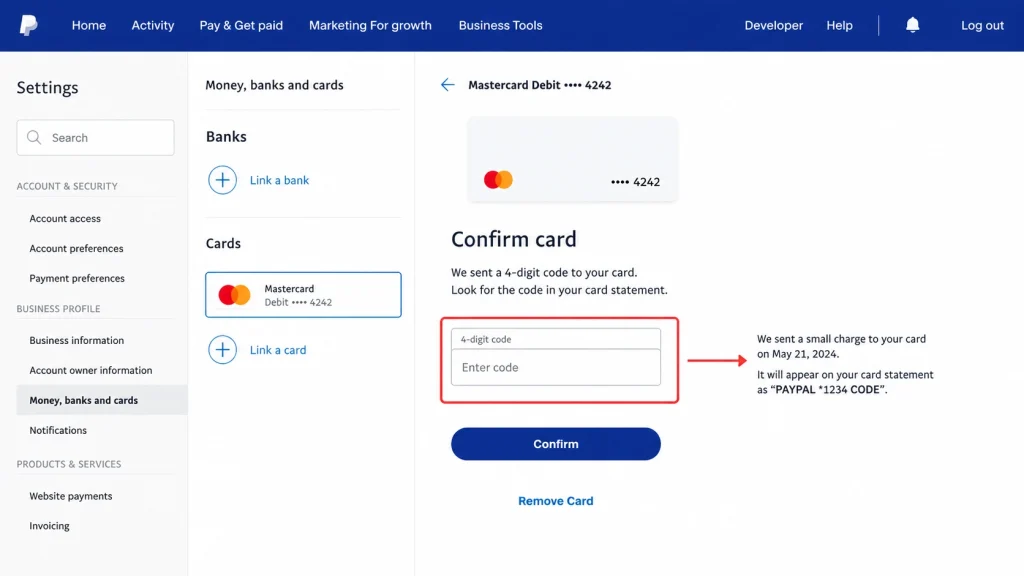
Go to Account Settings, then Money, Banks and Cards, then Add a Card on desktop. In the mobile app it is Wallet, then Add Debit or Credit Card. Enter the card number, expiration date, and billing address.
PayPal then places a small temporary charge on the card, commonly $1.95. The charge description contains a four-digit code. When it appears on your statement, return to your PayPal wallet, click the card, select Confirm Card, and enter the code. PayPal refunds the charge.
What a confirmed credit card gets you
It raises your sending limit and confirms an active payment method. What it does not do is give you a way to withdraw money. A credit card can fund payments out of PayPal, but PayPal cannot push a balance back onto it. Your money stays in the PayPal balance until you spend it. It also does not count as full identity verification if your account gets flagged for review.
Method 2: Confirm a Debit Card
The steps are identical to credit card confirmation, but the outcome is meaningfully better. Add the card under Money, Banks and Cards, wait for the four-digit code on your statement, and confirm it in PayPal. What changes is that a debit card works in both directions.
A confirmed debit card unlocks instant transfer as a withdrawal route, because PayPal’s instant transfers run on debit card rails rather than ACH. That means you can receive money into your PayPal balance and move it out to the card, usually within thirty minutes.
This is the single most useful step for anyone without a bank account, and it is why the debit card path beats the credit card path if you have the choice. It is not free, though, which the next section covers in detail.
One caution: retail prepaid debit cards bought at a store are usually rejected at the card-adding step. PayPal’s system identifies most prepaid BINs and declines them. Bank-issued debit cards work.
Method 3: Submit Your SSN for Identity Verification
PayPal accepts a Social Security Number as a standalone identity verification that requires no linked payment method at all. This is the path that most closely replicates the account standing of a bank-verified account, and it is the one people are least aware of.
PayPal may prompt you for it when you hit a sending limit, after a certain volume of received payments, or if your account is flagged for review. You can also submit it before being asked, under Account Settings, then Account Verification. PayPal runs an identity bureau lookup to confirm the SSN matches the name and address on file. This is a soft check and does not affect your credit score.
SSN submission clears identity restrictions but does not create a withdrawal route. You still need a card or bank account to move money out. Pair it with Method 2 rather than treating it as an alternative. If PayPal has already asked you for documents, our walkthrough of confirming your identity on PayPal covers what it accepts and how long review takes.
Method 4: Enroll in Direct Deposit and Get Bank Rails Without a Bank
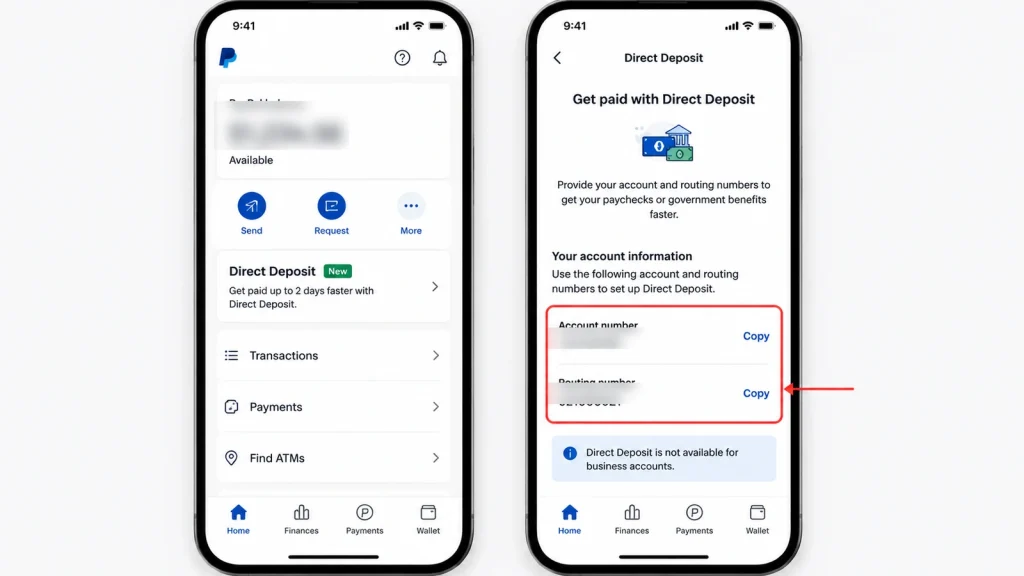
This is the option almost nobody writes about, and for an unbanked reader it is the strongest one available. Enrolling in Direct Deposit, or opening a PayPal Debit Card, provisions you a real account number and routing number issued by The Bancorp Bank. You get functioning bank rails without opening a bank account.
That routing and account number is not decorative. You can hand it to an employer for payroll, to a government agency for benefits or a tax refund, or use it as a direct debit payment method at third-party merchants. Money lands straight in your PayPal balance.
The practical effects:
- Payroll and benefits arrive without a bank. Direct Deposit works for paychecks, federal and state benefits, and tax refunds.
- The PayPal Debit Card spends the balance directly. Anywhere Mastercard is accepted, with no monthly fee and no minimum balance.
- ATM withdrawals are free at MoneyPass machines. Non-MoneyPass ATMs carry a $2.50 fee, and a daily withdrawal limit applies.
- Balances gain pass-through FDIC insurance. Once you open a Debit Card account or enroll in Direct Deposit, PayPal places your US dollar balance with program banks, where it becomes eligible for pass-through FDIC coverage. Without that, balance funds are an unsecured claim against PayPal.
That last point is the one worth sitting with. It is a genuine difference in what happens to your money if something goes wrong, and it costs nothing to trigger.
Direct Deposit is only available on personal PayPal Balance accounts, not business accounts, and the payer has to be US-based. If you want the physical card, getting a PayPal card in the mail covers the application and delivery timeline.
What Happened to the PayPal Prepaid Mastercard
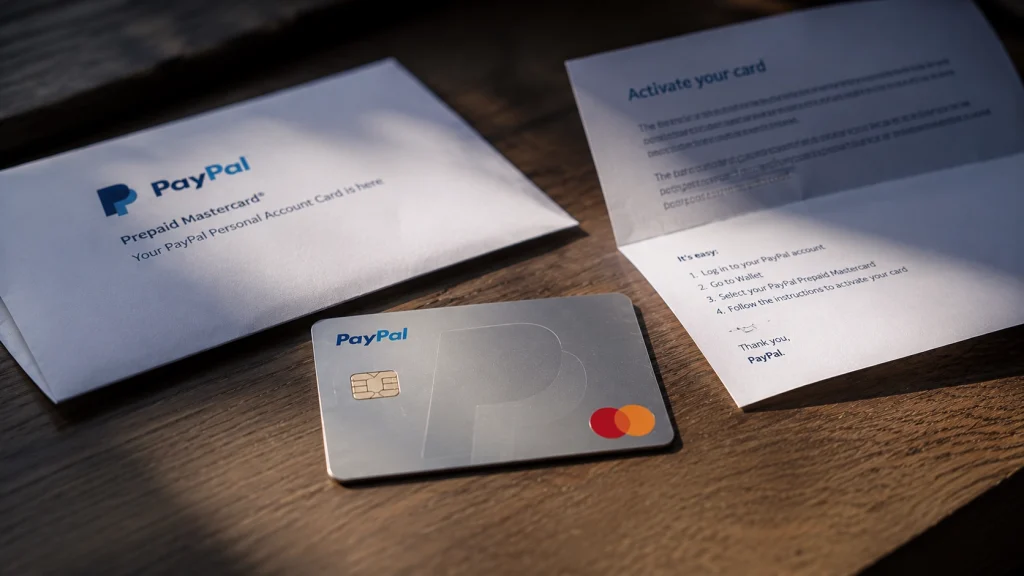
If you have read an older guide recommending the PayPal Prepaid Mastercard as the answer for unbanked users, that option no longer exists. PayPal discontinued the program on April 30, 2026. All accounts were closed, and loads, direct deposits, and card transactions are rejected.
Cardholders who did not move their account to Netspend have any remaining balance returned by check. Balances of $1.00 or more are mailed automatically to the address on file, and balances under $1.00 need a phone request. PayPal charges no fee for these checks. The full notice sits on PayPal’s Prepaid Mastercard page.
The replacement is Method 4 above, and it is a better deal. The Prepaid Mastercard carried a $4.95 monthly fee, roughly $59 a year, plus reload and ATM charges. The PayPal Debit Card has no monthly fee, gives you the same direct deposit capability, and adds free MoneyPass ATM withdrawals. Anyone still following prepaid-card advice is paying for something they can now get for nothing.
What Withdrawals Actually Cost Without a Bank Account
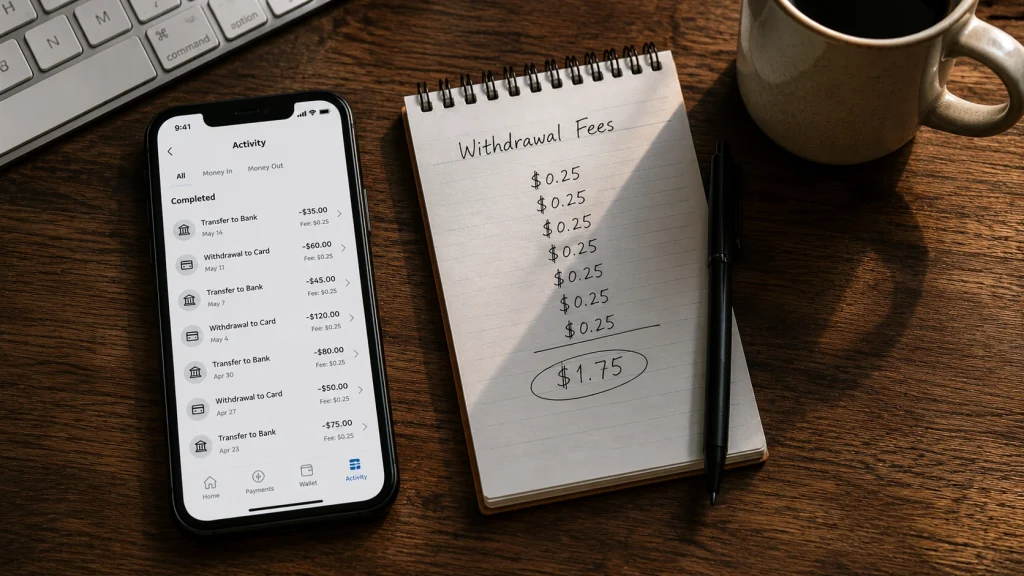
Here is the part that decides whether this setup works for you long term. Standard ACH transfers to a linked bank account are free. Without a bank account, your only withdrawal route is instant transfer to a debit card, which costs 1.75% of the amount, minimum $0.25, capped at $25.
That rate changed in June 2022, up from 1.5% capped at $15. Any guide still quoting 1% or a $10 cap is describing pricing that has not existed for four years.
| Amount withdrawn | Instant transfer fee | You receive | Effective rate |
|---|---|---|---|
| $50 | $0.88 | $49.12 | 1.75% |
| $200 | $3.50 | $196.50 | 1.75% |
| $500 | $8.75 | $491.25 | 1.75% |
| $1,430 | $25.00 | $1,405.00 | 1.75% |
| $3,000 | $25.00 (capped) | $2,975.00 | 0.83% |
| $5,000 | $25.00 (capped) | $4,975.00 | 0.50% |
US personal account rates, verified against multiple 2026 fee trackers, August 2026. Merchant account pricing differs.
The cap kicks in at about $1,430, and above that the effective rate falls. So the cost-control move is counterintuitive: withdraw less often, in larger amounts. Someone pulling $200 out weekly pays around $182 a year. The same person withdrawing $2,600 once a quarter pays $100. Same money moved, $82 saved, purely on timing.
Run against a bank account, all of that would be zero. That is the honest price of skipping the bank link, and for anyone moving real volume it is the strongest argument for eventually opening one. If instant transfer is failing rather than just costing you, the reasons PayPal instant transfer stops working covers the usual causes. For the wider set of levers on PayPal charges, see how to avoid PayPal fees when receiving money.
Verification Methods Compared
| Method | Raises send limit | Enables withdrawals | Full identity verification | Bank account needed |
|---|---|---|---|---|
| Bank account (micro-deposit) | Yes | Yes, free ACH | Yes | Yes |
| Credit card confirmation | Yes | No | Partial | No |
| Debit card confirmation | Yes | Yes, instant at 1.75% | Partial | No |
| SSN / identity submission | Yes | No, method still needed | Yes | No |
| Direct Deposit enrollment | Yes | Yes, via PayPal Debit Card | Yes | No |
| Debit card + SSN | Yes | Yes, instant at 1.75% | Yes | No |
When SSN Verification Actually Matters for Taxes
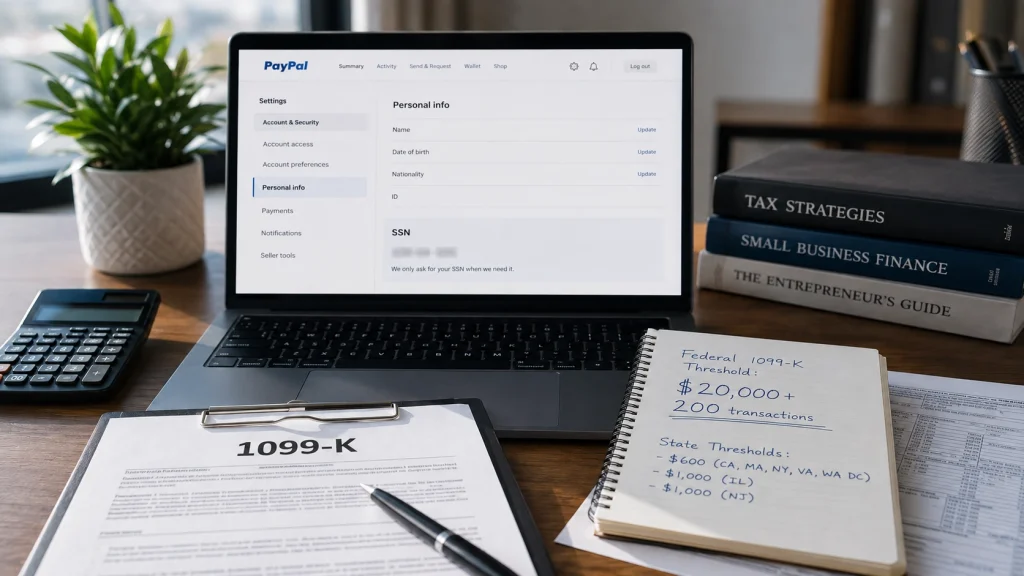
A lot of older advice ties SSN submission to a $600 tax reporting threshold. That threshold no longer applies. The One Big Beautiful Bill Act, signed July 4, 2025, permanently restored the federal 1099-K threshold to more than $20,000 in gross payments and more than 200 transactions, and applied it retroactively.
Both conditions must be met. A freelancer receiving $18,000 across 40 PayPal transactions gets no federal 1099-K. The scheduled drops to $5,000, $2,500, and eventually $600 were repealed before most of them ever took effect.
Two things that still catch people out.
States set their own thresholds, and several are far lower. If you live in one of these, PayPal may issue a 1099-K well below the federal bar.
| State | 1099-K threshold |
|---|---|
| Maryland, Massachusetts, Vermont, Virginia, Washington DC | $600 |
| Illinois | $1,000 and four or more transactions |
| New Jersey | $1,000 |
A 1099-K is a reporting form, not a definition of income. All income from selling goods or services is taxable and reportable whether a form arrives or not. Not receiving one is not the same as owing nothing.
The practical upshot for verification: submit your SSN when PayPal asks, because unresolved identity requests trigger holds on received payments regardless of any tax threshold. The tax form and the account restriction are separate systems.
What You Still Cannot Do
Even a fully verified account with a confirmed debit card and SSN on file has gaps against an account with a linked bank.
- Free standard transfers are unavailable. ACH withdrawals to a bank are free. Instant transfer to a card is 1.75%. Over a year of regular withdrawals, that difference is real money.
- Some payment requests specify bank funding only. You cannot fulfill those without a linked account.
- PayPal Credit and Pay Later products may require a bank account as a backup funding source at certain credit line amounts.
- Card-only funding constrains large sends. Card networks apply their own transaction limits, and a credit card send may be treated as a cash advance by your issuer, with a separate fee and a higher APR.
None of these are dealbreakers for ordinary use. They matter if PayPal is your primary financial tool rather than an occasional one. For a clearer picture of where PayPal ends and banking begins, see what bank PayPal actually uses.
Frequently Asked Questions
Can I verify PayPal without a bank account?
Yes. Confirm a credit or debit card, submit your SSN for identity verification, or enroll in Direct Deposit. A confirmed debit card plus SSN gives you the closest equivalent to a bank-verified account. The main difference afterward is withdrawal cost, since instant transfer to a card is 1.75% while ACH to a bank is free.
Can I fully use PayPal with only a credit card and no bank account?
With limits. A confirmed credit card raises your sending limit and funds payments, so you can send money, shop, and receive payments into your balance. What you cannot do is withdraw. PayPal cannot push a balance back onto a credit card, so funds stay in PayPal until you spend them or add a debit card.
How much does it cost to withdraw from PayPal without a bank account?
Instant transfer to a confirmed debit card costs 1.75% of the amount, with a $0.25 minimum and a $25 cap. Withdrawing $500 costs $8.75. Because of the cap, larger and less frequent withdrawals cost proportionally less, so batching cash-outs saves real money.
Is the PayPal Prepaid Mastercard still available?
No. PayPal discontinued the program on April 30, 2026, and closed all accounts. Loads, direct deposits, and transactions are rejected. Remaining balances of $1.00 or more are returned by check automatically. The PayPal Debit Card with Direct Deposit replaces it and has no monthly fee.
Can I get direct deposit without a bank account?
Yes. Enrolling in Direct Deposit or opening a PayPal Debit Card provisions you an account number and routing number issued by The Bancorp Bank. You can give those to an employer or government agency, and payments land in your PayPal balance. Direct Deposit is personal accounts only, not business.
Does submitting my SSN to PayPal affect my credit score?
No. PayPal runs an identity bureau lookup or soft check to confirm the SSN matches the name and address on your account. Soft checks are not visible to lenders and do not affect your score. This is different from a credit application, which uses a hard inquiry.
Do I get a 1099-K from PayPal if I earn over $600?
Not federally. The threshold reverted to more than $20,000 and more than 200 transactions under legislation signed in July 2025, and both conditions must be met. Several states set lower bars, including $600 in Maryland, Massachusetts, Vermont, Virginia, and Washington DC.
Can I use a prepaid card to verify PayPal?
Usually not. PayPal identifies most retail prepaid card numbers and declines them during the card-adding step. Bank-issued debit cards work. Since the PayPal Prepaid Mastercard closed in April 2026, there is no PayPal-affiliated prepaid exception left.
What happens if I never verify my PayPal account?
You hit a cumulative sending limit that PayPal does not publish, and payments stop going through until you verify. Received funds can be held for up to 21 days, which is a serious constraint if you are being paid for goods or services rather than just shopping.
Can I use a family member’s bank account to verify my PayPal?
No. PayPal’s terms require linked payment methods to belong to you, and the practical risk is worse than the policy one. If PayPal debits that account and the owner disputes the charge, your account gets restricted. Use a debit card in your own name instead.
Does PayPal verification work the same way outside the United States?
No. Card confirmation is broadly available internationally, but SSN submission is US-only and Direct Deposit through The Bancorp Bank is a US product. Some countries offer local identity options, and in certain regions bank linking remains the only route to full verification.
Verifying PayPal Without a Bank Account: What to Actually Do
For most people, the setup that works is a confirmed debit card plus an SSN submission when PayPal asks for it. The card raises your sending limit and gives you a way out. The SSN clears identity restrictions and stops the holds. Together they cover almost everything a bank-linked account does.
If you are unbanked rather than bank-averse, add Direct Deposit. The account and routing numbers it provisions do the work a bank account would for payroll and benefits, the PayPal Debit Card spends the balance with no monthly fee, and your balance picks up pass-through FDIC eligibility along the way. That combination did not exist as cleanly two years ago, and it is strictly better than the prepaid card it replaced.
The one cost you cannot design away is the 1.75% on every instant withdrawal. Batch your cash-outs and it stays small. Move money out weekly and it adds up to more than most people expect by December. Worth checking what you paid last year before deciding this setup is permanent.