The routes that genuinely cost nothing are different, and there are more of them than most articles admit. You can list on a marketplace, sell through a social account, or open a storefront that charges a percentage of each sale instead of a monthly fee. Pair any of those with a product you do not have to buy upfront, and your starting cost really is zero. This guide covers all of it: what every platform actually charges in 2026, which free routes work, what they take per sale, and the exact monthly sales figure where paying a fee starts costing you less than staying free.
To start an ecommerce business without money, sell on a marketplace like Etsy, through social accounts, or on a per-sale storefront such as Payhip’s free plan, which charges 5% per sale and no monthly fee. Pair it with dropshipping, print-on-demand or digital products so you buy no stock. Expect to pay payment processing of around 2.9% whatever you choose.
Table of Contents
What It Really Costs to Start an Ecommerce Business Without Money
Three claims appear in nearly every article on this topic. Two are wrong, and acting on them costs you a weekend. Here is each one checked against the platform’s own documentation, with the price you would actually pay.
The three claims that do not hold up
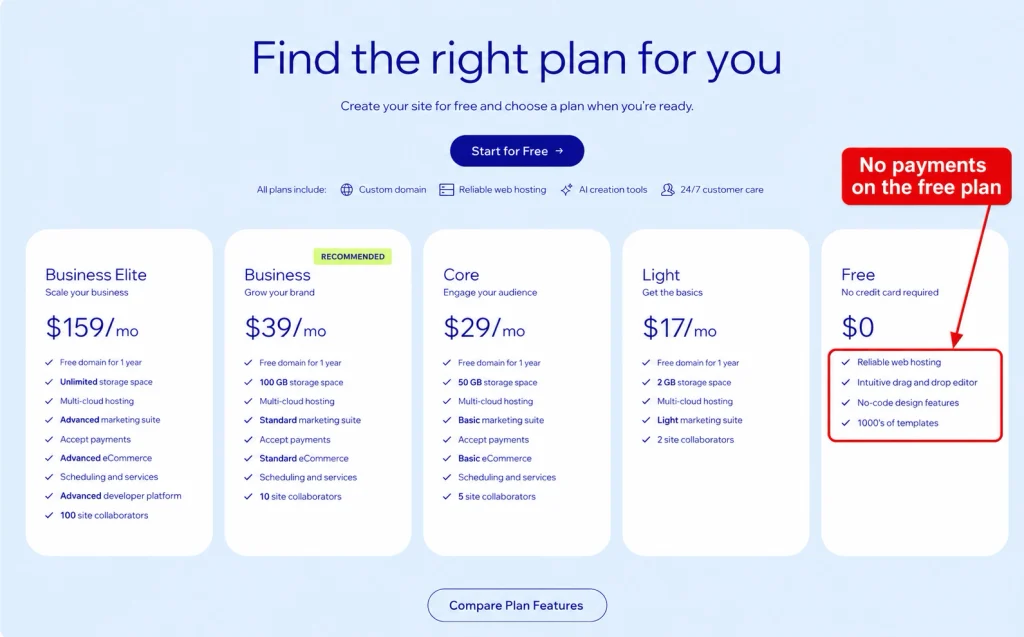
“Use Wix’s free plan.” You cannot accept payments on a free Wix site. Wix’s own support documentation states you must upgrade your site before it can take payment on a form, and the same applies to a store. The cheapest Wix plan that accepts payments is Core at $29 a month billed annually, or $36 billed monthly. The Light plan at $17 does not include payments either.
“Shopify has a free trial.” It runs three days. After that you pay $1 a month for three months, then $39 a month on monthly billing or $29 on annual (Shopify pricing, checked October 2026). Three days is enough to click around the admin. It is not enough to build, photograph, write and launch a store. Treat Shopify as paid software with a cheap first quarter, and if you do decide to start a Shopify store, use the dollar months to build rather than to browse.
“WooCommerce is free.” The plugin is free. Hosting and a domain are not. Budget $3 to $10 a month for shared hosting plus $10 to $15 a year for the domain. Connecting a payment gateway is a setup job rather than a toggle, as our Stripe and WooCommerce setup guide shows. Cheaper than Shopify, still not zero.
What each route costs side by side
| Route | Monthly cost | Per-sale cost | Genuinely $0 to start? |
|---|---|---|---|
| Payhip free plan | $0 | 5% plus processing | Yes |
| Big Cartel Gold | $0 | Processing only | Yes, limited features |
| Etsy | $0 | $0.20 per listing plus transaction and processing fees | Near enough, listing fees are cents |
| Social selling with a payment link | $0 | Processing only | Yes |
| Shopify Basic | $1 for 3 months, then $29 to $39 | 2% extra without Shopify Payments | No |
| Wix Core | $29 annual, $36 monthly | Processing only | No |
| WooCommerce | $3 to $10 hosting plus domain | Processing only | No |
Prices checked October 2026 against each platform’s own pricing page. Payment processing of roughly 2.9% plus a fixed fee applies on top of every row.
Free routes charge a percentage of revenue instead of a monthly fee. That is a good trade while you are small and a bad one once you have volume, which is the real decision this article is about. If you are budgeting properly rather than starting at zero, our breakdown of what it costs to start an ecommerce business has the full picture.
The Routes That Genuinely Cost Nothing
Four routes let you open for business today without spending anything. Each one trades money for something else, usually control or margin, and knowing which trade you are making matters more than the platform you pick.
Sell on a marketplace first
Etsy, eBay, Depop, Vinted and Facebook Marketplace all let you list without a subscription. You are renting someone else’s traffic, which is exactly the point. A brand new independent store has no visitors, and getting visitors is the expensive part nobody budgets for.
The trade is that you do not own the customer relationship and you compete on the same page as everyone else. Use it to prove people will pay for your thing before you build anything of your own.
Use a per-sale storefront
Payhip’s free plan has no product limit and no monthly fee. It takes 5% of each sale plus whatever Stripe or PayPal charges. Big Cartel’s free Gold plan gives you a real checkout with limited features. Both give you a shareable store link without a card on file.
The 5% only matters at volume. On $500 a month in sales that is $25, less than any paid plan. On $5,000 a month it is $250, and a $29 plan is obviously cheaper.
Sell through social accounts
An Instagram or TikTok account plus a payment link is a complete sales channel, and it is how a large share of small sellers actually start. It costs nothing but time. The weakness is that you are building on rented land, and reach can change overnight without warning.
Sell something you do not have to buy
Here is the part that makes zero realistic rather than theoretical. If you never buy stock, you never need capital.
Dropshipping. The supplier holds inventory and ships to your customer when you sell. Margins are thin, delivery is often slow, and you answer for quality you never saw.
Print-on-demand. You upload designs and the product is printed only when ordered. No minimum order, but per-unit costs are high, so your pricing has to carry them.
Digital products. Templates, presets, guides, courses. No unit cost at all, which is why the free per-sale platforms are built around them. All the work sits upfront.
Your own manufactured goods. If you already make something, you have no sourcing problem, only a sales channel. Selling direct instead of through distributors is the argument behind ecommerce for manufacturers, and it changes the economics more than any platform choice.
Affiliate. You sell nothing and earn commission on referrals. No inventory, no customer service, and no asset of your own either.
Services. Not ecommerce strictly, but it is the fastest route from nothing to revenue, and it funds the store later.
When Paying Beats Starting an Ecommerce Business Without Money
A percentage is cheaper than a monthly fee until your sales reach a certain level, then it flips. Against Shopify Basic on annual billing at $29 a month, and a free platform taking 5%, the crossover lands at roughly $580 a month in sales. Below that, stay free. Above it, you are paying for the privilege.
The crossover, worked out
| Monthly sales | Free plan at 5% | Shopify Basic annual | Cheaper |
|---|---|---|---|
| $200 | $10 | $29 | Free plan |
| $500 | $25 | $29 | Free plan |
| $580 | $29 | $29 | Identical |
| $1,000 | $50 | $29 | Shopify |
| $3,000 | $150 | $29 | Shopify |
Two things that table misses. A paid platform usually converts better, so cost is not the only input. And a domain of your own, at $10 to $15 a year, is worth buying long before you need a paid plan, because it is the one asset that moves with you when you switch.
Shopify is not the only destination either. When a store does outgrow a free plan, the alternatives worth considering include several that cost less per month than Basic.
The Costs Nobody Puts in the List
Even a zero-budget launch has unavoidable costs. Payment processing takes roughly 2.9% plus a fixed fee on every sale and cannot be avoided on any platform. The rest are avoidable at first and become necessary later. Budget for them or they arrive as surprises.
What to expect
| Item | Typical cost | Avoidable? |
|---|---|---|
| Payment processing | About 2.9% plus a fixed fee per sale | No |
| Getting paid across borders | Conversion spreads and withdrawal fees, see Stripe versus Payoneer | No |
| Domain name | $10 to $15 a year | At first, not long term |
| Product photography | $0 shooting it yourself on a phone | Yes |
| A sample of your own product | One unit | Not really |
| Returns and refunds | Varies, processing fees often are not refunded | No |
| Business registration | Varies by state and structure | Depends |
| Paid ads | Whatever you choose | Yes, and you should at first |
The one people skip is ordering a sample. Selling a dropshipped product you have never held means your customer discovers the quality problem before you do, and they tell you by asking for a refund.
Marketing an Ecommerce Business Without Money
Free marketing costs time instead of money, and the time is real. Pick one channel and do it properly rather than five badly. The order below is by return per hour for a store with no audience, not by how exciting each one sounds.
The five channels worth your hours
- Organic social, one platform only. Pick where your buyers already are. One account posted consistently beats four neglected ones.
- Content that answers buying questions. Not brand storytelling. “How to choose X”, “X vs Y”, “is X worth it”. These reach people already shopping.
- Email from day one. Collect addresses before you have anything to send. It is the only audience you own, and free tiers cover your first few hundred subscribers. If you sell wholesale or B2B rather than direct, cold email software is a different tool from a newsletter platform, and the two get confused constantly.
- Communities where your buyers gather. Reddit, Discord, Facebook groups. Take part honestly. A sales pitch in a community gets you banned, not customers.
- Your existing network. The first ten sales usually come from people who already know you. That is not cheating, it is how most businesses start.
Hold off on paid ads until you know which product sells and what a customer is worth. Money spent on ads before product-market fit buys data at a very high price.
Running the Business Without Spending
Free tiers cover everything a new store needs. Analytics, task tracking, design and bookkeeping all have usable free versions, and none of them is the thing that decides whether you make money. The spreadsheet is.
The free stack
- Google Analytics for traffic, plus your platform’s own dashboard for sales.
- Trello, Notion or Jotform Boards free plans for orders and tasks.
- Canva free for product images and social graphics.
- A spreadsheet for costs and margins.
Work out what each sale nets you after product cost, platform percentage, processing fee and shipping. Plenty of apparently healthy stores lose money on some lines and nobody notices until the volume is big enough to hurt. Once the recurring costs outgrow a spreadsheet, expense management solutions do the job it stops doing well.
Your First Month, Week by Week
Four weeks is enough to go from nothing to a first sale if you sequence it properly. The order matters: validate before you build, and build before you promote. Most people reverse it and spend three weeks on a store for a product nobody wanted.
The plan
| Week | What you do | Spend |
|---|---|---|
| 1 | Pick a niche, find five competitors, check what they charge | $0 |
| 2 | Choose one product or a small range, order a sample if physical | One unit |
| 3 | Set up a free storefront or marketplace listing, write descriptions, shoot photos | $0 |
| 4 | Tell your network, post daily on one channel, make the first sale | $0 |
If month one produces no sales, the problem is almost never the platform. It is the product, the price, or the fact that nobody knows the store exists. Switching platform is the most popular response and the least useful one.
Where it usually goes wrong
| Mistake | What happens |
|---|---|
| Building the store before validating the product | Weeks of work on something nobody wanted |
| Picking a niche you like with no demand behind it | Interest without buyers |
| Not knowing your per-unit margin | Selling at a loss without realising |
| Dropshipping without ordering a sample | Customers find the quality problem first |
| Spreading across four social platforms | Four neglected accounts |
| Paid ads before product-market fit | Expensive data |
| Treating a free plan as permanent | Paying 5% where $29 would be cheaper |
| Never buying a domain | No asset, and a platform move starts you over |
Frequently Asked Questions
Can you really start an online store with no money?
Yes, if you sell on a marketplace, through social accounts, or on a per-sale platform like Payhip’s free plan or Big Cartel’s Gold plan, and you sell something you do not buy upfront, such as digital products, print-on-demand or dropshipped goods. What you cannot do for free is run a hosted store on your own domain.
Is the Wix free plan enough to sell products?
No. Wix’s own support documentation says you must upgrade your site before it can accept payment, so a free Wix site cannot take money at all. The cheapest Wix plan that accepts payments is Core at $29 a month on annual billing, or $36 monthly. Most guides listing Wix as a free ecommerce option have this wrong.
How long is the Shopify free trial?
Three days. After that the first three months cost $1 a month, then it is $39 a month on monthly billing or $29 on annual. Three days lets you evaluate the admin, not build and launch a store, so plan to pay from the start rather than treating it as a free runway.
Which platform is cheapest for a brand new store?
Below roughly $580 a month in sales, a free per-sale platform such as Payhip costs less than Shopify Basic on annual billing. Above that, the flat monthly fee wins. Run the numbers against your own expected volume rather than trusting any platform’s own comparison page.
Do I need to register a business to sell online?
In the US, if you trade under your own legal name you are automatically a sole proprietorship and, per the SBA, “you won’t need to register anywhere.” Using a trade name usually means filing a DBA, and licences or permits may still apply. Registering also brings liability and tax benefits worth having.
Is dropshipping still worth starting in 2026?
It still removes the inventory cost, which is the point. Margins are thin, shipping is often slow, and you carry responsibility for quality you never see. Order samples of anything you list, and treat it as a cheap way to test demand rather than a business model on its own.
What is the cheapest way to accept payments?
Whatever your platform supports, since processing runs around 2.9% plus a fixed fee across Stripe, PayPal and Shopify Payments. The saving is avoiding the platform fee stacked on top: Shopify adds 2% on Basic if you do not use Shopify Payments. The two main processors differ more on disputes than on rates, which we cover in Stripe versus PayPal for sellers.
Should I buy a domain if I am on a free platform?
Yes, early. At $10 to $15 a year it is the cheapest item on the list and the only asset that moves with you when you change platforms. Everything else you build on a free plan belongs to that platform, including the URL your customers have bookmarked.
How many products should I launch with?
One to five. A big catalogue on day one means thin descriptions, rushed photography and no idea which product is carrying the store. Big Cartel’s free plan limiting your range is less of a constraint than it sounds, and it forces a decision you should be making anyway.
What sells best with no upfront investment?
Digital products, because the unit cost is zero and the free per-sale platforms are built for them. Print-on-demand comes next, then dropshipped physical goods. That ranking is by how much money you can lose, not by how much you can make.
The Bottom Line
Starting an ecommerce business without money is realistic once you accept the trade. You pay a percentage of each sale instead of a monthly fee, and you borrow someone else’s audience instead of building your own from nothing. Both get more expensive as you grow, which is the right problem to have.
So open on a marketplace or a free per-sale storefront, sell something with no unit cost, and buy a domain early because it is the one thing that stays yours. Move to a paid platform when your volume makes the flat fee cheaper, which lands near $580 a month against Shopify Basic. Order a sample of anything physical before you list it.
What decides whether this works is not the platform. It is whether anyone wants the product and whether you know your margin on it. Both are free to find out, and both are what most new sellers skip while they compare checkout themes. So before you open a single account, can you name the person who buys your first thing, and what they are paying for it?
If the store outgrows a free plan and you want it built properly on WooCommerce or a custom stack, that is the point where development pays for itself rather than being an upfront cost.