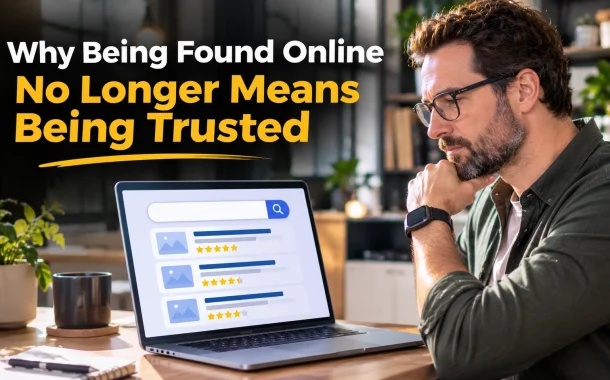
Quick answer: Ranking on page one of Google shows that a business understood optimization, not that it can be trusted. Buyers now look for outside confirmation, such as press coverage, named customers, verifiable credentials and original research, from people with nothing to gain from the sale.
Buyers have noticed. They see the same polished homepage, the same stock photo of smiling staff, the same promise of industry-leading service on every competitor’s site, so the page stops working as evidence. People look elsewhere for it: reviews, forums, a colleague’s message, a mention in a publication they already read. The search engine finds the door. Something else decides whether anyone walks through.
Search engines have made the same call, quietly. Google’s guidance for its quality raters names trust as the most important element of what it calls E-E-A-T. Ranking systems try to reward that; they can’t always measure it.
That something else is outside confirmation: a person or institution with nothing to gain from your sales vouching, however briefly, that you exist and do what you say. It is harder to fake than a website, which is the point. Media placement services exist for exactly this gap; they help a business get its story, or its data, in front of editors, and published coverage hands readers a signal no self-published page can. The outlet has a reputation of its own to protect, so some vetting has already happened. Done honestly, the work shortens a very long road, since most small firms have neither the time nor the contacts to build editor relationships alone.
Table of Contents
Why the old signals broke
Fake reviews are the clearest case. For years a star rating worked as shorthand, until paid reviews and bot-written praise made the number cheap to manufacture. Regulators have responded. In 2024, the US Federal Trade Commission finalized a rule banning fake reviews and testimonials, including AI-generated ones, with civil penalties attached. A rule that has to exist tells you how bad the problem got.
Then came generative AI. Anyone can now produce a hundred competent-looking articles before lunch.
The cost of looking credible has dropped to almost nothing, which changes how readers behave. When any site can sound authoritative, sounding authoritative proves little. So people lean harder on signs that still cost something to get: a named author with a track record, a publication that would be embarrassed by an error. That’s not cynicism. It’s a sensible response to cheap imitation.
AI search summaries complicate things further. When a tool answers the question directly, the user may never open the company site; which sources the summary draws on becomes the real contest. Mentions on established third-party sites are a sensible bet there. A claim that exists only on your own domain is easy to skip.
What readers check now
Reputation also lives in more places than it used to. A buyer might check the company site, read reviews, scan the founders’ LinkedIn profiles, search the company name plus “complaints”, look for press. Each of those is a small test. Failing one doesn’t lose the sale; failing several, or finding nothing at all, often does. An empty trail reads as suspicious now. A company with ten years of ranking and no outside mentions looks oddly thin. For more on what shapes this picture, see 6 things that affect your company’s online reputation.
What counts as trust evidence, then. Roughly in order of weight: coverage in a respected outlet, named customers willing to speak, credentials that can be verified, original research, a clear record of correcting mistakes. None of it can be bought outright. All of it takes time.
This is where small businesses get stuck. They publish constantly, tweak headlines, chase keywords, wonder why inquiries don’t convert. Traffic arrives; belief doesn’t. The fix usually isn’t more content. It’s evidence from somewhere else, ideally from several somewheres, pointing the same direction.
In business-to-business buying the gap is wider. A purchasing manager can’t afford a bad vendor; the decision gets reviewed by colleagues, sometimes by legal or finance, and each reviewer runs their own quick search. Outside coverage gives that committee something to point at when asked why this supplier. Procurement teams like paper trails. A published article is one.
Consumer choices work the same way, only faster. Someone picking a dentist or a roofer has maybe ten minutes and a nervous stomach. They’ll skim two reviews, then look for any sign a third party has noticed this business exists. A line in the local paper or a regional magazine does more than a fifth paragraph of self-description.
Coverage works partly because of how it’s read. A reader who finds a company quoted in a trade magazine doesn’t think about backlinks or domain authority. They think: someone who writes about this industry for a living considered this firm worth a line. That’s a judgment made by a stranger with no stake. It carries weight because the company didn’t write it. Search engines notice the same links, as it happens, so the effort pays twice, but the first audience is human.
Be wary of anyone promising guaranteed placement in a named national outlet, or selling “features” on sites that exist mainly to host paid posts; readers and search engines both discount those, plus disclosure rules apply when payment is involved. Ask what the work product is. Ask for past results you can verify. A serious provider won’t mind.