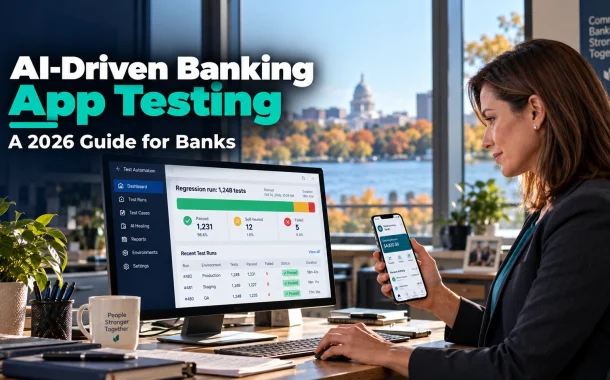
The first problem is speed. AI testing tools can write, run and repair tests far faster than a manual team, which matters when a bank ships updates every few weeks. The second problem is trust. Regulators now expect banks to test the AI models they use as carefully as any other model that touches a customer’s money. Banks, credit unions and fintechs in the US, UK, Canada and Europe face both problems, often in the same quarter, and the rules changed a lot in 2026.
Quick answer: AI-driven banking app testing uses AI to generate test cases, repair broken scripts, create synthetic customer data and predict where defects will appear. To test an AI model safely before going live, a bank should rate its risk, validate it independently, test for bias and drift, run it in shadow mode against the current process and set monitoring limits before launch.
Table of Contents
What AI-Driven Banking App Testing Means
AI-driven banking app testing covers two different jobs. One is using AI to test banking software, such as mobile apps, online banking and core integrations. The other is testing the AI models a bank uses, such as credit scoring, fraud detection and chatbots. Most banks need both, and each has its own tools, owners and rules.
AI for Testing vs Testing of AI
- AI for testing. Tools that use machine learning and artificial intelligence to write, run and maintain tests for your mobile app, online banking portal or core system integrations. QA and engineering teams usually own this work.
- Testing of AI. Checking that a credit model, fraud model or customer chatbot gives accurate, fair and explainable results before customers rely on it. Model risk, compliance and data science teams usually own this work.
AI testing tools cut release cycles. AI model testing keeps you on the right side of examiners and fair lending law. Mixing the two up is how banks end up with fast releases and an unvalidated model, or the reverse.
Why Banking Apps Are Hard to Test
Banking apps are hard to test because they sit on old, connected and tightly regulated systems. A single transfer can touch a mobile app, an API gateway, a fraud engine, a core banking system built decades ago and a payment network. A change in any one of them can break the others, and a bug can move real money.
The Problems We See Most Often
The financial software stack inside a typical bank creates these testing problems:
- Complex, connected systems. Dozens of platforms pass data to each other, so a small change in one can break a flow far away.
- Strict rules. Every release has to keep audit trails, disclosures and data protections intact.
- High transaction volume. Payday, tax deadlines and holiday shopping push loads far above normal.
- Legacy cores. Older systems often lack test environments that match production.
- Device sprawl. Mobile banking has to work across hundreds of phone models, OS versions and screen sizes.
Manual testing can’t keep up with this. That gap is why AI-driven banking app testing has moved from pilot projects into everyday release work. Teams balancing release speed against quality face the same tradeoffs we cover in how companies balance speed, quality and cost in software development.
How AI-Driven Banking App Testing Solutions Work
AI-driven banking app testing solutions add learning and pattern-spotting to standard test automation. They generate tests from requirements, repair scripts when screens change, create safe fake data and pick the tests most likely to catch a bug. AI in Test Automation is now built into most commercial testing platforms.
| Technique | What it does | Where it helps banks |
|---|---|---|
| Test case generation | Reads requirements, user flows or code changes and writes test cases | New features like card controls or bill pay |
| Self-healing scripts | Fixes tests when a button ID or screen layout changes | Mobile apps with frequent UI updates |
| Synthetic test data | Creates realistic fake customers and transactions | Testing without exposing real account data |
| Visual testing | Compares screens pixel by pixel across devices | Statements, disclosures and balance screens |
| Risk-based test selection | Picks the tests most likely to catch a defect from a given change | Shorter regression runs before each release |
| Predictive defect analysis | Uses past bugs to flag risky modules | Planning where testers spend their time |
| Performance anomaly detection | Spots unusual response times under load | Payday and month-end traffic spikes |
Synthetic Data Matters Most in Banking
Real customer data is the biggest blocker in bank testing. Copying production data into a test environment creates privacy and security risk. Synthetic data tools learn the shape of real data, such as balances, transaction patterns and edge cases, then generate fake records that behave the same way. Teams can test overdrafts, failed transfers and fraud alerts without touching a real account.
Self-Healing Tests Cut Maintenance
Mobile banking apps change often. Each redesign used to break large parts of a test suite. Self-healing tools look at several attributes of each element and pick the right one when one attribute changes. Testers still review each fix, since a “healed” test that clicks the wrong button is worse than a failed one.
Where AI Testing Still Needs People
AI won’t decide whether a disclosure meets the law or whether a flow feels right to an older customer. Exploratory testing, accessibility checks with real assistive tech and sign-off on regulated content still need human testers. Treat AI as a way to free your team for that work, not as a replacement for it.
How to Test AI Models Safely Before Going Live
To test AI models safely before going live, a bank follows model risk management: rate the model’s risk, check its data, validate it independently, test fairness, stress it, run it in shadow mode and set monitoring limits. The steps below match what US, UK and Canadian supervisors expect, and they work for credit, fraud, AML and pricing models.
A 10-Step Pre-Launch Process
- Add the model to your inventory and rate its risk. Record what it does, who owns it, what data it uses and what decisions it affects. A credit approval model is high risk. An internal document search tool is lower.
- Check the data first. Look for gaps, outdated records and groups that are under-represented. Most model failures start with training data.
- Validate the model independently. Someone who didn’t build it should review its design, test its outputs against real outcomes and compare it to a simpler challenger model.
- Test for bias and fair lending risk. Compare approval rates and error rates across protected groups. In the US, lenders must give specific reasons when they deny credit, even when a complex model made the decision.
- Make the results explainable. Use methods that show which factors drove each decision, and confirm staff can explain them to a customer or examiner.
- Stress and attack the model. Feed it extreme values, missing fields and recession-style scenarios. For chatbots, test for prompt injection, made-up answers and leaks of account data.
- Run it in shadow mode. Let the model score live cases in parallel with your current process for weeks or months without affecting customers. Compare the two before you switch.
- Set monitoring limits before launch. Define the drift, accuracy and fairness thresholds that trigger a review, and name who acts when they’re crossed.
- Treat vendor models the same way. A vendor’s own test report doesn’t replace your validation. Ask for documentation, run your own outcome tests and benchmark the results.
- Get sign-off and keep the evidence. Store test results, approvals and known limits so an auditor can see why the model was approved.
The NIST AI Risk Management Framework is a useful free checklist for steps 1, 5 and 8, even for banks outside the US.
Testing Generative AI and Chatbots
Customer-facing chatbots and AI agents need extra tests beyond traditional models. Build a set of real customer questions with approved answers, then score the bot on accuracy, refusals and tone. Red-team it with attempts to get it to reveal account data, give financial advice it shouldn’t or take actions without approval. Log every answer and tool call so you can trace what happened later. Our guide to AI agent monitoring covers the production side of this.
Financial AI Testing Rules in the US, UK, Canada and EU
Financial AI testing is shaped by model risk rules that changed a lot in 2026. The US replaced its 15-year-old model guidance, the EU delayed its credit-scoring AI rules and Canada set a 2027 start date for rules that name AI directly. The table lists the main frameworks banks follow and what each means for testing.
| Region | Rule | Status | What it means for AI testing |
|---|---|---|---|
| US | SR 26-2 (Fed, OCC, FDIC) | Issued April 17, 2026, replacing SR 11-7 | Model risk guidance aimed mainly at banks over $30 billion in assets. Generative and agentic AI are outside its scope. |
| UK | PRA SS1/23 | In effect since May 17, 2024 | Model risk principles for banks with internal model approval, covering AI and machine learning models |
| Canada | OSFI Guideline E-23 | Takes effect May 1, 2027 | Applies to all federally regulated lenders and insurers, and explicitly covers AI and ML models |
| EU | EU AI Act | Credit scoring rules apply from December 2, 2027 | AI used to assess creditworthiness of individuals is high risk and needs testing, documentation and human oversight |
| EU | DORA | In effect since January 17, 2025 | Requires regular digital resilience testing of ICT systems, including advanced testing for larger firms |
What the US Gap on Generative AI Means
The Federal Reserve’s SR 26-2 letter leaves generative and agentic AI out of scope because those models are new and changing fast. That doesn’t mean anything goes. The letter tells banks to apply their own risk management to tools it doesn’t cover, so chatbots and AI agents still need documented testing and controls.
Canada and the EU Name AI Directly
Canada’s OSFI Guideline E-23 defines a model to include AI and machine learning methods, and it applies to every federally regulated bank and insurer. In Europe, the EU AI Act treats creditworthiness models for individuals as high risk. Our post on how SaaS platforms solve compliance challenges shows how teams track rules like these across regions.
Build In-House or Use an AI Testing Partner
Build in-house if you have the scale to keep a dedicated AI testing team busy all year. Use a partner if you’re a community bank, credit union or fintech that can’t justify that headcount, or if you need results this quarter. Many banks mix both, keeping model validation inside and outsourcing app test automation.
Questions to Ask a Testing Partner
That’s why many banks find a solution outside their own walls. A software testing service provider that knows banking can set up AI-driven automation, synthetic data and device coverage faster than a new internal team. Before you sign, ask any partner these questions:
- Have you tested apps for regulated banks or credit unions?
- How do you handle customer data, and do you use synthetic data by default?
- Who reviews AI-generated and self-healed tests before they count?
- Can you produce audit-ready evidence for each release?
- Will you document model testing to match SR 26-2, SS1/23 or E-23?
Research on AI in testing shows it works best alongside skilled testers, not in place of them. Our post on handling vendor compliance risks covers the contract side, and our guide to writing a pentest report auditors trust shows the kind of evidence examiners expect. Leaders who need the wider picture can start with why business leaders must understand cyber risk.
Common AI-Driven Banking App Testing Mistakes
The most common AI-driven banking app testing mistakes come from trusting automation too much or testing a model only once. Each one below has caused problems we’ve seen on real projects, and each is cheap to avoid if you plan for it before launch rather than after an examiner or a customer finds it.
Six Mistakes to Avoid
- Testing with copies of real customer data. Use synthetic or masked data unless there’s no alternative.
- Trusting self-healed tests blindly. Review every automatic fix.
- Validating once and forgetting. Models drift as customer behavior changes. Monitoring is part of testing.
- Skipping shadow mode to hit a launch date. A few weeks of parallel scoring catches problems a test set misses.
- Accepting vendor reports as validation. Run your own outcome tests on every vendor model.
- Ignoring chatbot risk because it isn’t a “model”. Customer-facing AI needs tests, logs and an owner.
FAQs
These are the questions bank and fintech teams ask us most about AI testing.
What is AI-driven banking app testing?
It’s the use of AI tools to plan, write, run and maintain tests for banking software, from mobile apps to core system integrations. Common uses include generating test cases from requirements, repairing broken scripts after a redesign, creating synthetic customer data and spotting performance problems before customers do. The term also covers testing the AI models a bank uses, such as credit and fraud models, before they go live.
How can a bank test AI models safely before going live?
Start by adding the model to your inventory and rating its risk. Then check the training data, have someone independent validate it, test for bias across customer groups and make sure staff can explain its decisions. Run it in shadow mode next to your current process, set drift and accuracy limits that trigger a review and keep every test result for auditors.
What are AI-driven banking and financial app testing solutions?
They’re platforms and services that add AI to test automation for banks, credit unions, insurers and fintechs. Most combine test generation, self-healing scripts, synthetic data and real-device testing, with reports built for audits. Some are software you license and run yourself. Others are managed services where a testing partner sets up and runs the automation for your team. Either way, look for synthetic data by default.
What is SR 26-2?
SR 26-2 is US model risk guidance issued on April 17, 2026 by the Federal Reserve, OCC and FDIC. It replaced SR 11-7, the 2011 guidance banks followed for 15 years. It’s aimed mainly at banks with more than $30 billion in assets, though smaller banks with complex models may still use it. Generative and agentic AI are outside its scope, but banks are told to manage them anyway.
Is AI testing required by banking regulators?
Regulators don’t require you to use AI testing tools. They do require banks to test and validate the models they rely on, including AI models, under rules such as SR 26-2 in the US, SS1/23 in the UK and E-23 in Canada. Examiners will ask how a model was tested, who approved it and how it’s monitored after launch, so keep that record ready.
How does the EU AI Act affect banks?
AI used to assess people’s creditworthiness counts as high risk under the EU AI Act. From December 2, 2027, banks using such systems in the EU must meet rules on testing, data quality, documentation, logging and human oversight. US and UK banks that score EU customers can fall under it too, so check where your models make decisions. Starting the paperwork early is far easier than retrofitting it.
Can AI replace manual testers in banking?
No. AI handles repetitive regression runs, test data creation and script upkeep, which frees testers for harder work. People still handle exploratory testing, accessibility checks with real assistive tech, review of regulated content and final release sign-off. Banks that cut human testers entirely tend to miss the problems that only a person notices, such as a confusing fee screen or a broken flow for screen reader users.
What is shadow mode testing for AI models?
Shadow mode means the new model scores real cases alongside your current process, but its results don’t affect any customer. You compare its decisions with the existing process over weeks or months. If the new model is more accurate and treats customer groups fairly, you switch. If not, you fix it without anyone being harmed. Most teams run shadow mode for at least one full monthly cycle so payday and month-end patterns are included.
How do you test a banking chatbot?
Build a set of real customer questions with approved answers and score the bot’s accuracy and tone. Then red-team it with attempts to make it reveal account data, give advice it shouldn’t or take actions without approval. Log every answer and tool call, and set an owner who reviews failures before the bot reaches customers. Repeat the test set after every prompt or model change, since small edits can change answers.
What does financial AI testing cost?
Costs depend on scope. Test automation tools are usually licensed per user, per device or per test run. Independent model validation is often priced per model, with high-risk models costing more because they need deeper review. Get quotes based on your number of apps, release frequency and the count of high-risk models you run. Compare that with the cost of a delayed release or a failed exam.
Conclusion
Megan’s team now runs AI-generated regression tests on every app release, and her testers spend their time on new features and accessibility instead of clicking through the same screens. The loan pre-approval model ran in shadow mode before launch. When her risk committee met, they signed off with validation results, fairness tests and monitoring limits in hand, rather than a vendor’s promise.
That’s the real value of AI-driven banking app testing. It speeds up the software side and gives you a clear, defensible way to approve the AI side. The rules are moving fast, with SR 26-2 in the US, E-23 in Canada and the EU AI Act all landing within two years. Start by listing every AI model you run, rate each one’s risk, and pick the slowest part of your release cycle for a first AI testing pilot. Which of the two problems is costing your team more time right now?